Op/ED #2: New Boss, Same as the Old Boss: The Corruption of Europe’s Anti-Corruption Populists

Owen Billo

Source: https://www.aier.org/article/the-big-fib-about-the-rich-and-taxes/

When populists come to power part of their platform is almost always anti-corruption, and yet these same populists are consistently corrupt themselves.  They portray themselves as outlets of the people’s will, and of course the people are opposed to corruption.  But positioning oneself as the sole outlet of the people’s will also creates an image of infallibility, which is inevitably used to cover up corruption.  Focusing on Europe, the populist parties which have taken power (primarily in Eastern Europe) have been ideal examples of this.

In Hungary, Prime Minister Viktor Orban started off as a liberal opposing Hungary’s authoritarian Communist regime.  He and his party, Fidesz, fought against that regime’s deep-seated corruption, and he has built off of that image ever since.  Today, as a far-right populist, Orban rails against the fictional corruption of George Soros and the LGBT+ community, trying to shore up his image as Hungary’s saviour from financial, political, and moral corruption.  At the same time, Orban’s government is in a standoff with the European Union (EU) over nepotism as well as misuse and embezzlement of EU funds by Orban.  Hungary’s media situation is also atrocious, with media regulations being heavily biased in favour of the ruling Fidesz party and most private media being owned by the pro-Fidesz Central European Press and Media Foundation.  Both Hungary and Poland have been accused by the EU of weakening judicial independence in their countries.

Hungarian Prime Minister Viktor Orban delivering a speech at a right wing political convention. Source: https://www.transcontinentaltimes.com/vows-to-cut-hungary-funding/

While Poland’s Law and Justice party is not quite as corrupt as Hungary’s Fidesz, that charge of weakening judicial independence is very much true.  Last year, Poland fell to its worst ever ranking in the global corruption index from Transparency International.  This year, it worked the rolling back of anti-corruption legislation into a bill also assisting Ukrainian refugees.  Because “you wouldn’t want to vote against helping Ukrainian refugees, would you?”  All of this is in stark contrast to the party’s fight against the fictional corruption of what it calls “LGBT ideology.”  Even the party’s name, “Law and Justice” conjures up the image of an anti-corruption party, and yet an anti-corruption party it is not.

Czechia is a country which recently removed its corrupt anti-corruption party, the ANO (Action of Dissatisfied Citizens), from office.  However, before that happened the ANO was just like Fidesz and Law and Justice.  ANO’s leader, Andrej Babis, is the second-richest person in Czechia and “has won elections based on a pretense that [he] is not a part of the establishment and that he would deal with [a] corrupted political elite.”  Despite this image of Babis as an anti-corruption crusader and his party’s name reflecting anti-corruption attitudes, after losing his election he is now on trial for committing fraud worth $2 million.

Corruption as discussed above is not just limited to EU countries either, as Russian President Vladimir Putin is one of the worst offenders in power right now.  Since he came to power almost 23 years ago, Putin has publicly waged a battle against Russia’s oligarchs – powerful Russian businessmen who hold monopolies over various Russian industries.  He rose to popularity in part because of his aim to clean up Russia after the difficulties of the Yeltsin administration, and this still bolsters his popularity.  Before his invasion of Ukraine, Putin was in hot water due to his lavish, multi-billion dollar mansion being revealed by Putin critic Alexei Navalny.  Navalny was later poisoned -narrowly surviving- and then jailed by the Russian government as retaliation.  After the invasion of Ukraine began, American sanctions on Russia are beginning to reveal the true extent of Putin’s wealth and his friendly connections with oligarchs who were ostensibly supposed to be his enemies.
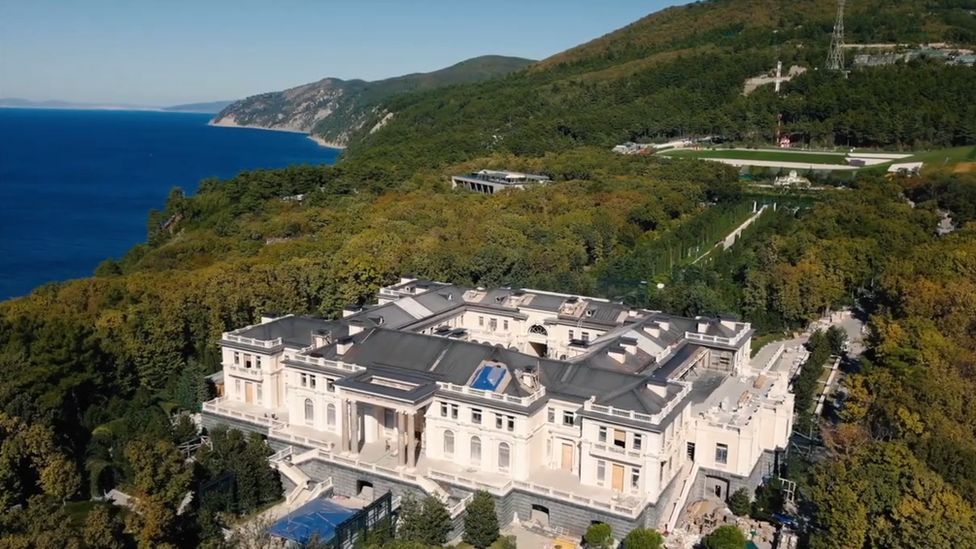
Vladimir Putin’s lavish mansion on the Black Sea. Source: https://www.bbc.com/news/world-europe-56007943

Overall, Eastern Europe (both inside and outside the EU) provides some great examples of how populists portray themselves to be anti-corruption and then turn out to be corrupt themselves.  Additionally, when the corruption they initially railed against is defeated or if they are personally suspected of corruption, they tend to use scapegoats as a distraction.  Anti-corruption populists do often replace genuinely corrupt, non-populist governments. That corruption should not be ignored, but nor should anybody forget that the populist replacements are just as corrupt as those they replace, if not more so.  In the end, the anti-corruption populists are the new boss, same as the old boss.

Opinion Piece #2

Beating Them or Joining Them? The Conservatives and the Far Right in Britain by Aimee Brown

Tomorrow, Rishi Sunak will become the prime minister of Britain. He will, in fact, be the third prime minister in just seven weeks, a fact indicative of a level of dysfunction that makes being positive about British politics difficult. However, if pressed, one might observe that at least Britain no longer has a far-right populist party to worry about. After all, it was only a couple of years ago that the United Kingdom Independence Party (UKIP) surprised everyone with its electoral success. But now, it has sunk back into electoral irrelevance. Surely this is cause for relief given the plethora of Britain’s continental neighbours in which far-right populist parties have experienced unprecedented electoral victories, most recently The Brothers of Italy and The Sweden Democrats. In contrast, Britain’s democratic institutions and mainstream parties seem to have successfully weathered the storm of populism.

And yet, perhaps the reason that UKIP doesn’t exist anymore is because it doesn’t have to. Following UKIP’s breakthrough in 2013, then prime minster David Cameron worked to beat the party by co-opting elements of its message, especially around immigration. Most significantly, the Conservative Party felt so threatened that Cameron called a referendum on Europe, which he infamously lost. This was UKIP’s great victory, after which it promptly collapsed as the Conservatives reinvented themselves as the party of Brexit. In essence, they rendered UKIP irrelevant by ceding to its demand. Former leader of UKIP, Nigel Farage, has stated that “My achievement has been to take an issue that was considered to be completely wrong, perhaps even immoral, and help to turn it into a mainstream view in British politics.” UKIP’s sole representative in the House of Commons, reflecting on his party’s catastrophic 2017 election results, stated that he was “far from despondent. In fact, I am elated. Why? Because we have won.”

UKIP was not the first far-right rivel that the Conservative Party outflanked by co-opting its ideas. In 1967, the fascist National Front (NF) party was founded in response to opposition to immigration. A year later, Conservative member of Parliament Enoch Powell gave a speech in which he denounced immigration from the Commonwealth because it would have the result that “the black man will have the whip hand over the white man.” He further argued that banning racial discrimination in housing, employment, commerce, and public services would unfairly disadvantage “the indigenous population”, and that it would be like “throwing a match on to gunpowder.” He ended dramatically by saying that “As I look ahead, I am filled with foreboding; like the Roman, I seem to see ‘the River Tiber foaming with much blood’”. Upon making the speech, Powell was immediately fired and his top-tier political career was effectively ended. However, recruitment to the National Front soared. According to a former party official, “Before Powell spoke, we were getting only cranks and perverts. After his speeches we started to attract, in a secret sort of way, the right-wing members of Tory organisations.” The National Front grew to claim over 12,000 members and enjoyed unprecedented success in the Greater London Council elections of 1977.

But in 1978, leader of the Conservative Party Margaret Thatcher gave a television interview in which she stated that “people are really rather afraid that this country might be swamped by people with a different culture.” Indeed, “the British character has done so much for democracy, for law and done so much throughout the world that if there is any fear that it might be swamped people are going to react and be rather hostile to those coming in.” Of course, the frightened British people in question are presumed to be white, the immigrants are presumed not to be white (no mention of a terror of New Zealanders, for example), the verb ‘swamped’ is used twice for emphasis, and the end result of violence is implied. This interview did not signal a change in Thatcher’s policy so much as it did a change in the rhetoric used to talk about it. In effect, Thatcher had introduced the National Front’s racist discourse into mainstream politics and brought the exiled Powell’s ideas back into the fold of the Conservative Party. By doing so, she managed to steal the far-right’s thunder. After the interview, the Conservative Party enjoyed a dramatic surge in support and, a year later, won the general election. The National Front, on the other hand, failed to win a single seat and collapsed into irrelevance. Dead but not gone, it joins UKIP as a fellow anti-immigrant and Eurosceptic ghost that haunts a Conservative Party whose current dysfunction is not unrelated to its previous success in beating its far-right opponents by joining them.

Fascism: Rebranded

Hello again everybody! Sorry for the delayed response (I know the fans of my articles are avidly waiting so excuse my tardiness).

This week on populism in Europe, we are focused on the rebranded version of fascism that came out of the events of WWII. As a result of the strong feelings of keeping to the left side politics ie: socialism (in order to not repeat the fascism of the Nazis), there was an equal reaction which enforced people in countries all over Europe to suggest a lean to the far right. This change was enforced by the creation of parties like the N.F. (National Front) party in Britain, the MSI in Italy, and the N.D. (the Nouvelle Droite) party in France (who, as stated by Benjamin Bland, often followed the political reforms of Italy). A major theme for this week as well was the transnational aspect of this rebranding of fascism in not only Europe but in African countries as well. Muammar Gaddafi, leader of Libya from 1969 to 2011 was often praised by the NF for his way of leading the country, stating that his political style was; “a progressive and forward-thinking nation’ that was naturally ‘of great interest to National Revolutionaries throughout Europe.”. Gaddafi himself has also stated against the importance of parliament in political systems; “The mere existence of a parliament means the absence of the people”.

If there are any that wish to discuss this topic further, feel free to message me through Hate 2.0.

British National Party (BNP)
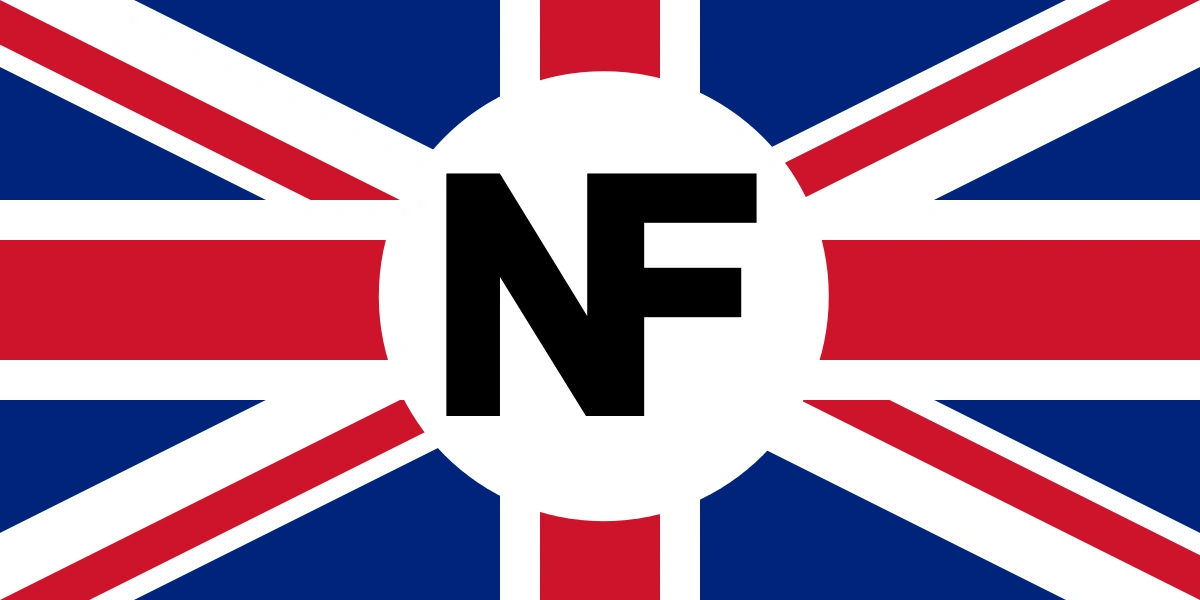
National Front Party (NF)

Above are two images of the BNP and the National Front party (can anyone see any relation in the two flags?).

The parallels of neofascist and populist spillover

By Melyssa Clark

The spread of neofascism in the 1960s and the 1970s between Italy and France can been seen to mirror the spread of the populist movement in that there is a spillover effect between countries who share in a similar set of political or cultural crisis.

Within Italy during the 1960s, fascism within the political system was never completely eliminated as the MSI party was allowed to continue and civil servants, who were employed under the fascist regime, were kept in the government. Moreover, the start of the strategic use of tension with the student revolt, allowed for the “deep state” to bolster support for authoritarian leadership as a solution to civil violence, which was framed to be done by the far left.

Similarly political, societal, and civilian crises existed in France during the same time, which created an environment similar to Italy in creating an appeal to fascist ideology. In turn, after the popularity of de Gaulle waned, the far-right started to create the New Order, whose goal was to create the French version of the Italian MSI party.

When looking at the current state of populism within Europe, it parallels the spread mentioned above as similar crises within different member state of the EU have similar rhetorical outcomes. For example, the migration crisis has not only led to a xenophobic response from various populist parties but also a call to female voters in the need to support these policies as migrants are framed as threatening women’s rights.

A Similar Story So Far…

By: Hannah Long

Neo-facism extends itself to many sentiments revolving with an ultranationalist outlook. It seeks to continue the narrative facism during its role in WWll, while transitioning its tactics to almost catch up in a sense with the then ever changing European political sphere. A past that in the hyperallergic article likes to point out isn’t exactly the past as there is a steady progression from the 1960s and 1970s to conceal or ignore rising neo facism. Each of the readings describe that while the major and blatant characteristics of facism have disappeared they have only been replaced by more subversive concepts by parties to get their message across, they find other ways such as appealing to the working class using terms then and even now like “shared values.” In the beginning neofascist movements were appealing to those who were angry (although that aspect has still remained)-at Europe’s departure from fascist ideology, the idea that this was no longer deemed acceptable and was being replaced with a suspicious and in their eyes week democratic system provided all the necessary tools to build up hateful attacks. Fast forwarding to the present day and not much has changed, the two major departures that can be seen across all European societies is the growing number of women at the forefront of extreme right wing parties and a discrepancy between government and the population. Both of which are factors of a population who feel left behind by their democratic counterparts, to the point where democracy seems as if it is actively working against the native (namely white) inhabitants. 

Sources:

Angelique Chrisafis, “From Le Pen to Alice Weidel: How the European far-right set its sight on women” The Guardian January 29, 2019

Charlie Jarvis, “Milan Museum Commemorates Fascist Past at Expense of the Present” Hyperallergic (August 2, 2021),

Grant Amyot, “The Shadow of Fascism over the Italian Republic,” Human Affairs 21, no. 1 (2011): 35–43

The Neo-Fascist Chameleon

Jacob Braun

Neo-fascist movements, for all intents and purposes, I believe to be at their core the same as their fascist predecessors. Both movements seek to attain the same end goal- it is instead the means they use to reach it which are unique. Interwar and wartime fascist movements were characterised by their violent tactics and militarism. On the other hand, postwar neo-fascist movements did perpetrate violence but shifted radically in the advertisement of their cause. Instead of purely pragmatic alliances engineered by wartime fascists, postwar neo-fascists sought to actively learn from other “third way” groups in some form of fascist transnational cooperation. 

It would also be during the 60s, 70s and 80s that neo-fascist groups would focus more on increasingly conspiratorial rhetoric, such as “the deep state” which was targeted by Italian neo-fascists. Combined with the fear which was sown within the Italian public about a socialist takeover, neo-fascist or neo-fascist-adjacent groups were easily able to create authoritarian policies. Arguably during the years of lead in the First Italian Republic, fascism was in name only eradicated from the echelons of its government. In practice, it would only be until the Second Republic where its influence would die down; but not completely.

The unique aspect of postwar neo-fascism is its ability to veil itself as “respectable discourse,”— seemingly beginning as a popular grievance which reveals itself as a totalitarian rabbit-hole.

Neofascism – Growing and Changing to be Suited for Today

By Blaise Rego

At one point fascism was a topic that was hard to define but you knew it when you saw it, but that’s all changed with the advent of neofascism. Neofascism is an insidious part of modern political discourse that has altered what we once thought of far rightwing movements and leaders.

In the past the alt-right has be lead by angry men who raged against immigrants, modernization and changes to the societal fold. The neofascist movement has be co-oped be women in recent years. Across Europe women have begun to take power in alt-right by modernizing their parties and their movements. Leaders such as Marine Le Pen and Giorgia Meloni began to realize that the younger generation was unattracted to the male dominated racist politics that had symbolized the alt-right movement for generations. These leaders changed how their parties were viewed by the greater public. Le Pen is a single mother who still argues for the nuclear family as a core part of society.

The movement has become more flexible ideologically allowing for greater variance of identities within the movement. Individuals were part of the LGBTQ community have ascended to high ranks within these fascist groups showing that there has been modernization within the ranks. It has to be said that certain identities are allowed within these groups to modernize them allowing the group for focus more specifically on their other. Most of the European alt-right groups “other” immigrant populations as they feel that immigration is the root of societies problems. Neofascist groups have modernized in some respects to become more appealing to a younger generation while maintaining most insidious parts of their ideology to suit their base.

Shifting Views of the post-war Movements

By Felix Nicol

As a sort of follow up to last week, this week’s readings especially resonated with me in regards to the attempt to grow far-right movements through a somewhat expansion of the target group. In this regard, Bland’s article somewhat reiterated last week’s perspective portrayed through the Nouvelle Droite, which attempted to turn the far right towards a more European concept. The National Front’s support for regimes like that in Libya somewhat underlined a different perspective of the same coin: supporting segregation from both sides. To me, the reading on women getting involved in far right politics seems to share a similarity in grouping oneself with those who would share similar ideology, as long as the premise is somewhat broadened. This reading made it clear that men are not alone in their perception of racial threat, and that by focusing on these issues, far-right groups are able to garner an increasing female support. In this regard, I feel that these readings especially explored how, perhaps somewhat as a reflection of the ND’s attempts, far-right movements are shifting their rhetoric to become applicable for a larger audience in order to garner more support.

On another note, I found the reading by Glynn on female perpetrators especially thought provoking, through its reflection of gender-norms through terrorism. The reading quite thoroughly underlines the aspect that women were unable to talk openly about their violent past, as violence was closely associated with men. To some extent, it harkens back to the gender norms we’ve talked about in previous weeks, where one was allowed to stray somewhat from their gender roles, as long as they returned eventually. It was not the fact that these women participated in violence, but rather their return to innocence or victimization that pressured them.

Fascism but not Fascist at the same time

By Adam Paquin

The articles for this week really stood out because although we have seen plenty of radical far right movements not only in this class thus far but in general that is what is portrayed by the media. In the Jarvis article we see another picture, one of a far-left radicalism. One that is even capable of extreme terrorism and fascism ideals. And with the Ruth article we got to see another side of history, one centered around women and their voices during these ruthless times. We got to hear about women and their struggle to find their voices in a vastly male centric world. The articles from this week seemed to flow really well together as they all showed different but similar sides of fascist regimes attempting to portray themselves as not being so. And this ties very well into one of our discussions from a previous week in which we see ourselves talking about Fascist leaders always stating how they are in fact not fascist. How they are not racist while at the same time shouting racist comments and spreading racism throughout their campaigns. And we certainly get a good view of this in the Jarvis article, which is centered around multiple bombings that happened in Milan. Bombings that were produced by far-right extremists but were certainly not terrorist related. And as shown throughout the article virtually no actions were taken to prevent these or punish any perpetrators. Which again sounds like things we have already spoken about in other cases from this course.  

Post Nazism and Fascism Memory

By Louis Lacroix

“Memory is the strongest instrument we have to avoid the errors of the past and strengthen the common fabric and shared values of the city.” The Milano è memoria exposition and its creator have created piece to commemorate the past and particularly the tragedy that endured Milan endured on December 12, 1969 with the bomb planted by a neo-fascist group killing 17 and injuring even more. Ironically and dramatically, Fascism and Nazism are two of the most infamous concept of the 20th century, yet they are still brought forward. These ideologies are massively denounced and despised, yet groups will revendicate their names and their ideas. Italy is the prime example for that. The first and the second Republic had to deal for around 30 years after the bombs with the likes of Junio Borghese and strategies of tension that promoted neofascism while hammering the republic. Britain was afflicted with similar problems in the 1980s, where the New Front, compared to a neo-Nazi group, rallied more radicals to support their claims. While memory is powerful and important in forging legacies associated with the terms, it seems that ideologies such as fascism and Nazism won’t because negatively associated enough for younger generations of radicals to completely drop them. I think one of the major problems for the collective memory resides in how it is presented, how the state educates its citizens on the matter. Particularly in this period of time, the alienation of both side of the political spectrum banalize many terms and a part of the problem certainly resides in it.