OP-ED Fascism: Past Present and Future

By: Cyrus Hutnyk

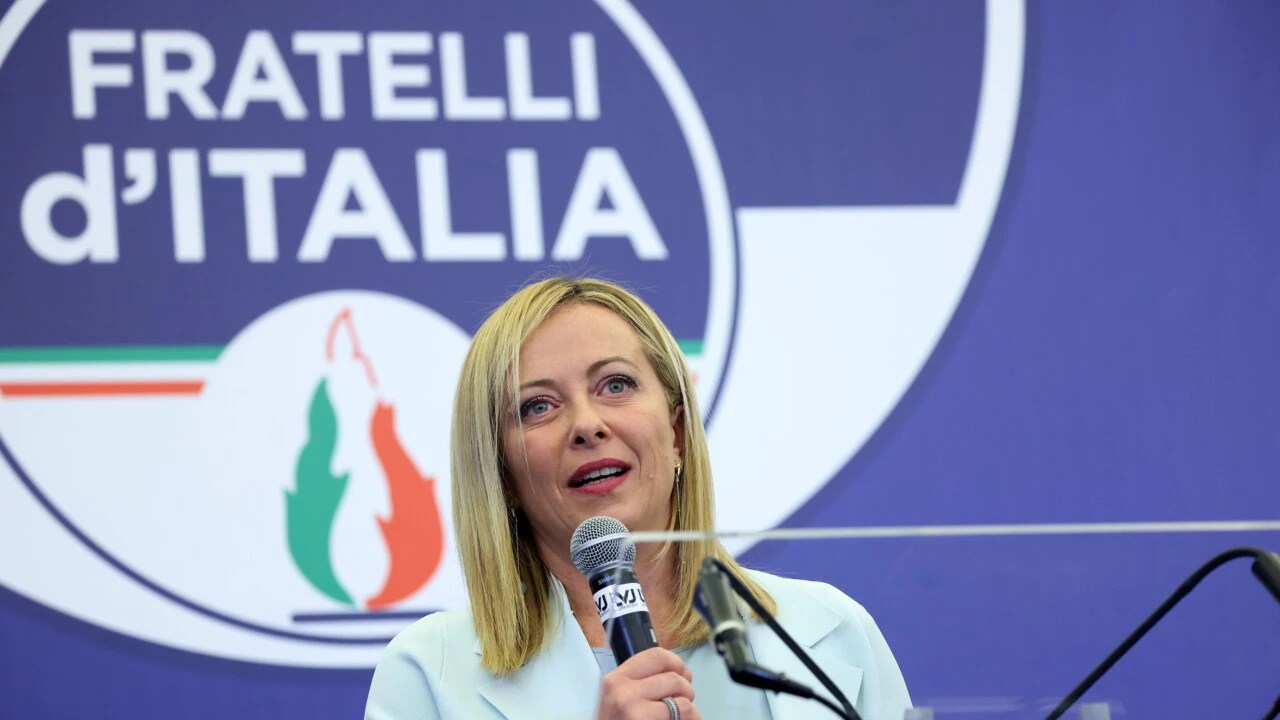
As of September of 2022, the Nationalist Brothers of Italy party in Italy are looking bound to make the move into power as a prominently far-right group looking to lead the nation, a party with its history attached to infamous fascist Mussolini and his fascist rule nearing one hundred years ago. The leader of the Nationalist Brothers of Italy party Giorgia Meloni has a reputation as being against the European Union, migrants, and Italy’s ties to the west among other things, and she and her party are spreading these concerns and beliefs nationally. Despite winning with over a quarter of all votes for Meloni’s party this year, in the past the Nationalist Brothers of Italy has failed to amass anywhere near this much attention, indicative of Italian’s growing attention for far-right or otherwise nationalist ideology or movement. Furthermore it is known that individuals associated with Meloni are supporters or otherwise admirers of Putin which draws troubling parallels and creates anxiety over the future of the relationship between nations.

Benito Mussolini was a politician and journalist who eventually founded and was leader of the National Fascist Party, to then become Prime Minister of Italy up until his removal in 1943 during World War II. Initially Mussolini was a socialist and a member of the Italian Socialist Party, but was removed for his opinions and avocation for military and violent intervention during the events of World War I. This train of thought and ideology eventually led to his now well known fascist rule opposing egalitarianism and class conflict and supporting an extreme nationalism. While the movement that he led was based in radicalism and conservatism, what shone through was taking violent action. Arguments and debate surrounding opposition to fascism began to become silent through constant imprisonment, exile, and removal of people via deadly force. Divides in ideas concerning the implications of fascism arose in the period between World War I and World War II when it became clear the ideology was the difference between being involved in war or not.

Beyond what is or has happened in Italy or other nations across the water, the West can be found to have its own form of right leaning ideologies and politics through its own leaders. Trump has cemented himself in history through his term as president of the United States. His campaign was created and run based on a powerful sense of nationalism crafted through techniques of promising a restoration of the nation to a mystical former glory that it supposedly once held in its shockingly short history. To remedy the problems present and brought up by earlier leadership as well as promise of being above or tearing down supposed enemies of the nation are the tools that can be identified in any other instance of fascist or far-right rule beyond Mussolini or potentially Meloni.

With the impacts and lessons that can be learned from Trump’s time in office, western powers as well as European ones are fearful of a far-right rise, evident in the fervent support of Ukraine in it’s budding territory war with Russia. Liberal powers taking this action also creates the contrast and connection between opposing ideologies and right leaning ideology, not being in support of a foreign war becomes being against the potential of far-right rise, and so on and so forth to republicans becoming more and more far-right or even extremist.

Fascism and far-right ideology is not something that will ever completely disappear, people will always have a diversity of thoughts and ideas, and that should be welcomed and fostered. That being said its about understanding the limits to controversial thought and understanding where the line is that moves into ideas harming people, which is exactly what fascism promises to do historically.

Op Ed #1, The Resurgence of Fascism

By Liam McCrorie

If I were to tell you 10 years ago that fascism would be on the rise again soon, I am sure you would not believe me, or at least have a hard time believing me. I would have a hard time believing that as well, 10 years ago I would have said that we are living in one of the most progressive times in history. People in marginalized groups were getting more rights and gaining better standings in society. But with all this progressiveness, came push back from the far-right. And by today this has manifested itself as fascist and far-right groups popping up all over the world. These groups that seem to be all about taking rights away from people seem to be gaining a lot of traction, but why?

Fascism, and fascist parties have always had their supporters, but not to this degree. Typically, far-right groups would only have small followings of mainly white men, but now we can see men and women of all nationalities supporting far-right movements. For example, the Latinos for Trump movement, a large group of Latinos who supported and voted for Trump, even though Trump had so many anti-immigration policies which affected many Latino people in a negative way, such as building a wall across the Mexican-U.S. border, and separating families at the border. Women are also supporters of these far-right movements, typically Christian women who want to block other people from access to rights, to be more in line with the Bible. Think of what happened with the Supreme Court back in June when they overturned Roe v. Wade.

By now far-right political parties are part of the norm and are seen everywhere, we can definitely say that there is a rise of fascism sweeping the world. Lately we have seen the Italians elect the first fascist leader since Benito Mussolini. Giorgia Meloni leads the Brothers of Italy party a far-right political party with neo-fascist roots. Although she denies the party is fascist, her policies and actions speak otherwise. The party is fervently against same-sex marriage and for LGBTQ couples to adopt children. They are anti abortion and hold up other Christian values they believe to be important. Meloni is also extremely anti-immigration, just like other right wing parties, and she even is a believer and spreader of the Great Replacement Theory, which many fascist parties rely on to attract a base of white nationals who hate immigrants.

Meloni is just one of many far-right leaders who are gaining a lot of popularity, and in her case becoming leader of her nation. There was Donald Trump a few years ago, who was extremely far-right and used populism to gain popularity with the voters, promising to ‘Make America Great Again’ by fixing the economy and getting rid of immigrants and ‘others’, who are a threat to society. And in Sweden the Sweden Democrats are one of the biggest parties, and they have Neo-Nazi roots, and have similar policies to Meloni and Trump, mainly to stop immigrants from coming to their country and ruining it for the white people who already live there. There are many other far-right populist leaders like Jair Bolsonaro in Brazil, and even in Canada far-right groups are beginning to get some traction. The Peoples Party of Canada is a fairly new party, only founded in 2018 by Maxime Bernier, who is also their current leader. While not as extreme as some other parties, they are still looking to reduce immigration in Canada, as well as doing less to combat global warming, all in the name of a better economy.

The economy seems to be the biggest factor in why people seem to be attracted to the far-right, and if the economy is working good for them then they can look past the more extreme policies some of these parties want to implement. This is seen everywhere like the Latinos for Trump, who by all means should hate Trump, but instead will look past all his racist and anti-immigration rhetoric, because he is building a better economy which could help them as individuals, even if it is damaging to Latino communities as a whole. These far-right leaders are on the rise all over the world for a variety of reasons and are gaining more and more popularity by the day. Its hard to say what will happen in the coming years but the rise of Fascism is making the future look very worrying.

The EU cannot prevent the rise of Populism

By Felix Nicol

“Let’s preserve the peace and security of Hungary” poster from Orbán’s election campaign. Photo: Raketir / Shutterstock. Source

The spread of populist movements in Europe in recent times has become an increasingly problematic issue for the European Union, especially when observing the democratic backsliding in Hungary. Recent news that the EU may look to suspend funds vis-a-vis Hungary as a result of the country’s illiberalism shows the commitment of the EU to ensuring the return of liberal, democratic values to Hungary. As a reply the Hungarian government has put forth two anti-corruption laws it intends to put in place. Though seemingly promising, a deeper analysis would suggest that these laws are insufficient in suppressing Orbán’s illiberal democracy. In fact, it should be doubted that the EU has any coercive power in returning liberal values to its illiberal member states.

Though the EU funding in question makes up 9% of the Hungarian GDP, it is clear that Orbán does not find himself particularly threatened. In fact, when looking at Hungary’s proposed anti-corruption laws, it needs to be understood that the democratic institutes of the country are often only democratic on the surface. In this regard, the effectiveness of the EU’s leverage of funding comes under question. Even if they were to have stronger requirements as recommended by some, it is unlikely that further institutional reform will change the situation of the country. For this reason, the EU likely needs to look for further leverage to truly get Orbán’s regime under control.

Yet what does the EU have left to leverage? When taking in the historical context, the options look even murkier. In discussions with potential members, the EU is known for using their “carrot and stick” methods, using membership as a key driver of political reform. Hungary is no stranger to this, as prior to its own accession to the EU, reform in the country was certainly driven by potential membership. It is also important to understand in this context that the EU already has a set of laws, the acquis communautaire, that potential states must adhere to in order to be truly accepted into the Union. Under this understanding, the implications of Hungary’s move towards an illiberal democracy underlines key flaws in the underlying democratic framework of the Union, which should look to protect and continue its own democratic values. That is to say, despite having respected all of the requirements the EU put in place for candidacy, Orbán’s populist movement was still able to move away from the liberal democratic institutions that were put in place. If the EU was unable to ensure Hungary remained democratic through its acquis communautaire, what tools does it have left?

Furthermore, it is important to recognize that with the rise of other populist movements, it may become increasingly difficult to even apply restrictions towards Hungary. While Poland has long held good relations with the country, the rise of more populist movements in the EU could suggest increased leverage in the EU for populists. With Italy’s Giorgia Maloni showing ties to Orbán, as well as Sweden’s radical right-wing party with neo-Nazi roots show that support on an EU level is present. With the growing support of populist movements, the abilities of the EU to effectively fight these movements is put into question even further. In this regard, with the questionable viability of the EU’s legislative abilities in preventing the rise of illiberalism, reconsideration is in order if it wishes to retain its liberal democratic ideals.

Despite the focus on Hungary for its particularly pronounced departure from the liberal norms of the EU, it should not be assumed that it is alone in its departure from these values. The previously mentioned Poland has aligned itself with Hungary precisely because of their similar values, providing each other with a partner in antagonizing the Union. Furthermore, in a world where the labeling of parties like Orbán’s FIDESZ as “‘fascist’, extremist or far-right” does nothing to delegitimize them, reconsideration of the tools used to ensure continued liberal democracy are in order. A step away from tools like the EU’s acquis communautaire and financial incentives is necessary, and perhaps more effort in remedying the root causes of populism are in order. Recognition of certain factors such as anti-immigrant sentiment or economic insecurity as underlying factors for the growth in populism is important, but consideration on how these might be improved is necessary. Otherwise, liberal democracy risks pushing an increasingly diverse group towards the populist movements it looks to prevent.

Op/Ed #1: Fascism is back on the rise

By: Nicole Beswitherick

Son of a blacksmith, born in 1883, Benito Mussolini was named after the Mexican revolutionary leader, Benito Juarez. He was a born revolutionary as people may say. Growing up, Mussolini saw the hunger and the struggles people in the working class had been experiencing; he was one of them. Later on, he became a leader of the Socialist party and editor of its newspaper but broke ties with them over an issue of Italian neutrality in WWI. When Mussolini began his banner, an army of followers soon came underway, some of them known as the “Blackshirt Militia”.[1] People funded this movement when seeing Mussolini as a tool to suppress the radical revolution that they were afraid of.

Mussolini’s fascist movement promised a lot of things like extreme radicalism and extreme conservatism. But its main goal was action, which was achieved through violence. Fascism was fought in parliament, the press, etc. The arguments and fights to get rid of it were stopped when those of the opposition had been sent off to prison, exiled, and in some other cases, murdered.[1] Fascism later turned out to be a more subtle reason to win the support of the Italian people.

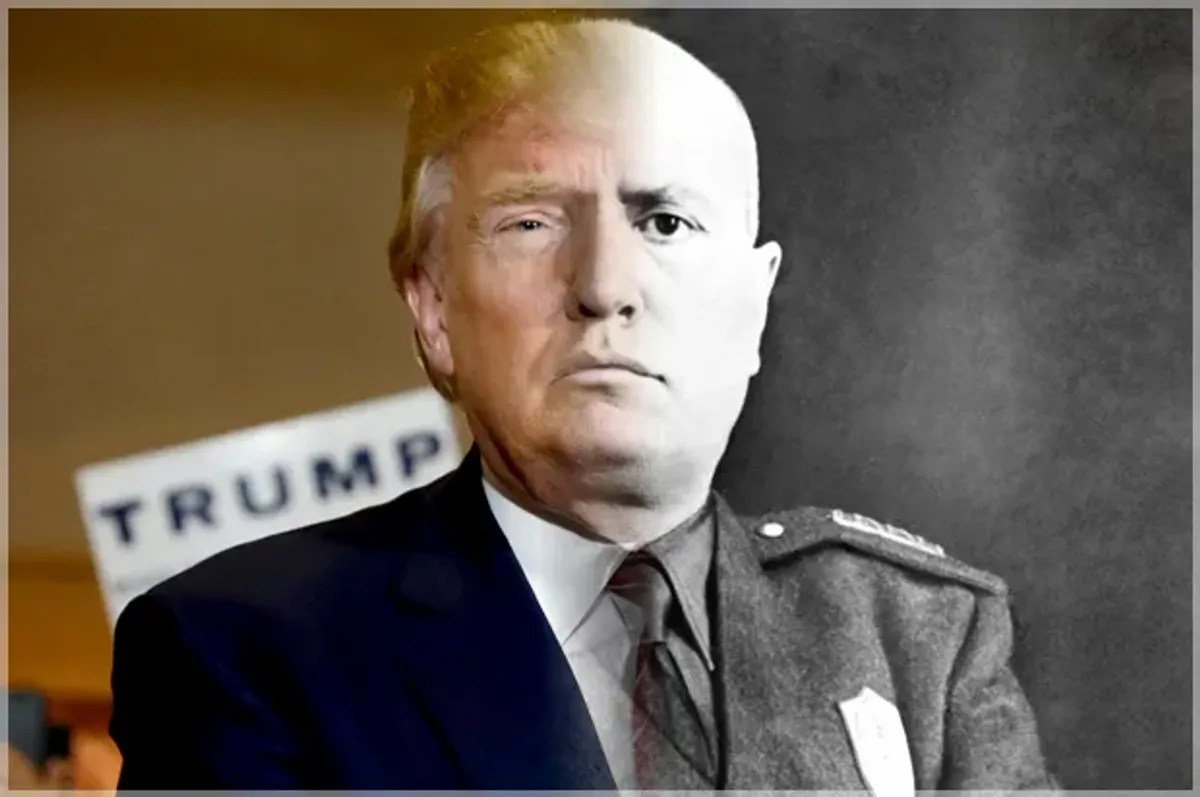
A photo merging the faces of Donald Trump and Benito Mussolini, as people see a resemblance is their leadership styles [Photo courtesy of AP/Richard Drew/Salon)

In 1935, the Ethiopian war rallied nationalists more strongly around the fascist regime and showed Italians that fascism meant war. During and right before WWII, (1936-1943) there was a bigger distinction between fascism and antifascism. Underground movements were increasing in popularity, and fascism did not collapse entirely until Mussolini’s lieutenants cast him away, allied military victories got involved, and there was a rebellion of the people.[1] Although fascism did eventually fall, could it be on the rise again? Could it be seen in North America?

On 25 September 2022, Giorgia Meloni (leader of the nationalist Brothers of Italy) took the lead in a far-right victory for Italy. She is set to become the first female PM in Italy, with her party that is directly descended from the fascist movement of Benito Mussolini.[2] Meloni is known to pummel the European Union (EU), international bankers and migrants, and this has all spread concern about the reliability the nation has in the Western alliance.[3] The Brothers of Italy party had won 26 percent of the vote, the highest of any single party. In 2018, her party won only 4.3 percent of the vote.[4] This makes Meloni the “prohibitive favourite” to become the first female prime minister in Italy. Undoubtedly, the Italian population is slowly gaining interest in a far-right nationalist group.

Even though Meloni is a strong supporter of Ukraine, many of her coalition partners have a deep-rooted admiration for Vladimir Putin and have criticized sanctions against Russia.[1] This is another issue the West is seeing. Seeing as Meloni is the leader of such a far-right party which comes directly from the fascist Mussolini, it is no wonder that people are worried about a rise in fascism. It’s happening in Italy right now. But is fascism an issue in the West?

Food and gas bills are skyrocketing under the “onslaught of inflation and prolonged wage stagnation.”[5] Billions of dollars have been redirected by Western nations in this time of economic crisis to fund a war in Ukraine. The liberal class is terrified of a rise in neo-fascism and characters like Donald Trump who subserviently bid in the war industry and corporations.[5]

Brothers of Italy leader, Giorgia Meloni [Photo courtesy of Sky News Australia]

The liberal class is in debt, and that means that those who publicly denounce the foolishness of permanent war and NATO expansion, exploitation of workers in globalization, neoliberalism, etc, come increasingly more and more from the far-right.[5] This rage from right-wing people has been classified as “Christian fascism” in the United States and is making gains in Hungary, Poland, Italy, France, and others. Extremism is a holding of extreme political or religious views, also known as fanaticism. It is essentially radicalism, and there are political leaders (demagogues) who are promising moral and economic renewal, revenge on “enemies” and a return to lost glory. Remind you of a guy with orange skin, yellow hair, and who shouts, “Make America Great Again?”

Fascism has always been with us, and it might never truly go away even though it was already thought to. Far-right activists are gaining more supporters, especially over the COVID-19 pandemic. Although it may not rule out democracy, fascism and far-right nationalists are on the rise and the groups keep getting bigger.


[1] The Rise and Fall of Fascism – American Historical Association

[2] Is Italy Seeing the Rise of New Fascism? – Foreign Policy

[3] Giorgia Meloni Wins Voting in Italy, in Breakthrough for Europe’s Hard Right – The New York Times

[4] https://www.theguardian.com/world/live/2022/sep/25/italy-general-election-2022-results-live-giorgia-meloni-latest-news

[5] https://canadiandimension.com/articles/view/the-return-of-fascism

The Far Left in Considering the Far Right

By Felix Nicol

Perhaps a bit on the nose considering Professor Evans directly addressed this last week, but I thought it interesting to ponder the meaning of a reading on the New Left in a week called “1968 and the New Right.” Though the obvious conclusion might be that contrast, I believe the readings instead showed us the superfluous reality of the post-Nazi era. Ideologies associated with the far Right were present in Leftist movements, like in the November 9th 1969 bombing of the Berlin Jewish Community Center (Biess 210). On the other hand, Benoist’s ideology under the Nouvelle Droite shows us that though a clear path between the Fascist past and New Right present exists, there is a clear separation on many fronts. In particular, the transnationalist angle inciting a Euro-centric approach rather than a national one is in stark contrast with the previous Nazi regime. In this regard, I believe the important takeaway from the readings is the revolutionary nature of the post-1960s, where both sides tried (and perhaps struggled) to separate themselves from their problematic past. 

To me, this was especially present in the New Left reading, which underlined that both sides pinned the other as “fascist,” which meant “they had no chance for meaningful dialogue or reform” (Biess 236). In the same vein, Benoist’s assessment that liberalism was also totalitarian (Bar-On 206) shows us that this criticism was not uniquely for the opposing side, but also against the status-quo. As was the case with the attempted shift away from the Fascist ideas of the past, I believe this shows the desire of these movements to validate themselves in an era where they felt it was necessary to create distance between themselves and the recent atrocities of the past.

The Far-Right Appropriates Ideas from Marxist Antonio Gramsci

Frank

One of the ways that the New Left challenged the postwar order was during 1968, when student movements shook Western and Eastern Europe. McCreary and Drescher argue that the Paris movement subtly changed patterns, attitudes, and institutions through the shock treatment of crisis. For instance, French institutes of higher learning experienced a revolution: their reactionary, conservative faculty and administration were replaced with left-leaning, progressive scholars. Some far right groups like the Novelle Droite saw this as a seizure of the levers of cultural power in civil society, signalling the need for far-right groups to fight fire with fire. As Bar-On discusses, the ND’s leader Alain de Benoist called for a ‘cultural hegemony’ project in order to create long-term, durable power.

This materialized in a form of far-right nationalist internationalism akin to what early-20th century Fascist leaders fostered to undercut their European rivals before and during WWII. While tactics of post-1968 European parties differed, they shared a core of ideas: an antipathy for liberalism, immigration, and multiculturalism. While the USSR was the boogeyman of the Cold War era, the US became it’s successor. As Deam Tobin highlights, ideas from thinkers like Julius Evola where diffused amongst dozens of far-right figures and leaders, who latched onto fringe theories like “spiritual races” and myths of Hyperborean origins. It is also not coincidental that Evola was a contemporary of Mussolini, who admired Evola’s work.

The spread of these ideas again demonstrates the strange relationship that ultranationalists have with internationalism. I found that the readings of this week provided useful frameworks through which to view this relationship: that it is in service of a mission to provide an alternative cultural hegemony to leftist liberalism.

Entrenching racism in politics

By Blaise Rego

The extreme poles of the political spectrum are threats to the foundation of democracy as they are inherently built upon unstable myths that often lead them to conflict with other groups. This post will focus upon the myths that entrench racist fears into every day politics.

The phrase “great replacement” has become a commonly held view by the far right across the world. It refers to the xenophobic idea that immigrants are coming to replace white people in North American/European societies. This idea was first penned by a homosexual writer from France, Camus, the author, began their career as a writer who position them-self on the left of France’s political spectrum. He then turned to the far right when he moved to rural France and saw that there was an increasing amount of muslim immigrants living in rural France.

The great white replacement was then spread internationally by far right groups who represented a new age of this movement. They capitalized on traditional conservative fears about immigration and created new conspiratorial fears that immigrants were colluding globally to replace white people in North America and Europe. The new right has normalized bigoted racism as concerns about policy. This has given greater credence to myths that immigrant groups are looking to come and “steal jobs and opportunities”.

Racist idea’s such as these have allowed for groups in the new right to pull racism back into real policy discussions. Across Europe tensions have gotten much more taught as far right groups stoke the flames of bigotry. From Sweden to Italy, the new right has gained power and influence by using racist myths to propel their ideas.

Corruption through and through

By: Adam Paquin

The readings from this week have several things in common in my opinion and that centers around the changing of the tides of European politics shortly after the second world war. During a time of recovery, there are several individual things going on, one of which is a changing of not only extreme right views but to an extent left views as well. We see this in the Biess article when he writes about all the changes going on throughout the system many similar to their past tactics some may argue were verging totalitarianism, while some state they were just rebuilding a destroyed economy from the dirt.

He also goes in depth into the student riots/protest that go on and how out of hand they become. He gives many quotes to insight the true extreme of the events that unfolded. I kind of blew me away the intensity that it was driven to with the police not only working on a protective basis. But in fact, beating and shooting the students to the extent that one is shot in the back while running away from the chaos. When reading this article, it becomes obvious that although the country of Germany was obviously hurting after the war. Many of the people in authority during the time of the Nazi regime could have very possibly still been in power. And article such as this one sort of tell the public that it was certainly time for a change in tactics to weave out the corrupt people in power.

A False Persona

Megan MacRae

The various articles observed this week demonstrate that political stances were significantly altered in post-war Europe. Specifically, it appears that right-wing followers observed the changing times worked to alter their ideologies in an effort to attract more citizens.

This notion is illustrated in Tamir Bar-On’s piece, “Transnationalism and the French Nouvelle Droite” as they review the efforts of the French Nouvelle Droit (ND). Bar-On touches on the fact that ND’s creator, Alan de Benoist, took the group through three specific stages. The first stage occurred during the 1960s and was one that clearly supported white supremacy. The second stage focused on biological racism during the 1970s, while the third stage occurred during the 1980s and circled around cultural racism. This third stage is the prime focus because it shaped ND into a group that was a bit convoluted in the sense that they seemed to believe in equality between cultures, but rejected immigration. When Bar-On discusses the fact that ND argued against a culture being superior to another, this initially made me think that ND might have been working towards a diverse outlook. However, it quickly became clear that ND was referring to the fact that ‘white’ cultures in Europe were not superior to one another. This point was further emphasized when it became clear that ND was not against immigration as a whole, but rather they rejected non-white and non-European immigration. This was obviously in an effort to protect the ‘culture’ of various European countries from the ‘sins’ of multiculturalism. 

I can understand why some post-war European citizens would have found ND and their fellow right-wing groups attractive. On the surface, ND looks to reject fascism and racism by advertising an appreciation for each culture. However, their inclusive persona does not necessarily reflect their true beliefs. 

Conspiracy, “Spiritual Racism”, and New Far-Right Discourse

by Kaileigh La Belle

This week’s readings illuminated how the Far-Right has changed its dialogue on race and culture toward what Bar-On described as “spiritual racism.” Pioneered by conspiracies about ‘Hyperboreans’ in the works of Julius Evola, this fascist discourse, like other Far-Right conspiracies, maintains the traditional racial hierarchies but caches it in an obscure language that, at first, seems strange but divorced from fascism. Consequently, these readings had me consider what this shift meant for the propagation of Far-Right ideas. 

Primarily, as Griffin points out, this shift in metapolitics, including away from biological determinism and towards cultural discourse, means that those who attempt to call out their fascist rhetoric are often the ones being labelled hysterical. Reflecting back to Week One’s readings, I think that the use of these conspiracies also enables the Far-Right to hide behind ‘irony’ as a defence. Thinking about the characteristics of these conspiracies, they are so divorced from reality that it would be incredibly easy to simply pass them off as satire. Really, I think we’d all be more comfortable thinking that people claiming that a secret race of ‘Aryans’ discovered Atlantis must be joking, or that their ideas are too far out to have any real bearing on political thought. But, as Tobin’s anecdote about the recent evocation of Evola by Bannon reveals, these thoughts are leaching into mainstream politics. 

Similarly “white replacement” conspiracies put forward by Camus and picked up internationally by the New Far-Right also embody this shift away from overt biologized racism towards “cultural discourse”, profiting off of traditional conservative anxieties about immigration. As immigration has historically been constructed as a political issue, the idea that immigrants “destroy culture” wouldn’t seem so unreasonable to some who might hold more traditional anti-immigrant political beliefs, such as that immigrants “steal jobs”. As such, conspiracies of this type can act as a point of radicalization, maintaining and spreading deeply racist ideas and anxieties. 

As such, the seemingly more covert nature of these new discourses, often centred around conspiracy, deal in very transmissible rhetoric that can play off of both far-fetched conspiratorial thought or participate in more mainstream discussion of historically politicized issues. I feel this makes them more adaptable to modern extreme political discourses. Again, reflecting back on Week One, I am left wondering how this style of metapolitics appears on the internet and how it’s designed to spread.