Far-Right Populism is not as Strong as we Think

By Felix Nicol

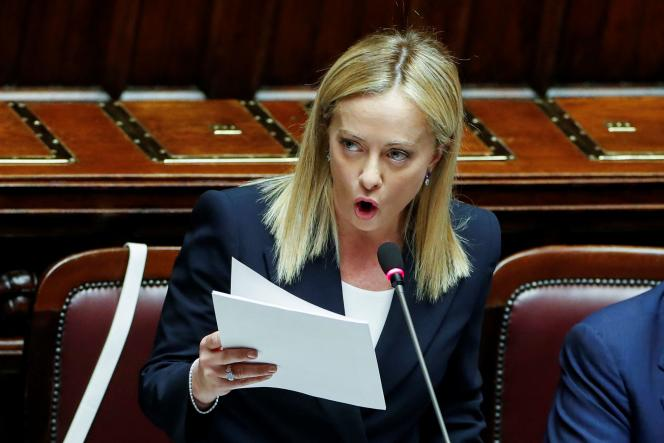
Giorgia Meloni speaking to the lower house of parliament in Rome, Italy (2022) Photo: Remo Casilli, Reuters. Source

With the recent rise of populist movements throughout Europe, talks of the dangers of far-right parties have once again become prominent. The rise of far-right parties in Italy and Sweden has made Orbán much less isolated in his far right agenda. This growth is closely tied to a shifting ideology of the Far-Right, which has distanced itself from its racist roots to focus on “right to difference” as a means to justify anti-immigrant sentiments. While this is certainly cause for concern, the actual implications of rising far-right populist movements seems largely overstated. In fact, backtracking and inconsistencies in policy as well as recent failures of populism suggest that the far-right has not quite found its footing.

Though the decision of the EU to suspend funds towards Hungary has proved insufficient, it is hard to argue that Brussel’s financial benefits are hard to resist for populists. Though Italy’s Giorgia Meloni has attempted to pin Germany as anti-European due to their stance on the energy crisis, it has become clear that the benefit of EU funding is simply too important. It incited her to backtrack on antagonism of Germany, instead asking for small policy changes to help keep the prices of energy and gas in check. Though this does not represent a complete shift away from Meloni’s good relationship with Orbán, it shows that the far-right is not as tightly-knit as might be assumed. 

Clashes in the rhetoric of populist parties are not limited to the energy crisis, however. In spite of Orbán’s positive position towards Russia, as well as support of Putin from possible coalition partners, Meloni has kept a pro-Ukraine stance. Once again, this suggests that the stances of far-right populists may not necessarily align as neatly as one might assume. That is to say, despite the assumption that other far-right parties may fully turn towards Orbán for support, the position of Meloni’s Brothers of Italy in the EU has made this difficult.

Liz Truss’ hasty resignation further complicates the situation. Her ineffective tax cuts intended for economic growth, which bear a striking resemblance to Giorgia Meloni’s economic proposals, will certainly create doubts regarding populist policies. The result is almost certainly a reduced willingness of center-right parties to lean on populist rhetoric as a means of garnering support. This suggests that as was the case with Meloni, instead of a shift towards far-right populism, center-leaning parties may look elsewhere for public support.

It is also important to remember that the success of these parties does not indicate widespread support for far-right populism across Europe. Countries like Germany, who have elected “the most boring guy in the world” show us that the success of the far-right has not followed everywhere. Further, the success of populist parties may instead represent the fragmentation of the opposition. This was the case in Sweden, where left-wing Social Democrats won the popular vote, but did not form a coalition. That is to say, while there have certainly been a few far-right parties elected in the EU, it does not represent a larger cultural shift across the region. Even with the rise of populist parties, Hungary lacked sufficient support to block its loss of Cohesion Funds in the European Council. Also of note is the history of the EU, which suggests that crises have actually been beneficial in strengthening the EU.
Though far-right ideology is certainly not harmless, it remains important to stay level-headed in understanding the threat that populist support poses to Europe. While Hungary under Orbán shows no major signs of slowdown regarding the success of its populist illiberal democracy, it is important to recognize that this trend is not true for all far-right populist parties. Meloni’s Brothers of Italy actually provides a strong argument to the contrary, as we’ve seen clear examples of ideological compromise with the EU on both the energy crisis and the war in Ukraine. The further failure of the Tory party in Britain as a result of a populist shift may further halt transitions towards the far-right. These factors, along with the reality that populism has not garnered a majority of support in the EU suggests that populism will not successfully undermine the democratic values of the region, even if the EU is unable to effectively prevent it.
The Transition of Hate, Anger, and Fear

BY: Francesco Sacca

Welcome back to the Sacca article everyone! It has been some time due to the student break that I received but I am back and ready to discuss more interesting topics with you all!

In this week’s material, we explored some themes that were new and some themes that have returned from previous weeks. From Anna Cento Bull and Christopher Molnar, elements of a returning nature present themselves. While they are both discussing two different regions within Europe (Bull with Italy and Molnar with Germany), similar topics that surround fear and unity through the exclusion of ‘others’ are made aware. While these topics have been discussed at length over my past few postings (and not to mention by other students on this website) there are some rather interesting topics that are brought up. For example, from Bull I now understand the origin of the term “Forza Italia” which, as an Italian, has been said both around me and by me many times. In Bull’s article, she states; “Forza Italia’s appeal to ‘the people’ thus simultaneously involved a redefinition of those who belonged and those who did not.”. Knowing now that the use of this term mentions a sense of belonging through ethnic exclusivity, I do not believe that I will be shouting the term during soccer games any longer.

In the article created by Kalb Don and in the article titled “‘Actually Existing’ Right-Wing Populism in Rural Europe”, we are introduced to some of the declining experiences of different European countries. How the desire to create a more free market based economy, was able to lead to a decline in things such as unemployment; “A massive reduction in formal employment throughout the region from some 70 percent to 50 percent”. This statement by Don shows just how impactful these changes were to European populations (simply for comparative purposes, during the Great Depression, the United States suffered a 25% decline in employment).

Sources used:

Anna Cento Bull, “The role of memory in populist discourse: the case of the Italian Second Republic” Patterns of Prejudice, 50:3 (2016): 213-231

Christopher Molnar, “Greetings from the Apocalypse”: Race, Migration, and Fear after German Reunification” Central European History, (2021), 1-25.

Don Kalb, “Post-Socialist Contradictions. The Social Question in Central and Eastern Europe And the Making of the Illiberal Right” The Social Question in the Twenty-First Century: a Global View edited by Jan Breman et al. (Berkeley: University of California Press, 2019).

Natalia Mamonova, Jaume Franquesa, and Sally Brooks, “‘Actually Existing’ Right-Wing Populism in Rural Europe: Insights from Eastern Germany, Spain, the United Kingdom and Ukraine,” The Journal of Peasant Studies 47, no. 7 (2020): 1497–1525

A Window of Change?

By: Hannah Long

When looking at Bulls work as well as Molnar’s work they both play with an idea of illusion, it is more so the illusion of progress. While there is no doubt that progress was seen in terms of widespread change across various countries and governments that is where the similarity ends, as this transitional period almost forced European countries to come face to face with many of the problems in their own respective states that they were ignoring for years. There were many blatant and ongoing problems related to migration and immigration then, and still remain so today. Interestingly, the issue of immigration (i.e. illegal & asylum seekers) into countries such as Germany seems to have had more attention in the spotlight than issues surrounding shrinking native populations migrating abroad, due to corrupt governmental structures or a depletion of jobs. Countries like Germany were now living in a more multicultural world, with many Germans already having nationalistic outlooks they became increasingly more extreme in their views against foreigners, specifically those of minority and non (white) European backgrounds. As Molnar explains in his work the 1990’s in Germany were marked with a fear of the “unknown,” or in this case a fear of what a more multicultural society would bring to Germany’s future, as a poll conducted in 1993 had over 60% of participants stated that the fear of over-foreignization should be taken seriously. 

Sources:

Anna Cento Bull, “The role of memory in populist discourse: the case of the Italian Second Republic” Patterns of Prejudice, 50:3 (2016): 213-231.

Christopher Molnar, “Greetings from the Apocalypse”: Race, Migration, and Fear after German Reunification” Central European History, (2021), 1-25.

Migration and the end of the Cold War

By Blaise Rego

The idea that Europe changed massively 1989 is no shock to anyone. This year was the triggered the collapse of what once was the competing lead world power, the Soviet Union. Revolution’s across the eastern bloc overthrew communist leaders and helped establish shaky new governments that altered the power balance of the European sphere.

New governments being established across Europe meant new ideas and political sensibilities began to govern in places that had stagnant policies towards many of the problems that plague modern Europe. This is clearly seen in the issue surrounding migration in europe. The collapse of communist regimes, releasing of the steel curtain and troubles across Southern Europe (the balkans) and Africa massively increased the migration to Eastern Europe. Migration to eastern Europe was not met with enthusiasm as economic issues troubled many of the post Soviet states. States like Hungary were forced into “shock doctrine” neoliberal economic policies that massively hurts their economy resulting in social unrest towards the government.

A societal base that is unhappy with the government, is dealing with internal political/economic issues, and external issues (migration) is fertile grounds for the growth of extremist ideas such as neo-fascism. These fertile grounds have allowed for political parties such as “Fidesz” in Hungary to blossom into the leading political organization in the country. Fidesz and Vitkor Orban have allowed for Hungry’s slow slide towards an “illiberal democracy” a term coined by Orban himself. These readings have shown how a series of events can have massive ripple on affects if there are external forces at play that shift how the events affect the world.

Racism in Germany

Megan MacRae

When reviewing how Europe, Germany in particular, treated migration, race, and democratization during the last two decades, a significant piece of information to explore is the change in perceptions around racism. This week’s readings, especially the piece from Christopher A. Molnar, illustrate the moral challenges Germany experienced after World War II.

What struck me most from this week’s material was the conversation surrounding a shift in Germany from biological racism, to cultural racism. Molnar does a significant job at highlighting how Germany’s perceptions towards race, migration, and democratization stemmed from a shift in racist attitudes among Germans. Molnar explains that unlike the racism that was prevalent in the Third Reich, postwar Germany experienced a racism that was based on cultural differences, rather than divergences between bloodlines. Among the various letters explored in the article, there were also government actions to limit the number of foreigners in the postwar country. Either through legislation, or financial efforts, it was clear that rise in foreigners living in the country made many Germans feel unsafe. This led some to believe that if Germany was to remain occupied by foreigners, the nation would collapse and a civil war could breakout, causing mass murder and extreme chaos. 

What I find most concerning about these apocalyptic thoughts is that they are born from a nation that had just reunified after a history of horror and death. I understand that the type of racism present in 1990’s Germany was different than the racism enforced by the Nazi’s, but I would have thought that a country, which had just been torn apart by racism in general, would have worked to avoid the same type of laws and belief systems that caused the country to collapse 50 years prior. I believe that I am over-simplifying the situation, but it is just something that came to mind after I finished the reading. 

Pan-European Tensions

By Lauren McCoy

While our previous classes have highlighted the importance of inter-European relationships between fascist parties, this week’s material re-emphasized the importance of inequalities within and among European states as a contributor to fascist movements. While our class discussion has always maintained fascist movements as distinctly nationalistic, I think it can be easy to equate a post-war European Union as having reconciled tensions that existed in the first half of the 20th century and focus on a pan-European identity against immigration from the Global South. While the Molnar reading reaffirms the important role that fears of the “non-European immigrant” play in far-right movements, the Kalb and Mamonova et. al readings have helped reveal resistance to the cosmopolitan European Union that I hadn’t considered previously. This was most visible in how the Mamonova et. al reading emphasized that East Germans joined fascist movements despite Islamophobic attitudes – revealing other tensions at play beyond racialized fears.

This left me with a question that perhaps I would be interested in discussing next class – has globalization and European integration made fears of “international conspiracies” seem more legitimate? I am not suggesting that radical anti-Semitic theories have any basis in reality, nor proposing that they should be taken as anything beyond hateful. Yet comparing global interconnections in 2022 from the mid-twentieth “classic” era of fascism, the advents of a European economy and neo-liberal capitalism have heightened international connections. The Kalb reading showcases this twofold: where national economies become increasingly dependent on global finance and where feelings of abandonment increase as cosmopolitan considerations replace labour/welfare/rural need. Reading about the relationship between neo-liberalism and East-European workers, I can see why disempowered populations may feel as though international forces have stripped their control over their livelihoods or how their considerations become sidelined by government agendas.

Does modern globalization serve to bolster long-standing capitalist conspiracy theories in a way that wasn’t present in the past? Or am I simply diminishing the international connections that existed previously among European states?

Othering and its contradictions

By Frank

One of the themes that struck me from the readings was how late 20th century Europeans “othered:” who did they consider to be included t of their “nation” or “people” and who they did not. What I found interesting was that the lines were often drawn differently depending on the context, and how this was done not only by leaders of radical right parties, but also by average citizens.

Cento Bull examines the more high-level perspective of far-right Italian Second Republic parties radically redefined inclusion and exclusion in their efforts to reconstruct the past. One example is discussed Lega Nord. On the one hand, they othered Southern Italians based on a dissonance between work ethic and perceived criminality vis-à-vis Northern Italians. On the other, they saw migrants (in particular people from Arab-speaking countries) as an excluded group from all Italians, Southerners included (p.222-3).

While Italian politicians were doing mental gymnastics to develop their imagined past, Germans in the recently reunified Germany were also engaging in othering from a more bottom-up persepective. Molnar’s piece highlights that post-War racism in Europe had shifted from Nazi-era “biological” differences to ideas of European cultures being incompatible with those of the global south. While this was a discourse pushed by far-right and neofascist groups, Molnar’s examination of letters from German citizens to President Wiezäcker illuminate that these ideas held sway over “average” German citizens, evidenced also by the 1992 anti-asylum compromise (p.498-501).

From these readings we can see how othering ultimately leads to the marginalization of, persecution of, and violence towards groups in European society that were not considered to be included in the dominant national or ethnic group.

A Difference that Unites People: Racism

By Louis Lacroix

To humans, differences between them and other individuals or groups are enough to set them apart in their mind. From a different opinion to the color of the skin, everything matters from that perspective. It’s also hard to accept change as it can be scary and it is exactly what populism is trying to exploit since its creation. This is what author Ivan Kalmar tries to argue about Hungary and Victor Orbán creating a culture of Islamophobia. Immigration is a catalyst for fear and with Europe having large waves of immigrants coming in it’s the perfect excuse to channel racist thoughts based on fear and anxiousness rather than the plain “evil” side of individuals. It is an excuse and an easy way out to blame society’s problems on rather than work out complicated equations to accommodate everyone. Racism then becomes a tool for a political party to manipulate the popular opinion to achieve their social and political goals. This leads to more institutionalized racism like in Turkey with the White Turks defined as the bureaucratic elite and the Black Turks as the common population. This influencing methods are particularly efficient and pernicious because at a certain points these ideas become an individual’s own thoughts and he starts to accept more radicalized positions that the populist group suggests, creating a cycle of hatred. It is a lot easier to blame an external source than to face the problems within their own nation building roots.

Populism, Myth, and the Fictional Good Ol’ Days

Owen Billo

Some kind of populist myth is mentioned in all of the articles this week, but most prominently in the Bull article. When Bull discusses the role of memory in populist discourse, it is that memory is being hijacked by myth to promote a “people” and their supposed “good ol’ days.” Those good ol’ days are a fiction constructed by the myth, but people’s memories are easily corrupted so they start to remember the past differently. Once people believe in a fictionalized past, it is easy for someone to say “x took that away from you” and the antagonism of populism begins.

In the Molnar article, the above sentiment is reflected in a partially medieval aesthetic reminiscent of the obsession with the medieval world that we read about earlier. One German man says of the Turkish immigrants something like “they had kicked out the Turks at Vienna in 1683 and should not be letting them in now.” The Kalb article about Eastern Europe shows a more interesting myth in that the good ol’ days are not as clear, but there is still the “x took that away from you” sentiment. After the collapse of the USSR, people in Eastern Europe had hope, but that hope was crushed by the failures of mass privatization, which they associated with liberalization. This resulted in the myth that “liberalism took your hope away from you.” The Mamonova/Franquesa/Brooks article shows the most clear ‘good ol’ days’ sentiment in discussing the rural-urban divide, where for rural-dwellers the time before urban migration was better but the amount to which it was better has been exaggerated. The result is a resentment towards ‘urban elites’ for luring their population away. Resentment also appears to be a common theme.

Perceptions of the far-right and racism

By Felix

In this week’s readings, especially those centred around Germany, key points came in direct conflict with the conceptions we may have made in regards to populism throughout the course. As we’ve discussed to great lengths, populism and fascism were closely tied to racist or pro-national ideology. However, Mamonova et al. and Molnar’s articles provide us with two different perspectives that somewhat come to clash with these notions.

In their focus on East Germans, Mamonova et al. explore the growth of far-right movements in the part of the country which was formerly communist. Rather than based on racial motives, however, we see that these movements are primarily based on discontent with the socioeconomic situation of East Germans, who felt themselves as “second-class citizens” (Mamonova 1504.) Further supported by the lack of anti-Muslim sentiment in the protests that took place in Dresden (Ibid 1504), we can suppose that the rise of far-right is not especially tied to their racist discourse. This comes to throw a first wrench in the cogs of our understanding of racism as a key component of populism and authoritarianism.

This is further complicated through Molnar’s exploration of the general sentiment in Germany at the time. In fact, it would suggest that anti-Muslim sentiments were more present in the general public and in government, as one could gather from the support towards Helmut Kohl’s plan to pay Turks to leave the country (Molnar 497). The growth of anti-Muslim sentiment, especially supported by the Chancellor of the CDU, becomes hard to pin as exclusive to populist or authoritarian far-right ideals. Rather, our understanding of the ties between far-right movements and racism needs to be reconsidered, perhaps especially due to the uncertainties present at the time.