After the end of the Second World War, Europe was primed for massive political change. This week’s readings bring us through the efforts of the New Left and New Right to establish political revolutions in their own rights, with varying degrees of success. Although both sides of the political spectrum sought to achieve their goals by differing means, many of the tactics they used were surprisingly similar in my opinion.
The “Revolutionary Angst” article encapsulates the New Left’s desires for a new West German political system, as they believed the current one was already on the path to authoritarianism. This concept of “involution” essentially stemmed from the New Left’s perception that the state was resting on its laurels under the capitalist order— where sedentism would bring fascism. A tactic which they used to bring public consciousness to this issue was calling themselves the “New Jews,” or self-victimisation. This is common among both left- and right-wing populist groups.
The New Right (in our case the French Nouvelle Droite) originates in a similar way; ideas promoted by Armin Mohler and Julius Evola of a “Conservative Revolution” and the necessity to emerge from a “black age” put emphasis on tradition and faith. Originally based in biological determinism (i.e. an Aryan race), the ND distanced themselves from open fascists and instead based their political grievances in cultural determinism.
This conflict would force many politically-active people to the centre in West Germany or France, essentially engineering the Neoliberal movement which broadly represented the centre-right.
The flag of the Soviet Union is lowered for the last time and replaced with the flag of the Russia, December 26th 1991. Source
On December 26th, 1991, the Union of Soviet Socialist Republics was dissolved into its 15 constituents— signifying the end of the Cold War. The capitalist western powers were finally able to reach through the Iron Curtain and begin the arduous process of democratization within states formerly subjugated by the Warsaw Pact, marking an era of increased European political and economic interconnectedness. However in the liberalization process of states such as the former East Germany, Poland and Hungary, the USSR had left behind the perfect storm of conditions for today’s populist parties to emerge; steeped in anti-establishment, anti-elitist and ultra-traditionalist rhetoric. The democratization experiment was something unfamiliar to most, and certainly had the possibility for improvement following the western powers’ first attempts in the aftermath of the Second World War. In my opinion though, we’ve gravely mishandled this situation which has allowed for the growth of a dangerous “populist plague.” If not properly amended, the inevitable takeover of Europe by right-wing populist parties will have dire consequences.
Life behind the Iron Curtain was very harshly regimented. One’s loyalty to their local communist party was of utmost importance to the authorities, lest they allow capitalist dissidents to run amok. Essentially, from 1946 to 1991 a herculean campaign of repression was undertaken across eastern Europe to foster the collectivization of society. After the dissolution of the USSR however, all of this oppressive architecture would vanish— finally allowing for these states’ transitions to democracy to occur. Initially, cooperation between western institutions and former communist states went smoothly. As time went on though, the groups most repressed by the USSR became more agitated and active in national politics; seeing organizations like the North Atlantic Treaty Organization (NATO) and the European Union (EU) as no more than mimics of their former Soviet overlords. An odd combination of nostalgia for the Soviet period and hatred for its communist governance combined to propel groups like the Alternative for Germany (AfD), Fidesz and the Law and Justice Party into the forefront of European politics.
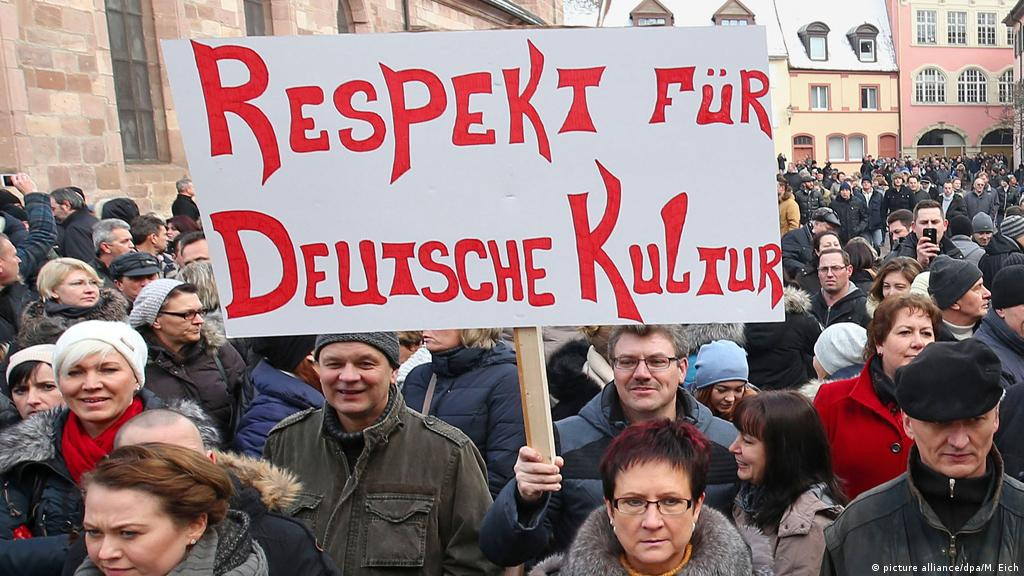
East Germany was perhaps one of the more repressive states to have existed during the Cold War. So, how has a party rooted in authoritarian conservatism been able to rise to prominence? Under the auspices of the Soviet Union and the watchful eyes of the Stasi (East Germany’s secret police, one of the most effective in history), the East German identity was shifted away from the individual and instead towards the community. The state was to be the most important organ in everyone’s lives— and individuals were solely cogs in the machine of the advancement of socialism. Post-reunification, many young Germans born in the territories of the former East Germany felt they had no identity to rely on[1]; a major factor for AfD politicians to take advantage of. If populism can offer a solution for problems caused by the former East Germany, prospective voters are more than willing to overlook its racist and xenophobic leanings.
A German man holds up a sign reading “Respect for German Culture” at an AfD rally. Source
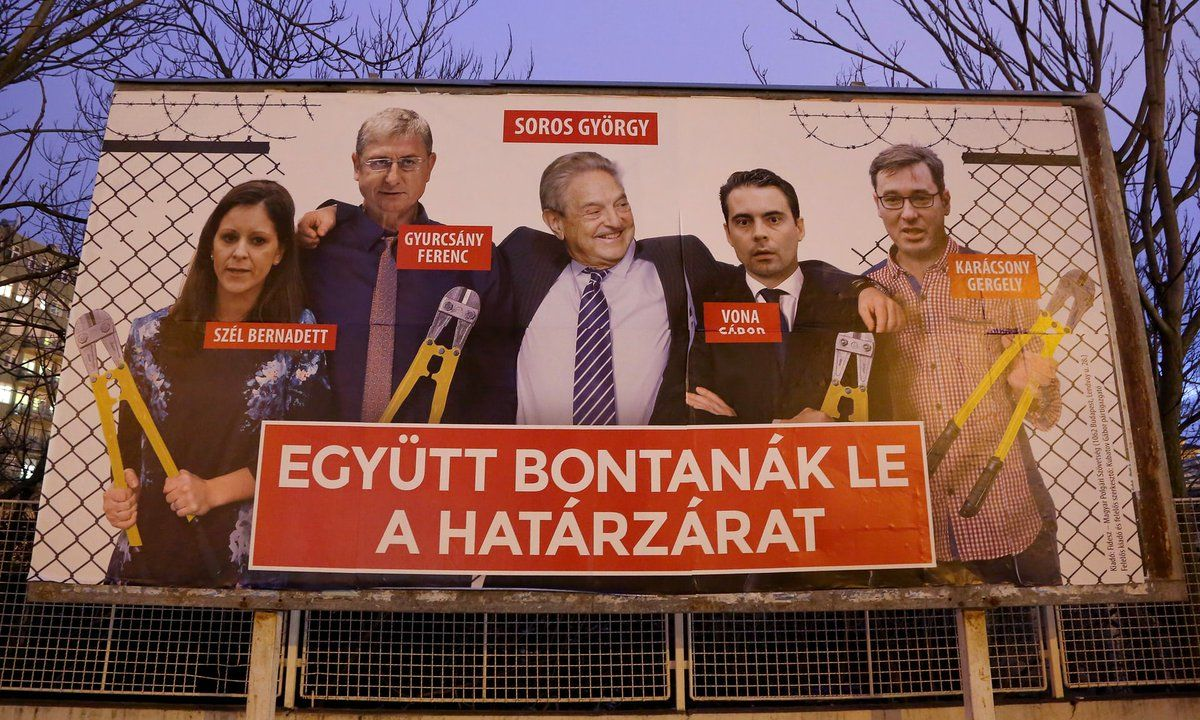
The Fidesz Party of Hungary adopted a similar strategy to that of the AfD— filling a void for voters with the promise of problem solving through direct democracy, as well as attacking democratic European institutions interpreted as detrimental to Hungary’s future[2]. Hungary too was subjugated under the Iron Curtain and was even invaded by its former Warsaw Pact allies in 1956[3], which would understandably cause many Hungarians to be weary of supranational institutions. Although a light amount of skepticism can be healthy, the skepticism promoted by Viktor Orban is rooted in antisemitism[4] and strongman authoritarianism that seeks to destroy the EU from the inside. Coincidentally, Orban is a close ally to Vladimir Putin.
A Fidesz Party poster depicts George Soros and other Orban rivals holding wire cutters, insinuating they will cut the border fence and allow migrants to enter the country.Source
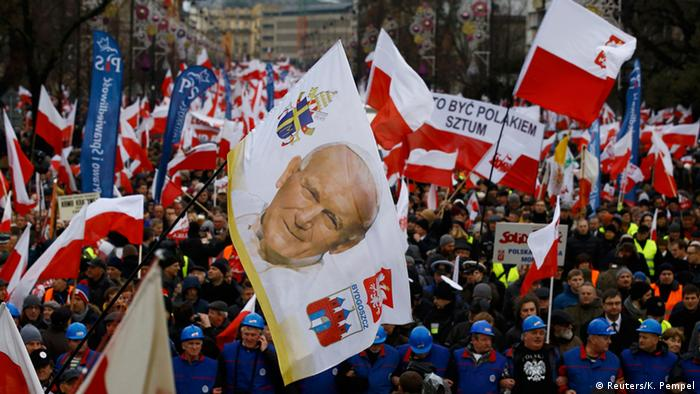
While AfD and Fidesz take advantage of the nostalgic aspects of populism, the Polish Law and Justice Party associates more with its religious aspects. Under Soviet State Atheism, Poland’s majority Christian population was severely repressed. Following the dissolution of the USSR however, this bottled-up religiosity was allowed to run wild; entrenching itself among far-right politicians and used as a tool to demonize the decadent west. Poland’s Law and Justice Party seek a return to Christian tradition and to do away with western degeneracy, such as abortions (which they have banned outright since 2021)[5] and homosexuality (which has been banned in entire regions of the country since 2019)[6].
Law and Justice Party supports using religious imagery in support of the party’s controversial judicial reforms. Source
It is apparent that populist parties have their roots in the totalitarianism of the former communist sphere. The USSR laid the foundations for today’s turbulent political climate, which has been exploited by its successor state, Russia, as a means to destabilize the west. This is an issue which must be recognized— if we do not prescribe the accurate antidote for the plague of populism, we will certainly lose this second Cold War we find ourselves in.
With my preconceived notions that fascist dictatorships were normally rigid, totalitarian organisms that kept a watchful eye on all state activity, it surprised me how much agency it afforded to citizens that were members of the party. Fascism in this sense is flexible and pragmatic; willing to change the definitions of certain constructs or look the other way if someone’s actions would result in the furthering of their cause. Look at the Nazi approach to the concept of masculinity for example— Walter Hauck’s photos in the Kühne article demonstrate this. Although the Sturmabteilung (SA) banned males from pushing baby carriages, the Nazi government’s approach to this act was less restrictive, as they believed the pride of being a family father nurtured masculinity. Extrapolating from this, the main appeal of fascism (at least to those in charge) was that anyone and anything could be a tool of the state, and if they weren’t they could make them so.
Additionally, this attitude towards the furthering of the nation would extend beyond the Second World War into the Cold War— under Francisco Franco’s dictatorship in Spain. Through the usage of propaganda portraying the state as strong and prosperous under fascism, the Spanish economy saw growth via a tourism boom. Although the influx of tourists would undermine his dictatorship and promote the urge for democratization, Franco was able to effectively prolong the existence of fascism through cultural instead of military means. Overall, the appeal to fascism is its malleability to whatever one’s cause may be.
Photo: A soldier of the Free Arabian Legion in German-occupied Greece, 1943
As far back as the aftermath of the First World War, groups of radical nationalists across Europe united to halt the revolutions sweeping across Russia and Germany, which they feared would spill over into their own countries. The idea of “Judeo-Bolshevism” would emerge in the interwar time period, serving as a justification for many devastating pogroms against Jews across the continent.
Radical nationalists of the 20th century would be found to collaborate with one another on tackling the threat of “Judeo-Bolshevism,” but would rarely see eye-to-eye concerning other issues on the grounds of ideological differences. “Judeo-Bolshevism” served as such a unifying target for these groups, as it was already a common ground for most Europeans; it was believed that Jews were the face of the [communist] revolutions of Europe, and had to be destroyed (Hanebrink 13). Radical nationalists yearned for the maintenance of the status quo of a conservative, christian Europe, denouncing any deviation from it as part of the Jewish conspiracy. For instance, upon the emergence of the Weimar Republic after the First World War, radical German nationalists named it the Judenrepublik, or “Jewish Republic” (Hanebrink 16).
Throughout history, it has been proven that as long as there is a unifying “evil” for nationalists to campaign against, cooperation is possible. Although internationalism is comparable to a cardinal sin for fascists, as long as it supports their personal goals such a grave transgression can be tolerated. In this case, consider the numerous international brigades fielded by the Third Reich during the Second World War. Taking advantage of anticolonial sentiments across their enemies’ territories, Nazi Germany was able to cooperate with sympathetic fighters in their struggles for a new world order (Motadel 843). However, the Reich’s fascist network of alliances conflicted too much to allow for further development of these groups because of their focus on subjugation instead of self-determination.
Cooperation between fascism and internationalism is not impossible. People need a common enemy to be willing to fight together, and looking back through history to find one is usually a predictable first step. Although whenever these alliances are made, one can expect them not to last long; at some point, pragmatic cooperation between nationalists will outlive its usefulness and competition will arise.
Works Cited
Hanebrink, Paul A. A Specter Haunting Europe: The Myth of Judeo-Bolshevism. The Belknap Press of Harvard University Press, 2018, pp. 1-45.
Motadel, David. “The Global Authoritarian Moment and the Revolt against Empire.” The American Historical Review, vol. 124, no. 3, 2019, pp. 843-877.
Ever since the election of Donald Trump in 2016, the term “populism” has seen a resurgence in academic literature and popular media. Although the idea of populism has been studied and monitored since the dissolution of the Soviet Union, most still have a very faint idea of what the concept actually means.
In his podcast with the Norwegian Institute of International Affairs, Rogers Brubaker lays out a general definition of populism as a repertoire of worldviews— characterised by a distrust in governmental institutions, cultural protectionism and crass behaviour. Despite populism further being argued as neither left nor right by Cas Mudde, right-wing populists have been able to wield this repertoire effectively as to champion their political objectives ostensibly in the name of the people. But if populism represents a fight against the elite caste of society which can be manipulated for both the left and right wings of the political spectrum, how does fascism connect to it?
According to Federico Finchelstein, populism in theory rejects the raw forms of political violence presented by fascism. But, the intolerant nature of right-wing populism as well as its many similarities to fascism provides a readily available jumping-off point for its followers to radicalise into fascists. For instance, Robert Paxton presents the invention of fascism as a kind of “national socialism;” a stark similarity to the populist rhetoric of patriotism and national identity with a necessity to protect the lower class of society who have fallen prey to parasitic elites. Sound familiar?
Through this week’s readings, we can attribute a loose definition to the ephemeral concept of populism and connect it to its most dangerous extreme form, fascism.
My name is Jacob- I’m a fourth year student in the BGINS program here at Carleton, specializing in European and Russian studies. I very much enjoy analyzing the course of historical events and how they’ve shaped relations between the West and Russia, mainly since the inception of the USSR and beyond. I’ve recently returned from an internship in Florence, Italy for my IER and I’m very excited to finally be back in the classroom again. It was a pleasure meeting you all last week, and I’m sure this semester will mark a great return to campus!



 Hate 2.0
You must be logged in to post a comment.