I went to an art museum

by Blaise Rego

all photos in this post were taken by me unless linked in photo caption

Over the past week I was in Montreal and was able to go to the Museum of Fine Arts (MBAM), an incredible art museum that bridges art and cultural history. What stood out to me was art from German artist from the post war period that used abstractism to convey deeper ideas and emotion. Three paintings stood out more than the rest did, they each expressed the nature of post war Germany but each painting did it a unique way.

Abstractism in art links the philosophical idea abstractism, the idea that your mind links new concepts with ideas that you have already learned with the artistic properties of abstract art. In a sense it explains why heavy brush strokes and dark colours can create emotions such as anger and sadness whereas light brushstrokes and light colours can harken happy or lighter emotions.

In Nazi Germany art was heavily censored. Adolf Hitler had rigid views on the art that the Third Reich would produce. He sponsored a campaign against “degenerate art” (i.e., what is viewed as modern art) stating that it had no place in Nazi Germany. Similar to most fascist ideology, they viewed artistic modernity as an extinction of modern ideals and wished to go back to “the good old days”. Hitler felt that art being produced at the time was too contaminated by Jewish influences and instead wished for Nazi artists to be inspired by Roman and Greek painting and art styles (romantic realist art). The postwar art on display at MBAM used the degenerate art style that was banned against by the Nazi to display the emotion and conflict that engulfed Germany in the post-World War 2 period.

Couple in Landscape – Ludwig Dettmann, an example of romantic realism

The painting “Landscape near Koblenz” struck me as I walked into the gallery as unlike the rest of the room, it seemed photo realistic and vivid. What struck me when reading the plaque was how the painter Gerhard Richter looked to weave a space in-between socialist realism  (art that was viewed to be communist) and abstraction. His painting described by the artist himself was stated to be “capitalist realism”, it evokes memories of the art the Nazi’s pushed to the forefront of the German art world with one striking difference. He states that any landscape that he creates is only temporary and it could be wiped out and erased in a moment. This harkens back to the idea that the war and the devastation that followed the invasion of Germany was still in the German collective imagination.

The other two paintings “Rechts und links eine Kirche – Jörg” (Right and Left a church – Jörg) and “Deutschland Café XIII” deeply pull at the idea that the German collective imagination was still fractured in the post war state. In “Deutschland Café XIII” by Jörg Immendorff (the subject of the other painting) there is clear symbolism of a broken Germany in the dead eagles strewn on the left side of the painting. With their necks seemingly broken it pushes the idea of the once strong and powerful German culture being killed in the conflict between the east and the west. 

The second painting “Rechts und links eine Kirche – Jörg” by Georg Baselitz evokes the divide between the east and the west using one white church and one muddled colour church with the painter Jörg Immendorff strung upside down between them. The dark colours contrasting with the bright paint and heavy brush strokes surrounding the strung up Immendorff create emotional weight when looking at the painting.  The red brush stokes give the viewer a sense that a violent act occurred and that the body that it upside down is being pulled in between the two churches. It evokes a notion that Germany was being pulled in two separate ways and the end result may be bloody.

Rechts und links eine Kirche – Jörg – Georg Baselitz

When viewing these paintings in person they evoked deeper emotions than I was expecting. The feelings of brokenness and conflict were palpable and the small placards beside the paintings gave greater depth to these feelings. I realized that the greatest asset of modern art was the ability for greater depth of emotion for the viewer through colours, textures, and symbols. This flies in the face of the Nazi logic about painting as realist art cannot always convey the emotions brought through abstractism. In the post war period German artists use degenerate art to demonstrates the conflict and the discontent that was created within the German collective imagination following World War II.

The following is just a quick art museum review – NOT PART OF OPED

So it was awesome, I had no expectations but the collection was extensive. The permanent collection had artists ranging from Picasso to Salvador Dali to Monet. Seeing paintings by these painters was bit awe inspiring and felt a little like checking a box off on the ever growing list of artists and art that I want to see before I die.

I was super fortunate to go when a Jean Michel Basquiat exhibition was being shown. I knew a little about him and his life before but I was blown away by his story and his artistic range. Before his death at 27 he worked with Andy Worhal, created TV and films, painted and created music. I will not do him justice by explaining here but if you are at all interested take an hour and do so research on him, it is well worth the effort.

The only criticism I would have of the museum was that the flow (ie. how you walk through and see everything) was less than optimal. Over the course of 4 hours I was only able to see maybe 1/2 to 3/4 of the collection. There is a who collection of Canadian art through history that I wasn’t able to get too but it gives me something to look forward to next time I am in Montreal.

Op/Ed#2 Greece-Turkey Relations: is a War Imminent?

By Louis Lacroix

Tensions between Greece and Turkey, two of the oldest NATO’s members, have been gaining attention from the rest of Europe in the past. It is said that diplomacy is going so poorly between the neighbors that a war could break out if the situation isn’t defused. But since the dissolution of the Ottoman Empire following the Great war and the Greco-Turkish war ending in 1922, no military conflict was able to emerge between them even with their history of competition and liberation. While it seems that the two countries are preparing for war, it will never happen as their dispute is about being superior to the other, not their rival’s elimination.

The modern relationship between Greece and Turkey begins with the recognition of Greece independency by the Ottoman Empire in 1832, but the point of focus will be after 1922. Hatred between the Turks and the Greeks never went away, and some events came close to start a new war, but it never happened. One of the best example would be the Istanbul pogrom against Greeks of 1955, as the Turk authorities hindered the influence and wealth of the Greek community in their largest city to provoke their rival and gain more economical autonomy in that region. Although outrage by this turn of events, Athens did not act on it, denouncing the pogrom and helping its Greek migrants. One of the particularly important element of the ongoing conflict is Cyprus. The island was invaded in 1974 and forced the island to split between a Greek and a Turk regime, even though most of the country’s population was of Greek descendancy. While the Cypriots live there in a relatively peaceful manner with one and other of different origins, they got into a political issue between their homelands. The island represents a special case because it embodies the essence of the battle between the two. While they have not taken direct action against the main territories, their nationalist ways have dictated their movements with the goal to humiliate and gain an edge on the other. Since the Turkish side of the island is still not recognized by the world, negotiations with Greece and the other half of Cyprus are still in progress with periods of more stability, with the 2000s having some non concluding attempts at closing the situation peacefully. Yet, direct war has not been declared while menaces of it are looming.

As of today, the tensions are rising once again over the militarization of the Greek side following the arms embargo lift on the Greek Cyprus administration. Furthermore, there has been some discoveries of natural gas and oil in this region of the Mediterranean Sea. The Greek government justifies its more aggressive stance as a mean of defense against Turkish bullying. They made a political calculus; the situation for the Northern Turkish government in Cyprus places them in a corner as they are stuck between the international stage not recognizing their legitimacy and the Greek side arming up. While the world consensus is to avoid war on the island, it would be difficult to impose sanctions on Greece or Cyprus as it will basically be a “liberation” war. Again, if an event like this happen, Turkey nor Greece will push the matter on their territories as the ONU and the United States will condemn the attacker and probably support the invaded. This will only be a blow to Turkish efforts of gaining influence over a foreign territory that has some Turkish individuals, and both of the competitors will go back to finding ways to harm the other.

Realistically, the only way Greece and Turkey are getting into a new war would be through Turkish minority sovereign movements in Greece in the Western Thrace. It would look similar to the situation in Ukraine with Crimea in 2014 and the current invasion, but since Turkey is definitely a lot weaker, they would require quite the mobilization effort from within Greece. Furthermore, after the tragic events of the 1955 Pogrom in Istanbul, there is approximately 2 500 Greeks in Turkey. Since one of the principal arguments to invade a country is justified through “protection” of their cultural population and its getting less and less possible for both sides, there is less interest to conquer territorial parts as the local population would still be very homogenous. It seems that for now that Greeks and Turks will simply continue to hate each other rather than look for the complete annihilation of the other.

Op Ed. #2: The internet and a new kind of shift in racist thought in the west

By: Cyrus Hutnyk

            Racist thought has been prevalent and an issue of varying degrees of severity over the last century with great frequency, whether you look to the terrible systematic racism in the structure of the United States that continues to negatively impact largely non-white people and people of lower income, or to the most drastic in cases of Nazi Germany under Hitler and the massive killing of Jewish people that occurred throughout World War II, the issue of racism in its different forms remains consistent. This being understood though, shifting attitudes and forms that racism takes are equally present in periods of upheaval for various nations. Sometimes this appears as a change in leadership, as present in post-war Germany. In Christopher A. Molnar’s work “Greetings from the apocalypse” that we analyzed in this week’s readings we see the shift from a case of racism having to do with a genetic level of racism promoted by oppressive government and relentless propaganda, to a racism coming from a cultural standpoint, attitude and regulation coming from a place of fear and social upheaval after the radical changes in Germany post-World War II.

            In a more modern setting, the age of the internet and a culture of capitalism and intense connection to the internet we can see another example of shifting and developing racism. Despite the western part of the world continuing to develop and (hopefully) evolve past this archaic racist thought, there are still many who not only hold these views but are able to use the internet as a megaphone to project them now more than ever.

            As long as the internet has been present there have been individuals using it nefariously. Websites like 4chan or similar message boards are infamous for their knack to amass people with hateful and harmful ideas into one spot, but equally racist rhetoric is alive and well on every popular social media platform, whether it be Facebook, Instagram, or most importantly: Twitter. Hateful and racist behaviour on Twitter has always been a problem, even more so due to a previous lack of moderation. Sometimes this looks like using racial slurs in tweets, but often it can take different forms, like in the case of Twitter accounts owned by influential people who start to promote or incite violence or hate against others, people like Donald Trump, and more recently celebrity figures like Kanye West who started spreading misinformation on the murder of George Floyd and tweeting anti-black rhetoric.

            These social media platforms tend to have a dangerous ability to amplify these messages, they get more traffic, more likes, more replies, more shares. Despite this Twitter was beginning to do some clean up, but have recently been bought out by capitalist Elon Musk, best known for his racist work environments and massive intake of government subsidies on his companies SpaceX and Tesla. Musk promises to unban users like West and Trump and welcome them and their ideas back on to the platform. He tweets often about turning Twitter into a truly free-speech platform. Problem with that is that Twitter already is that the only speech that is against the terms of service is that which is hateful and bigoted. What exactly are his intentions when he says he wants to create free speech on the platform? This is exactly the way that racism begins to shift, instead of how in the post-war Germany example, where racism thought changes its origin and attitude from genetics to culture, racism in the west is moving to a much less manageable digital space, where those in power either hold the hateful ideas, or want to promote the ability of users to spread them.

            If we expect to see positive change and reduction in racist thought massive upheavals in allowance for hateful speech need to be implemented. As it stands now bigoted speech and behaviour is looking to be more prevalent and louder than ever before in the digital space, one that is more impactful than ever before itself.

Rings of Power: How Irish Stereotypes Force us to Confront British Fascism

By Lauren McCoy

Amazon’s flagship series The Lord of the Rings: The Rings of Powers has created a lot of controversy since it first debuted in early September. Yet within all this scandal, accusations that the series reproduces racial hierarchies that depict the Irish as biologically inferior have gone notably overlooked. More than discriminatory, these representations reveal troubling connections between anti-Irish sentiment and British fascism.

Proto-Hobbits and Famine Cosplay

Set a thousand years before the original series, the Harfoots (ancestral predecessors of the Hobbits) are the first in the franchise to take on an Irish accent. The depiction isn’t flattering. Where RP-speaking Elves are at the forefront of science and combat great evils, the Harfoots stumble through mud with twigs in their hair, stuffing themselves with berries in what some have called “famine cosplay”. Having not yet founded the Shire, the migratory Harfoots reside in raggedy camps, writing in a rudimentary form of pictographs and acting as the light-hearted interlude between more serious plotlines. With rosy cheeks and dirt under their fingernails, it is hard not to view the lovable Harfoots as undeveloped when compared to other fantasy races.

The parallels between the Harfoots and discriminatory Irish stereotypes are staggering. Irish people were seen as incapable of reasoning, whose mental deficiency was linked to superstition, alcoholism, and minimal emotional control. Much like the Harfoots, the Irish were depicted as dressing in filthy rags that suited their “naturally” pre-industrial character. In this view, the Irish lacked the discipline to work their way out of squalor, reducing them to a ‘child-like’ race unable to achieve civility without Britain’s colonial supervision. What’s more concerning is that these characteristics were considered hereditary – preventing the Irish from being seen as anything beyond “amusing savages”.

The Harfoots’ exaggerated Irish accent reproduces the stereotype of Irish simplicity. With research showing that accents are connected to judgments about social status, the show’s reliance on “Irishness” as a shorthand for “primitive” demonstrates the continued relevance of these discriminatory representations. The Harfoots’ Irish accent is especially suspicious when considering our favourite Hobbits spoke with British accents – creating a dangerous implication that as Harfoots “evolve” into sedentary farmers, they mature out of their Irish accent. The deliberate use of Irish accents reveals the deep hierarchy of whiteness that lay at the heart of Rings of Power, where Irish under-development is counter-opposed by English civility.

Anti-Irish British Fascism

While hibernophobic representations are well-established in British history, these ideas found a new life on the extreme right. Between 1920s and 1930s, British fascists revived anti-Irish sentiments as a point of radicalization for right-leaning conservatives, utilizing ideas of Irish inferiority to garner support for more extreme anti-immigration policies. These efforts were supported by groups like The International Fascist League (IFL), who in emphasizing British identity as heritable and rooted in whiteness, stoked fears of the Irish as a biological threat to the purity of the British race.

Following Britain’s failure to prevent Irish Independence, fascists capitalized on feelings of “national humiliation” to generate anxieties about Britain’s decaying political system and racial vitality. With Irish Independence posing a serious threat to images of Britain’s biological superiority, fears of an Independent Ireland became a gateway to radical anti-Semitic Judeo-Bolshevik conspiracies. Fascist parties like The Britons depicted Irish populations conspiring with Jews to establish a Communist state on Britain’s backdoor, reframing Irish nationalism as part of a global plot to overthrow English civilization.

In light of what was interpreted as Britain’s imperial decline, parties like the British Fascists and The British Union of Fascists positioned themselves as saviours of the empire. For the far-right, the firm hand of authoritarianism was essential to ensure imperial unity and protect the empire. Latching onto understandings of British imperialism as a “civilizing mission”, fascists added a moralistic dimension to their politics. Calls to re-conquer the Irish became tied not only to the reassertion of racial hierarchies, but to global stability itself. The power of their anti-Irish position was immense, appealing to mainstream British citizens by emphasizing British biological superiority and affirming their dedication to the empire.

Anti-Irish Sentiments on the Rise?

While the days of interwar fascism may seem far removed, recent signs indicate that anti-Irish sentiment may be on the rise yet again. From discrimination against Irish footballer to holiday parks blacklisting guests with Irish surnames, concerns of hibernophobic attitudes have prompted an anti-Irish discrimination motion as recently as 2019. In this context, the Harfoots make up one small piece in a larger pattern of anti-Irish sentiments.

It would be alarmist to suggest that Rings of Power is a sign of anti-Irish action to come. However, when we look at historic connections between Irish racism and British fascism, the fact that Irishness remains synonymous with “primitiveness” is worth interrogating. The Rings of Power reminds us of the power these representations hold – prompting us to look backwards, consider how they’ve been manipulated in the past, and question our own prejudices in the present.

A shifting perspective on racism in post-war Germany

By: Cyrus Hutnyk

This week’s reading by Christopher A. Molnar, “Greetings from the apocalypse” was especially provocative and interesting for me, to take a look at the ethical and moral challenges that the nation faced in the wake of its horrible leadership offers a unique perspective into the process necessary to reestablish itself and make some sort of amends and improvements. Looking at things like migration, antisemitism, race, and how democracy was impactful in Germany are all pieces of the process that the new German leadership had to face and employ. This reading went into the changes in Germany over two decades, and especially highlighted changes in perception as it related to the aforementioned topics.

The author of this week’s reading allows for a greater understanding of different kinds of racism that was occurring, both in culture and biology and how they moved from one to the other. Equally we can see how perceptions and attitudes concerning certain subjects shifted over time. Molnar demonstrates that the racism post war was radically different from that under Nazi reign, having more to do with differences in culture and behaviour rather than coming from a biological or eugenics standpoint. Interestingly, Molnar’s writing shows us that foreign presence in Germany was still a contentious subject, sparking discomfort still. Understanding the differences in public opinion and the presence of racism in Germany in the post-war period shows us a concerning image of a nation on the back of genocide and tremendously harsh and oppressive rule. Though the sentiments are drastically different from those under Nazism, the conversation concerning racism is a dangerous one in a nation with a history like Germany’s. Some of the legislation and financial efforts or decisions in the post war period generate a sense of unease given the past behaviours of the German government.

Far-Right Populism is not as Strong as we Think

By Felix Nicol

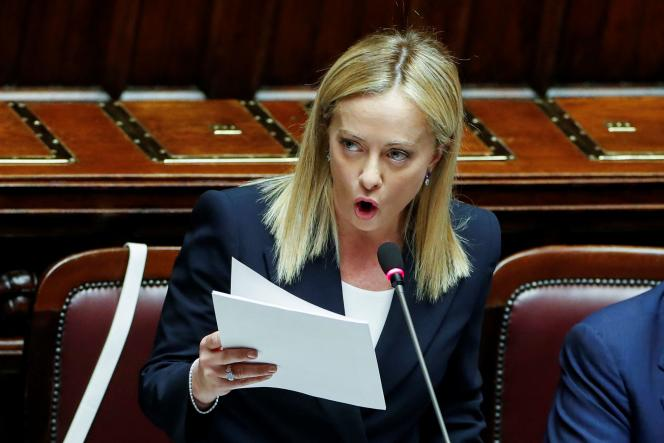
Giorgia Meloni speaking to the lower house of parliament in Rome, Italy (2022) Photo: Remo Casilli, Reuters. Source

With the recent rise of populist movements throughout Europe, talks of the dangers of far-right parties have once again become prominent. The rise of far-right parties in Italy and Sweden has made Orbán much less isolated in his far right agenda. This growth is closely tied to a shifting ideology of the Far-Right, which has distanced itself from its racist roots to focus on “right to difference” as a means to justify anti-immigrant sentiments. While this is certainly cause for concern, the actual implications of rising far-right populist movements seems largely overstated. In fact, backtracking and inconsistencies in policy as well as recent failures of populism suggest that the far-right has not quite found its footing.

Though the decision of the EU to suspend funds towards Hungary has proved insufficient, it is hard to argue that Brussel’s financial benefits are hard to resist for populists. Though Italy’s Giorgia Meloni has attempted to pin Germany as anti-European due to their stance on the energy crisis, it has become clear that the benefit of EU funding is simply too important. It incited her to backtrack on antagonism of Germany, instead asking for small policy changes to help keep the prices of energy and gas in check. Though this does not represent a complete shift away from Meloni’s good relationship with Orbán, it shows that the far-right is not as tightly-knit as might be assumed. 

Clashes in the rhetoric of populist parties are not limited to the energy crisis, however. In spite of Orbán’s positive position towards Russia, as well as support of Putin from possible coalition partners, Meloni has kept a pro-Ukraine stance. Once again, this suggests that the stances of far-right populists may not necessarily align as neatly as one might assume. That is to say, despite the assumption that other far-right parties may fully turn towards Orbán for support, the position of Meloni’s Brothers of Italy in the EU has made this difficult.

Liz Truss’ hasty resignation further complicates the situation. Her ineffective tax cuts intended for economic growth, which bear a striking resemblance to Giorgia Meloni’s economic proposals, will certainly create doubts regarding populist policies. The result is almost certainly a reduced willingness of center-right parties to lean on populist rhetoric as a means of garnering support. This suggests that as was the case with Meloni, instead of a shift towards far-right populism, center-leaning parties may look elsewhere for public support.

It is also important to remember that the success of these parties does not indicate widespread support for far-right populism across Europe. Countries like Germany, who have elected “the most boring guy in the world” show us that the success of the far-right has not followed everywhere. Further, the success of populist parties may instead represent the fragmentation of the opposition. This was the case in Sweden, where left-wing Social Democrats won the popular vote, but did not form a coalition. That is to say, while there have certainly been a few far-right parties elected in the EU, it does not represent a larger cultural shift across the region. Even with the rise of populist parties, Hungary lacked sufficient support to block its loss of Cohesion Funds in the European Council. Also of note is the history of the EU, which suggests that crises have actually been beneficial in strengthening the EU.
Though far-right ideology is certainly not harmless, it remains important to stay level-headed in understanding the threat that populist support poses to Europe. While Hungary under Orbán shows no major signs of slowdown regarding the success of its populist illiberal democracy, it is important to recognize that this trend is not true for all far-right populist parties. Meloni’s Brothers of Italy actually provides a strong argument to the contrary, as we’ve seen clear examples of ideological compromise with the EU on both the energy crisis and the war in Ukraine. The further failure of the Tory party in Britain as a result of a populist shift may further halt transitions towards the far-right. These factors, along with the reality that populism has not garnered a majority of support in the EU suggests that populism will not successfully undermine the democratic values of the region, even if the EU is unable to effectively prevent it.

The Transition of Hate, Anger, and Fear

BY: Francesco Sacca

Welcome back to the Sacca article everyone! It has been some time due to the student break that I received but I am back and ready to discuss more interesting topics with you all!

In this week’s material, we explored some themes that were new and some themes that have returned from previous weeks. From Anna Cento Bull and Christopher Molnar, elements of a returning nature present themselves. While they are both discussing two different regions within Europe (Bull with Italy and Molnar with Germany), similar topics that surround fear and unity through the exclusion of ‘others’ are made aware. While these topics have been discussed at length over my past few postings (and not to mention by other students on this website) there are some rather interesting topics that are brought up. For example, from Bull I now understand the origin of the term “Forza Italia” which, as an Italian, has been said both around me and by me many times. In Bull’s article, she states; “Forza Italia’s appeal to ‘the people’ thus simultaneously involved a redefinition of those who belonged and those who did not.”. Knowing now that the use of this term mentions a sense of belonging through ethnic exclusivity, I do not believe that I will be shouting the term during soccer games any longer.

In the article created by Kalb Don and in the article titled “‘Actually Existing’ Right-Wing Populism in Rural Europe”, we are introduced to some of the declining experiences of different European countries. How the desire to create a more free market based economy, was able to lead to a decline in things such as unemployment; “A massive reduction in formal employment throughout the region from some 70 percent to 50 percent”. This statement by Don shows just how impactful these changes were to European populations (simply for comparative purposes, during the Great Depression, the United States suffered a 25% decline in employment).

Sources used:

Anna Cento Bull, “The role of memory in populist discourse: the case of the Italian Second Republic” Patterns of Prejudice, 50:3 (2016): 213-231

Christopher Molnar, “Greetings from the Apocalypse”: Race, Migration, and Fear after German Reunification” Central European History, (2021), 1-25.

Don Kalb, “Post-Socialist Contradictions. The Social Question in Central and Eastern Europe And the Making of the Illiberal Right” The Social Question in the Twenty-First Century: a Global View edited by Jan Breman et al. (Berkeley: University of California Press, 2019).

Natalia Mamonova, Jaume Franquesa, and Sally Brooks, “‘Actually Existing’ Right-Wing Populism in Rural Europe: Insights from Eastern Germany, Spain, the United Kingdom and Ukraine,” The Journal of Peasant Studies 47, no. 7 (2020): 1497–1525

A Window of Change?

By: Hannah Long

When looking at Bulls work as well as Molnar’s work they both play with an idea of illusion, it is more so the illusion of progress. While there is no doubt that progress was seen in terms of widespread change across various countries and governments that is where the similarity ends, as this transitional period almost forced European countries to come face to face with many of the problems in their own respective states that they were ignoring for years. There were many blatant and ongoing problems related to migration and immigration then, and still remain so today. Interestingly, the issue of immigration (i.e. illegal & asylum seekers) into countries such as Germany seems to have had more attention in the spotlight than issues surrounding shrinking native populations migrating abroad, due to corrupt governmental structures or a depletion of jobs. Countries like Germany were now living in a more multicultural world, with many Germans already having nationalistic outlooks they became increasingly more extreme in their views against foreigners, specifically those of minority and non (white) European backgrounds. As Molnar explains in his work the 1990’s in Germany were marked with a fear of the “unknown,” or in this case a fear of what a more multicultural society would bring to Germany’s future, as a poll conducted in 1993 had over 60% of participants stated that the fear of over-foreignization should be taken seriously. 

Sources:

Anna Cento Bull, “The role of memory in populist discourse: the case of the Italian Second Republic” Patterns of Prejudice, 50:3 (2016): 213-231.

Christopher Molnar, “Greetings from the Apocalypse”: Race, Migration, and Fear after German Reunification” Central European History, (2021), 1-25.

Migration and the end of the Cold War

By Blaise Rego

The idea that Europe changed massively 1989 is no shock to anyone. This year was the triggered the collapse of what once was the competing lead world power, the Soviet Union. Revolution’s across the eastern bloc overthrew communist leaders and helped establish shaky new governments that altered the power balance of the European sphere.

New governments being established across Europe meant new ideas and political sensibilities began to govern in places that had stagnant policies towards many of the problems that plague modern Europe. This is clearly seen in the issue surrounding migration in europe. The collapse of communist regimes, releasing of the steel curtain and troubles across Southern Europe (the balkans) and Africa massively increased the migration to Eastern Europe. Migration to eastern Europe was not met with enthusiasm as economic issues troubled many of the post Soviet states. States like Hungary were forced into “shock doctrine” neoliberal economic policies that massively hurts their economy resulting in social unrest towards the government.

A societal base that is unhappy with the government, is dealing with internal political/economic issues, and external issues (migration) is fertile grounds for the growth of extremist ideas such as neo-fascism. These fertile grounds have allowed for political parties such as “Fidesz” in Hungary to blossom into the leading political organization in the country. Fidesz and Vitkor Orban have allowed for Hungry’s slow slide towards an “illiberal democracy” a term coined by Orban himself. These readings have shown how a series of events can have massive ripple on affects if there are external forces at play that shift how the events affect the world.

Racism in Germany

Megan MacRae

When reviewing how Europe, Germany in particular, treated migration, race, and democratization during the last two decades, a significant piece of information to explore is the change in perceptions around racism. This week’s readings, especially the piece from Christopher A. Molnar, illustrate the moral challenges Germany experienced after World War II.

What struck me most from this week’s material was the conversation surrounding a shift in Germany from biological racism, to cultural racism. Molnar does a significant job at highlighting how Germany’s perceptions towards race, migration, and democratization stemmed from a shift in racist attitudes among Germans. Molnar explains that unlike the racism that was prevalent in the Third Reich, postwar Germany experienced a racism that was based on cultural differences, rather than divergences between bloodlines. Among the various letters explored in the article, there were also government actions to limit the number of foreigners in the postwar country. Either through legislation, or financial efforts, it was clear that rise in foreigners living in the country made many Germans feel unsafe. This led some to believe that if Germany was to remain occupied by foreigners, the nation would collapse and a civil war could breakout, causing mass murder and extreme chaos. 

What I find most concerning about these apocalyptic thoughts is that they are born from a nation that had just reunified after a history of horror and death. I understand that the type of racism present in 1990’s Germany was different than the racism enforced by the Nazi’s, but I would have thought that a country, which had just been torn apart by racism in general, would have worked to avoid the same type of laws and belief systems that caused the country to collapse 50 years prior. I believe that I am over-simplifying the situation, but it is just something that came to mind after I finished the reading.