OP/ED#2 – Voters in France: Macron and Le Pen, Round 2

France is a large country in Europe with a rich history and culture and a population of 67.7 million.  It is an integral member of both the European Union (EU) and the North Atlantic Treaty Organization (NATO), and France’s complexities of diplomacy may be as daunting as 3-dimensional chess, and extremist views domestically limit Macron’s available political capital in the international arena.

Emanuel Macron and his Le Republique En Marche party was re-elected in the 2022 election with 58% of the vote, his top competitor, Marine Le Pen, leader of the National Rally (Rassemblement National) party had their largest-ever gains, winning 89 seats and denying Macron a majority government.  Previously known as the National Front, the National Rally party has been a political force in France for decades. They received 34% of the vote in the last election.

Le Pen voters are often referred to as far or extreme right, or even the anti-immigration party.  In the April 2022 election 41% of French voters supported Le Pen and the National Rally party, who were known for their racist and authoritarian beliefs.  During the campaign Le Pen repeated her intent to make social assistance programs unattainable for foreigners who had not worked for a minimum of 5 years in France and to ban Muslim headscarves (hijabs) in public. In addition, Le Pen associates with Viktor Orban of Hungary whom I talked a bit about in the previous OP/ED, and Silvio Berlusconi of Italy amongst other authoritarian and fascist leaders. To make matters worse she even spoke of withdrawal from NATO, and  Since 2011 Le Pen has declared her admiration for Vladimir Putin and his policies.  However, due to Russia’s invasion on Ukraine Le Pen has brushed off questions about Putin and began to shift her public position.

Similarly, here in Canada the issue of religious garments and symbols worn by those working for the Province of Quebec has been hotly debated in the National Assembly of Quebec, in parliament, at rallies, and throughout communities.  Bill 21, referred to as Quebec’s secularism law, has been controversial since receiving Royal Assent in June 2019.  Backlash against Bill 21 is supported by the Canadian Civil Liberties Association informing us how this law unfairly impacts Canada’s marginalized populations.  In August of 2022 the Canadian Broadcasting Corporation (CBC) reported on the Association of Canadian Studies new report which was a combined study with Leger, a prominent polling organization.  Lead researcher, Miriam Taylor explained – “Religious minority communities are encountering – at levels that are disturbing – a reflection of disdain, hate, mistrust and aggression.”

Prior to the 2022 election but after the war in Ukraine had begun, the people of France found Macron to be a good crisis leader, and his poll numbers improved.  Yet Macron’s record on immigration is not a good one, nor did he inherit anything resembling a functioning immigration system.  In 2018 the United Nations (UN) criticized France and the Macron government of inhumane and substandard conditions experienced by asylum-seekers. With an increased anti-immigrant sentiment among the French, Macron’s government has continued to destroy migrant settlements without providing services to even the most vulnerable.  The message they provide instead is move on.  Meanwhile, on March 10, 2022 Ukrainian refugees were given temporary protection in France, similar to those who hold Schengen Visas which are renewable every 6 months.  Neither Macron nor Le Pen offers any reasonable solution to France’s continued abuse of basic human rights,  and this same scenario is being played out in other European countries too.  In France there is room for the white Ukrainians fleeing war and no room for the people of color predominantly from countries that are under travel advisories in the West.

Sources:

https://data.oecd.org/france.htm

https://www.cnbc.com/2022/04/24/france-election-2022-result-emmanuel-macron-vs-marine-le-pen.html

https://graphics.reuters.com/FRANCE-ELECTION/POLLS/zjvqkomzlvx/

https://apnews.com/article/2022-french-election-marine-le-pen-vision-1dc32d753e839a2c1871db3bb47a3e2f

https://www.lemonde.fr/en/les-decodeurs/article/2022/04/21/what-are-marine-le-pen-s-ties-to-vladimir-putin-s-russia_5981192_8.html

https://montrealgazette.com/news/quebec/quebec-passes-secularism-law-after-marathon-session

https://www.cbc.ca/news/canada/montreal/bill-21-impact-religious-minorities-survey-1.6541241

ACS

https://www.euronews.com/2022/03/17/emmanuel-macron-unveils-policies-as-he-seeks-second-presidential-term

https://www.usnews.com/news/best-countries/articles/2022-04-26/what-macrons-win-means-for-immigration-in-france-and-the-eu

https://www.schengenvisainfo.com/news/france-changes-rules-for-ukrainian-refugees-staying-in-the-country/

Populism and the Other

by Kaileigh La Belle

In doing this week’s readings, I was struck by Cento Bull’s reading on populism and popular memory. In particular, her argument is that the other is consistently used to construct a populist national image. I think that this argument can be applied to other readings from this week. Namely, Molnar’s article on the role of racial anxiety in reunified Germany. Throughout the article, Molnar highlights narratives from reunified Germany in which German citizens suggest that immigration would threaten their country. As such, through this construction of the other, they attempt to call back to a mythic, historic image of Germany, one that is predominately white and Christian. 

The Cento Bull reading also encouraged me to consider why narratives of the other are so successful in creating both an imagined past and an imagined community around which people can rally. Personally, looking at cases such as those discussed in Molnar’s article, I feel that the ‘other’ is often conceptually distanced, but also physically distanced. For example, in his introduction, Molnar highlights a racist letter against immigration written by a man called Lange. In this letter, Lange uses examples of other ethnically mixed countries, namely in Africa, South America, and Eastern Europe, and suggests that this would be Germany’s fate. The physical distance between these countries would enable people to demonize the situation and present a myth as fact as there becomes greater space for disinformation.  

In conclusion, I felt that Cento Bull raised some interesting points about the role of the other in populist myth-making, which I feel carries over to other readings from this week. In considering this subject more critically, I found myself faced with continued questions as to how these processes occur and what makes them so successful in such varied situations.

Non asylum seekers seeking asylum

By: Adam Paquin

The Bull article has an interesting take on populism and tells us that all over the world there are several different definitions for this term we call populism. With many different styles or ideologies and in most cases, it is set to a sort of moralism which turns the official into a person of good and their opponent into a person of evil. She also argues that often a populist leader uses ones memory against them creating fabricated visions of history while placing their enemy at the center and stating that they are the reason for the states downfall.

The Molnar article gives us and in depth look into racism, antisemitism and all-around fears of immigration that many of the German citizens had after the Second World War. He specifies the fact that during the cold war and up until the mid 90’s anti-immigration sentiment was on the rise and until then they only accepted very minimal amounts of immigrants under strict circumstances. But after the collapse of communism, they started to receive a massive spike of immigration. One part I found rather interesting was the fact that their welfare system was so good that many German citizens proposed the idea that many of the “asylum seekers” might not even be seeking asylum. But in fact, taking advantage of the German taxpayers and the welfare system. Which now began to spread large amounts of violence both from Germans and immigrants seeking asylum. Molnar proceeds to go in depth more on the violence and riots that erupt afterwards.

Rehabilitating fascism and electing authoritarians: how it happened

By Jim Dagg

In “1984”, George Orwell wrote “who controls the past controls the future”. We are seeing this over and over again in this course. Bull’s article in this week’s readings positions “counter memories” as a commonly used and powerful tool of populist parties. With her focus on Italy, she highlights Berlusconi’s work in the 1990s vilify the left, which he has simplified to “communist”, and to which he assigned false blame for the Bologna massacre (at least). This was part of his work to rehabilitate the AN (heirs to MSI, and hence Mussolini). The second part of the “1984” quote is “who controls the present controls the past”. That part applies to Berlusconi – the media tycoon – just as aptly.

Bull’s notion of an “empty signifier” – what a great term! – is new to me. The signifier really is empty to begin with. Using Berlusconi as the example again, he co-opts “freedom” and fills it with the specific meanings that will appeal to a sufficient coalition of the population. In the winter of 2022, we in Ottawa saw the same term “freedom” used in precisely the same way by the trucker convoy. 

The Kalb chapter was dense and powerful.  He described the devastating effects of neo-liberalism on workers in former Soviet satellites. Then he showed how the reaction produced today’s populist authoritarianism in Hungary and Poland especially. While notionally western parts of the individual Visegrad countries have become important manufacturing centers for Europe, the eastern parts of these countries have fallen behind. Easterners in Hungary were then hurt badly by the financial crisis of 2008 and turned to populists for the answer. Orban was elected in 2010 and transformed Hungary into an “illiberal national workfare state”. The idea spread to Poland next.

 Kalb believes that, in transition to open markets, there grew a rift between the self-perceived “deserving” and “undeserving” workers. He claims this undermined possible solidarity among workers and was a missed opportunity. His description of conflict and hierarchy-seeking makes sense, but would broad solidarity among workers in eastern “provinces” have made any difference to their prosperity – or their precaritization 😉?

Legitimate Problems and Illegitimate Solutions by Aimee Brown

While scholars may struggle to define what populism is, it’s a lot less difficult to identify what causes it. Populism is a direct reaction to neo-liberal capitalism. As the Marmonova, Franquesa, and Brooks article puts it, “socio-economic inequalities are the fundamental driving force in defining political cleavages and conflicts in rural Europe today” (1516). Despite the claims currently being made in many neo-liberal democracies, neo-liberal democracy is the cause of, not the solution to, the ascendance of populism. However, as the Molnar article articulates within the context of Germany, in order for this fact to be comprehensible, the hegemonic teleology of neo-liberal democracy must be dismantled. If this is done, then the post-Cold War period “appears less as a redemptive end point and more as a foreboding new beginning” (514). This is because even in a success story like Germany, the application of neo-liberal capitalism resulted in losers as well as winners. Just ask the small farmers of Saxony. Neo-liberal democracy isn’t a centrist and neutral position. Nor is it inevitable or inarguable or without alternative. The alternative is populism. As the Marmonova, Franquesa, and Brooks article illustrates in several countries, while neo-liberalism has been great for agricultural mega-corporations, it has been really bad for small farmers, so why wouldn’t those small farmers look for a political alternative? Similarly, due to the depopulation caused by neo-liberalism, representative democracy no longer works for rural areas, so why wouldn’t the people who live there look for a political alternative? However, that alternative doesn’t have to be neo-fascism. For example, the politics of rural Spain demonstrates that, if the Left can provide a compelling alternative, then they too can be successful. In the absence of a compelling leftist alternative, however, far-right populism wins by default. Unfortunately, far-right populism does nothing for the economically disadvantaged people who support it because, as Bull describes in the Italian context, populism reacts to economic problems not by encouraging class-consciousness, but by creating a consciousness of “the people”. This provides no alternative to neo-liberal capitalism, the root of the problem, but merely an “other” group (southern Italians, Roma, Turks) upon which the problem can irrationally be blamed. In the absence of a credible Left that would identify class as the most useful category of societal analysis, the losers in the rigged game of neo-liberal capitalism are left only with a far-right populism that expresses their legitimate rage using an illegitimate discourse of nationalism and race.

The Right’s Favourite Pass-time: Othering Migrants

Jacob Braun

The topics of migration and democratisation stand out to me most succinctly in this week’s readings. In the years following German reunification and the dissolution of the USSR, these topics were on the minds of everyone in the Western Bloc; how to manage the influx of migrants from formerly Communist states, and how to properly integrate those states into the Capitalist free market world order. Combined with the increasing globally-interconnecting environment of the 1990s and early 2000s, issues that arose during this period continue to plague European politics to this day. Most notably, I would like to draw parallels between increased foreign migration to Germany after reunification and increased migration to Europe as a whole resulting from the outbreak of the Syrian Civil War in 2011.

As we’ve discussed together in class, racism and “othering” seems to be a constant in the ideology-bundle of right-wing populism. Throughout the Cold War, large numbers of Turkish immigrants migrated to West Germany to rectify their postwar need for labour. Many of them were unable to become German citizens, as West German citizenship law operated under jus sanguinis (meaning your parents must be German for you to be German). It would only be until 2000 when Germany would reform their citizenship law to jus soli (meaning if you are born on German soil, you are German). Yet, the presence of a large non-German population would spark a wave of neo-Nazi resurgence and attacks on foreigners from people desperately trying to keep Germany for the Germans. Come 2011 with the outbreak of the Syrian Civil War and subsequently the largest refugee crisis since the Second World War*, the German right-wing would capitalise on a large influx of non-white Muslim immigrants to popularise their platform. Similarly to the influx of Turks, discrimination and violence would befall these populations.

*This title may now go to the ongoing Russo-Ukrainian War, which has produced almost 15 million refugees displaced worldwide compared to Syria’s 11 million.

Persistent German Racism in the Post-Soviet Era

Image from https://www.pewresearch.org/fact-tank/2014/11/03/berlin-walls-fall-marked-the-end-of-the-cold-war-for-the-american-public/

Even before the dissolution of the Soviet Union, vast swaths of people from East-Germany had attempted to flee into the west. Many would attempt to cross the wall in Berlin with some even being killed. Of course this issue would spill over once the Soviet Union fell, and many individuals that made it into the west were not all necessarily coming in with good intentions, and the Molnar article explains how German society found itself more multicultural then it ever had been, and that this had created a lot of tension among the far-right. This tension would spill over in the form of violence against non-Germans, and would highlight that racist sentiments were still very much prevalent in Germany even by the 90’s. What is even more shocking is that these sentiments were not just disorganized far-right groups, but the German government itself “Chancellor Helmut Kohl and his government developed a plan that sought to dramatically reduce the number of Turks in Germany by paying them and their families to leave Germany forever. The plan, overwhelmingly supported by the German people, was put into law in 1983.” (Molnar) The fact that this action was overwhelmingly supported by the German population hammers home that those racist sentiments were still there. What is even scarier is that it is still present pretty much to this day as highlighted by Mamonova when she talks about how the right-wing party “Alternative für Deutschland” is heavily backed by eastern villages in Saxony where racist anti-refugee sentiments are very strong. Why do they still feel this way though? Is it really just remnants of fascist ideology, or is there something else at play here?

Readings Used:

Christopher Molnar, “Greetings from the Apocalypse”: Race, Migration, and Fear after German Reunification” Central European History, (2021), 1-25.

Natalia Mamonova, Jaume Franquesa, and Sally Brooks, “‘Actually Existing’ Right-Wing Populism in Rural Europe: Insights from Eastern Germany, Spain, the United Kingdom and Ukraine,” The Journal of Peasant Studies 47, no. 7 (2020): 1497–1525

Cutting Off Russia from the World Op Ed # 2

By: Adam Paquin

In the past several months since Russia’s invasion on Ukraine, many countries across the world have begun cutting ties with Russia and refusing to purchase several commodities as well as oil. All of this in a hope to damage the Russian economy, slow down their flow of military funds and support Ukraine in these unprecedented times. From a far, this seemed to be an easy task as most thought that Russia was only good for exporting oil and gas, but in fact they are also massive suppliers of precious metals as well. Russia is the world’s largest producer of Palladium which is used in many electronics and cars. And they are also the world’s second largest producer of platinum which is used in jewelry and many medical devices. They are also major producers of gold, aluminum, and nickel.

In the eyes of the rest of the world this is their first step in an attempt to put Russia economy and their development several decades. As over the past few decades we as a complete human race have discovered that working as a whole world speeds up development of knowledge and technology. If Russia as a country was no longer part of this international development, they would have to create many of their own internal domestic technology and technology firms all from scratch. Now this comes with many advantages and disadvantages for not only European countries but for the Unites States as well. Let’s say that Russia never existed, and Europe ended right at the edge of Finland, Ukraine, Kazakhstan and China who would the United States have to fight with in an arms race. Would the United States be where they are now if not for their cold war with Russia during the late 20th century. Would Germany have won previous wars against Europe if Russia had not been involved. Russia although in modern times is not a part of NATO and may seem like a foreign place to outsiders. The country has been a major player in the history books, and I am sure would impact the lives of everyone if one day in the near future is cut off from the rest of the western world.

I am sure that the world would find the ability to replace Russian resources eventually if we lost them completely, but we would certainly struggle until we replaced them. As we are already seeing gas prices are rising drastically all over the world, and this is just the beginning. Some countries such as Germany, who rely on Russian gas much more than other countries. People would freeze to death in the winter months if cut off from natural gas instantly and completely. Nickel prices rising astronomically in London on the London Metal Exchange which forced a shut down for over a week. And the car industry and vehicle prices would also climb to unprecedented levels until we were able to find another source of palladium to supply the world.

 So now we need to ask ourselves who is being hurt more by the sanctions placed on Russia them or us, and if the answer is them does Putin really care enough to put an end to this war in order to restore his countries reputation with the world. But if the answer is us, is there any alternative to show our support for Ukraine? Either than starting World War Three, do we continue to aid Ukraine in sending military equipment and continue this outrageous war that Russia has started. Or do we stop helping Ukraine and let them fall to the hands of Putin, all of these questions have been on the minds of Members of NATO for the past several months and have put many countries aside from Russia and Ukraine in a very tough moral dilemma. I for one am more curious as to what will happen once this war comes to an end. Will all be forgiven as if it never happened or will Europe and the rest of the world put Putin on trial for his war crimes along with many of his military leaders who supported some of the travesties that have happened to innocent Ukrainian civilians.

Op/Ed #2 – What to expect from Meloni and the Brothers of Italy

By Jim Dagg

Italians have elected a government led by the FdI (Brothers of Italy) party. Opponents call it neo-fascist, though its leader – and now Prime Minister – Giorgia Meloni calls it post-fascist. What should we expect from Meloni’s government?

FdI is definitely on the far right. The Thesis of Trieste, passed at a party congress in 2017 is the party’s ideological platform. Using a model of R.R.P (radical right party) characteristics, one analyst establishes the importance of “nativism, nationalism and authoritarianism” as well as “euro-skepticism” in this platform. Having said that, the platform is one thing; implementation when in power is another. History shows that situational parameters (social, political, economic) and the abilities of the leader have a huge impact on the ability to implement a program.

Meloni is an excellent politician. She has a reputation within the Italian establishment for “pragmatism and sharp intelligence”. And as a woman who has made it to the top of Italian politics… she is tough. In 2012, she led a split from Berlusconi’s mainstream center-right “People of Freedom” alliance, creating the FdI and became its first (and only) leader. She is a fiery and captivating speaker. She is charismatic: even the attempt to mock her in a video “Io sono Giorgia” worked in her favour. When the national unity government of Mario Draghi took power in 2021, she kept her small party in opposition, aware that Italians tend to vote for change. During the snap election which followed Draghi’s resignation, as it became clear that Meloni might win, she began to moderate her positions – including on supporting the euro. In the end, her party won 26% of the vote, up from 4% in 2018. Her coalition partners each won under 9%, putting Meloni in the driving seat of a strong majority government.

Pragmatic, smart and tough, Meloni will play the cards she has been dealt and look for opportunities to implement her party’s program. She has already said that she is leading a center-right government, not a far-right one. She tried hard to recruit a non-political technocrat as finance minister, though she was unsuccessful. She has fully stepped away from euro-skepticism: €200B from the EU – in COVID recovery grants and loans – is immediately at stake. She knows that Europe makes it easier for Italy to manage its huge debt, and that 71% of Italians support use of the euro. She is a full-throated supporter of Ukraine, in complete alignment with EU policy – and against the policy of far-right fellow-traveller Viktor Orban in Hungary. In affirming this recently, ‘she said that Italy was fully, and “with its head held high, part of Europe and the Atlantic alliance.”’  She has no interest in changing the abortion law nor laws that permit same-sex civil unions, as these have proven popular to the population at large. Smart politicians – even true believers – know when the time is not right.

Meloni will pursue her far-right policies where she can: most likely under the categories of nativism and nationalism. This may include new legislation around perceived “illegal” immigration and all aspects of “welfare chauvinism”. Both initiatives are likely to target Islamic immigrants especially. An amplification effect is likely: when the government discusses and passes laws which move to the right in this way, they shift the understanding in the community. This may lead to self-justification for additional official (police) and unofficial (vigilante) action against the identified communities. This is what the world should watch out for.

Talented and determined though she is, Meloni faces daunting challenges. The economy is projected to contract by 0.7% in 2023 and inflation is at 9.4%. She couldn’t recruit as she wanted for some cabinet posts, including for the Minister of Economy and Finance: Giancarlo Giorgetti, who got the appointment and was in Draghi’s unity government as Minister of Economic Development, actually said that he was not confident he could do the job. Meloni’s coalition partners Salvini (The League) and Berlusconi (Forza Italia) have made a habit of expressing approval for Putin and his war in Ukraine. They may choose to make trouble for her for their own reasons. And EU human rights rules as well as economic factors may make it difficult for her to implement some of her agenda.

Meloni’s government, like any democratically elected government in history, will need to be pragmatic about implementing her party’s program. Meloni will likely prioritize some high-profile policies which advance the nativist and nationalist aspects of her platform. But anything more will be limited by situational considerations including an inflationary yet shrinking economy, Italy’s immediate dependency on the EU, and Meloni’s own dependency on mercurial partners Salvini and Berlusconi.

European Football and Populism: More than a Coincidental Connection? OP/ED #2

by Jacob Braun

Football and right-wing populism in Europe are irrefutably intertwined. Although FIFA ostensibly supports an apolitical stance at its games, spectators and players alike engage in right-wing sloganeering and nationalist displays. Attracting large numbers of predominantly white, male spectators who get riled up for their club’s victory, it’s no wonder there’s a problem in the pitches. Whether FIFA likes it or not, their football arenas are used as political tools by European populists to take advantage of the xenophobic and racist sentiments rife within them. If we want to deal with this issue, we really need to kick it out!

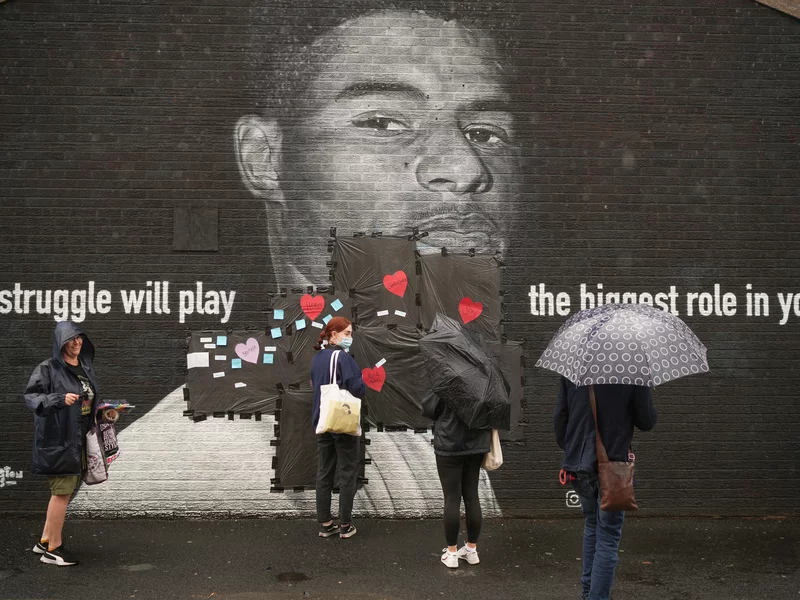
European football fans are notorious for being quite violent at times. With such an aggressively charged macho atmosphere surrounding the sport, it’s easy for passionate crowds to erupt into thuggish mobs. For star black players, football spectators channel their anger towards them for anything from missed goals to lost games. Take the 3 black players for England’s Euro 2020 team, who faced racist abuse after their loss to Italy in a shootout. When also taking into account the fierce nationalism which pervades the realm of football, populist rhetoric can effortlessly take root among amped-up spectators.

A defaced mural of Marcus Rashford is covered with supportive messages against his abuse following England’s 2020 Euro loss. Source

Populists love their dichotomies. The us versus them dynamic is integral to the populist ideology; denoting a clear enemy of the cause. It makes sense then why the “Donald Trump of Portuguese Football,” Bruno de Carvalho, used this binary rhetoric during his tenure (with the addition of some colourful language). De Carvalho rose to prominence thanks to his fiery personality and disdain for the old guard, echoing many other eminent populists. Thankfully the aggressive president-fan was ousted in June 2018, but his presence as the head of Sporting CP serves as an insight into how populists make names for themselves and take root in the football world. 

Bruno de Carvalho, the “Donald Trump of Portuguese Football.” Source

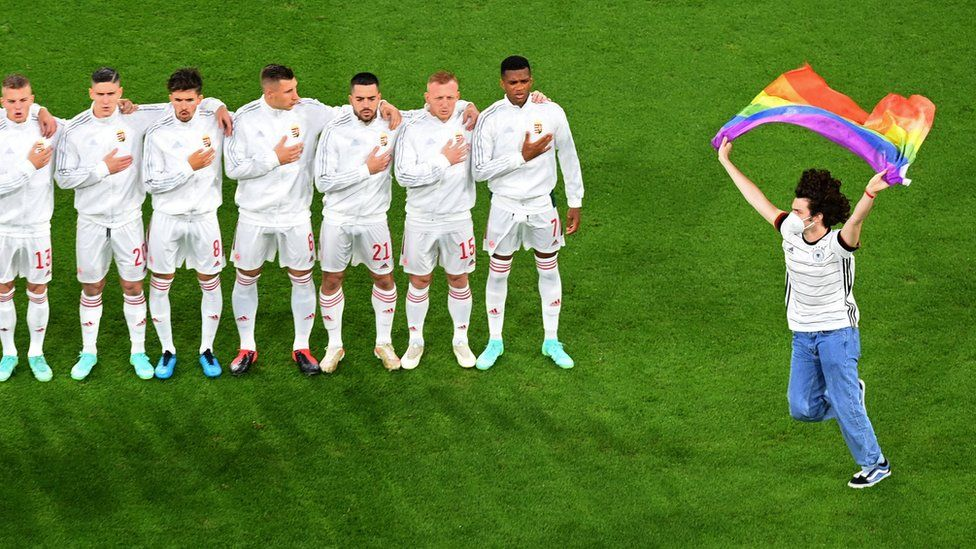
The purpose of football has evolved past solely kicking a ball around and scoring goals for amusement. In Hungary under the auspices of Viktor Orban, it has become a political tool. With every match that takes place on a Hungarian pitch, he pits his illiberal democratic values against the liberal democracies of western Europe. Because of his presence at matches in Hungary, football has become a meeting place for populist politicians and businessmen who are supportive of Orban. It has also become a place of populist rhetoric dissemination among the spectators, resulting in homophobic chants.

A fan runs on to the field protesting the Germany-Hungary Euro 2020 football match. This match took place in early June of 2021, shortly after Hungary’s legislation of anti-LGBTQ laws. Source

Football in Europe and right-wing populism go hand in hand. In the modern age football has evolved into a platform for political discourse, which has been co-opted by populist fans. As much as the governing agencies try to discourage its games from becoming political arenas, there is nothing that can be done other than actively recognizing and combating the issue. Holding an apolitical stance will do nothing! Overall, the need for the football to populism pipeline to be recognized is at an all time high while Europe is threatened by populist leaders. Maybe by shutting it, we can make a significant change down the line.