I find Kalmar’s (2020) four steps of mainstream anti-Islamic populism to be a very helpful explanation of the phenomenon, although it is somewhat unsettling that mainstream politicians like Viktor Orban can descend into racism and xenophobia by following a few simple steps. What struck me was a parallel between the sanitization of racist rhetoric in contemporary cases like Hungary and those of late-20th century far-right movements like the British National Front.
According to Kalmar, the “sanitization” of Islamophobic rhetoric through the rejection of antisemitism allows populists to promote Islamophobia openly without the fear of being labelled Nazis. In the Hungarian case, the “Soros Myth” could be unapologetically touted by Orban and Fidesz, despite it’s antisemitic nature and roots in the Elders of Zion conspiracy theory of the early-20th century.
The National Front in 1980s Great Britain also voiced their anti-antisemitism through a statement issued to a Jewish organization, stating that they accepted Jews into their organization and were explicitly opposed to anti-Semitism (Bland 2020, p.121). Perhaps this was also a measure to deflect accusations about being Nazis and shield their xenophobic and ethnocentric rhetoric. Bland explicitly states that neofascism and neo-Nazi ideas were at the core of the National Front (p.109), and that they saw conspiracy theories like “Zionist Imperialism” as significant threats to Britain (p.118), demonstrating that their anti-antisemitism was disingenuous (what a surprise!). Moreover, anti-immigrant discourse was also espoused by Margaret Thatcher and mainstream British Conservatives, perhaps as a way of normalizing the rhetoric coming from groups like the National Front (p.110).
While it is unknown if Orban was aware the history of the sanitization of racist and xenophobic discourse in Europe, the fact that is being done by an increasing number of European politicians today is troubling.
A recurring theme in the lectures so far this semester is antisemitism and how it evolved through time and particularly the 20th century. This week in particular, it focused on antisemitism in Indonesia after some waves of Jewish immigration in the 1920s and the Holocaust memory in Europe that brings today a trauma of outsiders and the ongoing bad perceptions of Jews. Racism is considered to be the profound hatred and denigration of a group of humans defined by skin color and/or culture by another one or various. We could think of white Americans having racial issues with black Americans or from a more radical perspective the genocide in Rwanda of Tutsis by Hutus. Antisemitism would be a more precise definition of racism, specifically applied to Judaism believers, but one big difference that can set them apart from a normal case of racism would be the globalisation of their defamation and bad reputation. Everywhere their communities seem to go outside of Israel, they’ve had to deal with racism of some kind. Particularly in Europe, a culture of hatred towards Jews was brewed and it almost became a consensus on the continent that Jewish populations are bad, even between bitter rivals like France and Germany. When this hatred culminates in the worst genocide in History orchestrated by one of the worst regime of all time and a sentiment of racism toward that people still persist, it becomes truly concerning. In my perspective, antisemitism is in its own category that transcend racism, because it is a culture that is temporally and globally discriminated against, which seems to have no end and no logic reasons behind it in these modern times.
Former Italian Prime Minister Benedetto Craxi, Unknown Author, via WikiMedia Commons Public Domain
For the first time since the Second World War, a Socialist Party in Italy came to power with Benedetto “Bettino” Craxi as its Prime Minister in 1983. With promises of reform and continued efforts to improve the economy from a devastating recession, the situation in Italy seemed to be getting better as the Years of Lead came to a close. Corruption and scandal would rock the Craxi government, putting an end to the First Republic and giving rise to a new, populist type of politician.
We get a very depressing look at multicultural intolerance out of our readings on Europe this week. The 2015 refugee crisis was the largest such challenge since the Balkan convulsions of the 1990s and the largest of non-European stock in … a very long time.
It is depressing to see that in Hungary this was seen as an opportunity for a party with an anti-immigrant message to establish a super-majority (able to change the constitution) in parliament. The Fidesz party, under Victor Orban, accomplished this by building a populist platform targeting the EU and financier/philanthropist George Soros that could mobilize the strong socio-economic discontent in rural Hungary. Hungary’s unprocessed history of antisemitism didn’t hurt either: they were primed to be angry about “other” refugees entering the country.
The Soros Myth was clearly an important tool for manipulating the Hungarian people. The campaign included 1) claims that Soros financed the Muslim migrant “invasion” 2) an all-citizens survey on alleged non-credible instructions from Soros to the EU for smoothing the way for immigrants in Europe, and 3) ominous “Big Brother” posters showing a (very creepy) Soros face. How did this campaign convince the Hungarian people? I’d say they just wanted to believe it all. It gave them an excuse for their antisemitism, and their islamophobia – which really amount to other-phobia. And it allowed them to vent their frustrations and anger at a target that was not their own government.
The Qanon pieces this week show that it is a malign twin to the Soros Myth. The details in this extended conspiracy theory are too fantastical to be believed by a rational person. But consider people who are suffering under COVID restrictions. They don’t know anyone who has been sick, and they’ve been in forced isolation from their friends and family. They are feeling manipulated, suspicious, and angry. Once they are suspicious of a conspiracy, Qanon allows them to dig as deep as they want. But you have to “want to believe”.
This week had some really interesting topics from antisemitism to islamophobia and of course it always leads back somehow to Nazism. But until this week I had never heard about this man named George Soros who is apparently responsible for everything that is bad in the world at least in Europe. And the Kalmar article goes further in depth as to how Soros main goal is to destroy life as we know it in Europe and how he has his hand in almost anything negative that has happened in the past several years. The article written by Ezgi Guner has a somewhat lighter topic focusing on the difference between white and black Turks in Turkey. And the major differences between these two groups that have been living simultaneously in the country. Guner describes the thoughts around many Turkish citizens and their thoughts on these terms of black and white. Which in Turkey not only seems very different than many other countries but not necessarily in a bad way but more so in a step forward for equality in the country. And then we look at the Stone article and read about the EU’s unwillingness to accept refugees from the Middle East and ask questions as to why this might be. As we have seen in the past, they were more than willing to accept them after the Second World War so why not now? What are the reasons behind the EU’s reluctance to take in people who are stranded after their homes are ravaged by war and famine?
Last week, the Anna Cento Bull article introduced the related concepts of the ‘empty signifier’ and the ‘chain of equivalence’. This week, they’re everywhere. To review, empty signifiers are symbols invested with a different meaning for multiple groups through a chain of equivalence. Thus, A also means B and C so TERM X means whatever you want it to mean. Empty signifiers are necessary for populism because if a signifier (a word, term, or symbol) had a fixed meaning (if it only meant one thing), then it would only be able to capture the imagination, or represent the interests, of one group. Populism needs to be popular with multiple groups by being all things to all men. It does this by taking a term and abstracting it until it loses all actual substance, so that it can then be invested with multiple diverse significations simultaneously.
For example, the Kalmar article describes how, in Hungary, ‘George Soros’, a signifier accurately representing one very rich man, has come to signifier ‘the Jews’, Freemasons, the Illuminati, immigrant hordes, being anti-Christian, and being anti-Hungarian. ‘George Soros’ has been emptied of its particular meaning through a chain of equivalence (now this guy means all of these things), until it has been rendered a universal negative. As Kalmar says, “Orban and Fidesz blamed George Soros for just about everything they opposed” (189).
This is all pretty boilerplate European antisemitism, but the Moses article explicates a less familiar linguistic taxonomy in Indonesia. There, a complicated history of colonialism has resulted in ‘antisemitism’ being emptied of meaning and conflated with anti-imperialism and anti-capitalism. Actual Jewish people are a very, very small minority in the country, so ‘the Jew’ becomes ‘the colonist’ becomes ‘the foreigner’ becomes a rationale for violence against Chinese people.
Finally, in the Vice video about Germany, being opposed to Covid vaccinations is, through a chain of equivalence, connected to a shadowy cabal plotting to enact a new world order, which leads to antisemitism, because the shadowy cabal is Jewish, because of course it is. And herein lies the power of a movement like QAnon. It’s not ridiculous and nonsensical, it’s an infinitely big tent constructed to accommodate all of the empty signifiers in the world. It’s stupid like a fox.
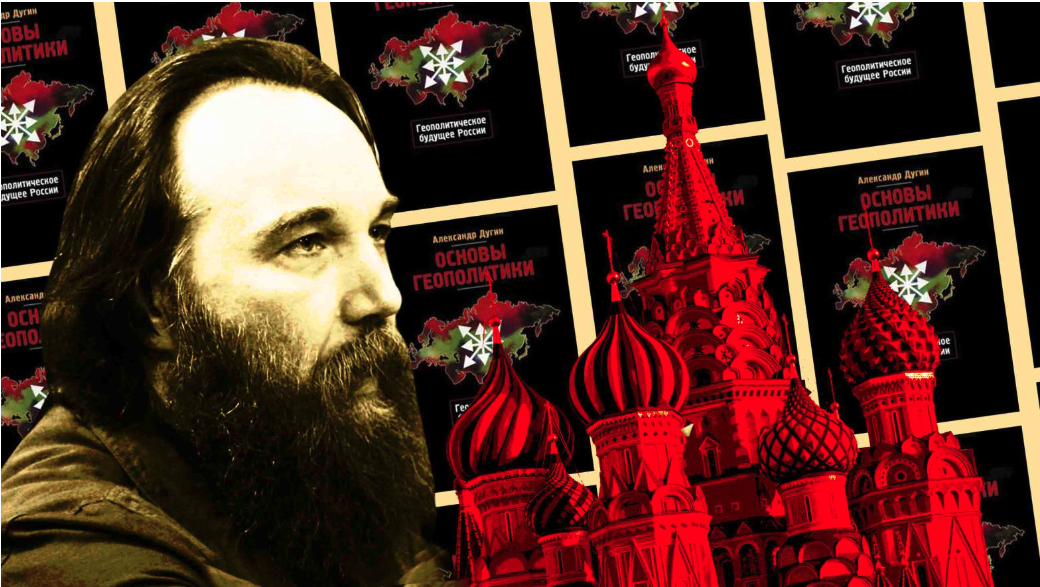
More than eight months after Russia’s February 2022 invasion, the War in Ukraine continues to be waged. Putin and a cast of murderous Russian officials continue to make headlines. But perhaps no figure is as curious as the neofascist Russian “philosopher” Alexander Dugin. His name resurfaced last August after his daughter (herself a far-right journalist) was killed in a car bombing in Moscow.
Relatively obscure in the West before Russia’s pre-February military buildup, Dugin has been a considerable intellectual force in Russia during the last two decades, advocating for a new Russian Empire built on anti-liberal and authoritarian values. But what is perhaps most curious about Dugin is that he was heavily influenced by the Italian fascist and neofascist thinker Julius Evola.
How did this Italian fascist theorist’s ideas reach Russia? How did Dugin use them to form his own political ideologies? Is there a connection between Dugin, his ideas, and Vladimir Putin?
Evola’s writings consistently denounced modern progress, liberalism, capitalism, socialism, and communism. It differed from traditional conservatism by also decrying Christianity, democracy, individualism, and the bourgeoisie – epitomized by the neoliberal USA. Evola was also a proponent of mythical Hyperborean histories of European ethnic origins. He even appropriated religious and cultural traditions from Buddhism and Hinduism to promote essential psychic and spiritual differences between “races,” classes, and sexes.
Alexander Dugin and Evola’s Ideas
Alexander Dugin was a Soviet dissident who first encountered Evola’s works in the final days of the USSR: “These readings changed my life,” Dugin said in a 2018 interview, “I had never heard anyone describe the contradictions of the modern world like Evola.” Dugin was expelled from university for “unorthodox activities,” which included the translation and samizdatpublication of Evola’s Pagan Imperialism.
Dugin remained in relative obscurity during the 1990s. But his status as an international far-right intellectual was elevated thanks to his “Eurasia Movement” launched in 2001, which claims to have a presence in 29 countries. Moreover, his ascent to academic respectability was completed through his appointment as chair of the international relations section of the sociology department at Moscow State University in 2009.
As is the case with many far-right intellectuals, Dugin’s political theories are complex and convoluted. Nevertheless, there are some major themes that can be extracted. First stated in his seminal work, TheFoundations of Geopolitics (1997), Dugin argued for the revival of Evola’s fascist idea of traditionalism: an eradication of modern, polyethnic, egalitarian, feminist, and democratic cultures, which he reduces to “American Globalism.” Dugin’s vision for Russia is of a vast, Eurasian, authoritarian empire of racially pure regimes in which women are confined to the home and breeding. Furthermore, Dugin also stated in a book to Hyperborean theory that Russia has a theological destiny to leader the “modern day Hyperborean societies” of Eurasia against the American-rule “Atlanticist” civilization.
Dugin and the War in Ukraine
Dugin’s vision for a vast, Russian-ruled Eurasian Empire rejects the idea of a distinct Ukrainian culture and nation. In The Foundations, Dugin argued that “Ukraine as a state has no geopolitical meaning, no particular cultural import or universal significance, no geographic uniqueness, [and] no ethnic exclusiveness.”
Furthermore, Dugin warned Ukraine in 2003 that embracing a pro-Western “Atlanticist model” would expose Ukraine to the menace of “gays, and homosexual and lesbian marriage,” values which he saw as threatening to Eurasian civilization. Here, Dugin applies Evolian ideas to the regional geopolitical situation.
Dugin’s ideas clearly reject Ukraine’s existence, as well as his threats against the country moving closer to the West. But establishing clear links between Dugin’s ideas and Putin is challenging, since the Kremlin is veiled in a shroud of secrecy that makes any decisive claim untenable.
It is also difficult to overlook the convergence between Dugin’s ideas and Putin’s rhetoric, in particular the claims which deny Ukraine as a distinct nation and culture. The February 2022 Invasion and the ensuing brutal war waged by Russia further reinforces the idea that Putin and the Russian Military are acting on the denial of Ukraine’s right to exist under historical, philosophical, and cultural pretexts, which itself constitutes a genocidal practice.
We can glean a few important ideas from the case of Alexander Dugin’s relation to Julius Evola’s ideas, as well as his non-negligible ties to formal Russian Power. Firstly, ultranationalist and neofascist ideas – like the ones espoused by Evola – can travel outside of their original national context. Secondly, right-wing thinkers (like Dugin) in other national contexts (like Russia) absorb and appropriate these ideas to develop their own right-wing and neofascist theories. Finally, under certain conditions and in certain critical moments, these ideas can draw the attention powerful people who use them to rationalize imperial projects and atrocious wars.
The Scott article and the Vice news video provide interesting insight into an issue that I’ve not considered until now. Qanon has been a pseudo cult like conspiracy theory for years now. Traditionally they would often only be associated with their unfounded claims on things like the existence of a global elite group of pedophiles. “Its roots date back to late 2017 when an anonymous social media user — using the name Q — published several cryptic messages on 4Chan, a platform often used by fringe conspiracy theorists and online extremists.” (Scott) However, the spreading of their influence has also led to a spread in their beliefs across the pond. As the Scott article also notes, the outbreak of Covid-19 has allowed the conspiracy to do exactly that. Many groups within Europe like the one highlighted in the Vice News video have embraced Qanon and reinterpreted it by adding their own spin on it in the form of anti-vaccination conspiracies, anti-Semitic beliefs, or even believing in Chancellor Angela Merkel being a puppet of the previously mentioned global elite. Specifically with the anti-Semitic part, this has been a trait that has remained particularly synonymous with Qanon conspiracies wherever they go. In all honesty, this conspiracy group stands testament to the fact that Societies will always have loonies, and if you give them the means to communicate easily with one another (like with the internet), they can spread and thrive in sometimes uncontrollable ways. In other words, we should tread carefully to not enable groups like these to evolve into anything more than what have seen, as this leads down a dangerous path that Germany unfortunately took in the 30’s.
The Far-Right has been around for a very long time but lately we’ve seen a rise in new tactics used by the Far-Right which is leading to the rise of the Far-Right groups and to a rise in Far-Right extremism. The Internet has given rise to the ability for people from all over the world to connect and share ideas and for people who otherwise would never have gotten the opportunity to meet one another to form online groups. This has led to a new wave of Far-Right extremists finding groups on social media and websites like reddit and 4chan. This is leading to a much more dangerous version of Far-Right extremism the likes we haven’t seen before.
The Far-Right are very different from what they were, say 20 years ago. It used to be very easy to see who was a Far-Right extremist and who wasn’t. But gone is the Skinhead look of shaved heads, combat boots and swastikas, now replaced by people who dress just like everyone else, dressed in nice suits or dresses, or regular everyday clothes. Brands like Thor Steinar capitalize on making Far-Right shirts that fit in with everyday life, even if their shirt was hateful its so hard to tell with all the secret coded language like having a shirt with ’88’ on it since the 8th letter of the alphabet is H and so 88 stands for HH which stand for Heil Hitler. The Far-Right is no longer a fringe group on the outskirts of politics they are now front and center and gaining a lot of support all over the world.
The Far-Right wants to be as mainstream as possible and always be in the public eye which is why the Internet and its far reach is invaluable to them. With more and more Far-Right politicians and groups using the internet and other platforms to spread their hateful messages the more normalized it gets in society and especially on the Internet. As the Far-Right tries and spread their message online they use many platforms which will pick up parts of their hate speech and will repost or share this message in other forums through the use of memes and various other means. This makes this type of speech seem normal and for some people especially youths this can be enough to persuade them to come to the Far-Right. This normalization of Far-Right hate speech can be very dangerous as it can and has many times led to hate motivated crimes against women or Muslims or immigrants.
Through the normalization of hate and hate filled speech by the Far-Right they have motivated people all over the world to commit horrible hate motivated crimes, fueled by Far-Right conspiracies. Many hateful groups have begun to spring up online all usually a bit different or targeting their hate towards a particular group but they are all essentially the same just following Far-Right conspiracies and using them to justify committing horrible acts. Groups online like Incels mix their sexual frustration with traditional Far-Right conspiracies, such as the Great Replacement Theory, to spew hate against women and immigrants, who they perceive to be taking women from them. People like Elliot Rodger who went on a killing spree in California in 2014, Rodger went on this spree because of his hate for women since he perceived himself to be the “ideal magnificent gentleman” and couldn’t understand why women did not want to have sex with him. Another notable Far-Right extremist is Brenton Tarrant, the man responsible for killing 51 people in two Mosques in Christchurch New Zealand in 2019. Not only was Tarrant’s attack fueled by hate towards Islam which was fostered in online chat rooms, he then proceeded to live-stream the shooting to further promote the hate towards Islam.
There are so many other examples of Far-Right extremists I won’t get into but it just shows how this hate is growing and is growing fastest online, where small groups of people with fringe ideas can meet and discuss and fuel one another’s hate. It used to take large groups of people all with the same ideas to form a strong group with the power to affect modern politics and society, but that’s what’s so dangerous about today, a small group or even a lone extremist can be motivated by online forums and videos of Far-Right politicians and Far-Right mouthpieces, people like Andrew Tate, and these small groups can do unprecedented damaged through domestic terrorism and hate motivated crimes.
European identity has a lot to do with collective memory. It’s how states like Italy and Germany came to unify, and how new states emerged within the European continent following the end of the First World War. Fast forward to the end of the Second World War, decolonization and the dissolution of the USSR, this collective memory has been diluted by years of immigration and emigration. Faced with the challenge of adapting their identity, Europe has been divided amongst their responses.
Memory also serves in determining this response. Among progressives, imagery of the Kindertransport (the rescue effort of children in Nazi-occupied territory) and Jewish refugees seeking to escape Nazi persecution are conjured. In response to the Syrian Civil war and the ensuing migrant crisis, Germany was one of the most eager European states to open its doors to migrants because it had come to terms with its Nazi past; “remembering to remember.”
Populists on the other hand in states like Poland and Hungary have not been confronted about their country’s Nazi-collaborationist history, and have thus not been able to come to terms with their pasts. Political action in these states is dependent on having immigrants as an “other.” As G.M. Tamas puts it, “only racism promoted by the state can persuade people to vote for the ‘dismantling of the few remaining elements of social services and social assistance.’” Through this rhetoric, we see groups like QAnon take root in circles with already similar thought processes.
The myths surrounding European identity buckle in the face of postcolonialism and mass migration because they were created by “othering” foreigners more so than engineering their own identity. It’s a lot easier to say “you’re not me!” to someone who looks and speaks a different language from you than to instead stop and question yourself, “who am I?”


 Hate 2.0

You must be logged in to post a comment.