Giorgia Meloni and the center-right coalition at the Quirinal Palace, Quirinale, via WikiMedia Commons
On October 22, 2022, Giorgia Meloni, leader of the far-right Fratelli D’Italia party, became Prime Minister of the Italian Republic. Based on a platform of anti-establishment rhetoric and populist nativism, Meloni’s coalition would take 44% of the vote— a resounding majority compared to her leftist opponents. As of yet, it is too early to determine Italy’s future under the new PM, but it will certainly be a blast to the past. As the phase of full populist transition ends, the battle for a new Italian identity begins.
FdI ORIGINS
Fratelli D’Italia (or Brothers of Italy) emerged primarily from two neo-fascist Italian political parties: the Movimento Sociale Italiano and the Alleanza Nazionale. The party itself is relatively new having been founded in 2012, touted by Meloni as a “new party for old…
It’s so infuriating to see right-wing populists creating the idea of “gender ideology” as just another weapon for stoking fear in the general population and thus mobilizing support for themselves. We can identify it readily as yet another “empty signifier”. As usual, it’s a label designed to manufacture anger and division. By opposing LGBT ideas with the normal operation of the family and the state, anti-gender initiatives become nationalist ones. This nationalist link (you are a danger to Poles if you’re not also Catholic and heterosexual) is even more strained than the argument that immigrants threaten the nation. But, similar to anti-immigrant campaigns, anti-gender campaigns also villainize real people.
Gender ideology’s headline enemy is LGBT people and their freedom: they get most of the vitriol. They are the most obviously different; they are labelled usefully as un-natural. But as the right identifies the heteronormative family as the intended victim of dangerous “gender ideology”, it also attempts to limit rights in such a family. Reproductive rights –contraception and abortion – are opposed, and male dominance is supported. These views get to ride for free on the “gender ideology” train.
Several of the articles observed that anti-gender arguments characterize “gender ideology” as a form of totalitarianism. Say what?! Ignoring the fact that there is no actual ideology… they emphasize its claimed non-democratic character: that a minority would impose new constraints on the freedom of the general population. Clearly – at least to some – the opposite is true.
Italian Customs boat enters port in southern Italy with Syrian Refugees, UNHCR/F.Noy, Copyright
Spurred on by widespread unrest within the Arab world caused by the 2011 Arab Spring protests, the Syrian Arab Republic was flung into a brutal civil war in early March of the same year. Until the breakout of the Russo-Ukrainian War, the Syrian Civil War would be the source of the largest refugee crisis in human history since the Second World War. With large amounts of majority Arabic, Muslim immigrants crossing the Mediterranean into Italy and Greece, a chain of events would unfold leading to an explosion in populist rhetoric within the EU.
A DECADE OF CRISIS
On entering the new millennium, the geopolitical landscape of the Mediterranean would change dramatically. Dictatorial regimes like Ben Ali’s in Tunisia and Qaddafi’s in Libya would be overthrown with the Arab Spring— with Al Assad’s regime seemingly…
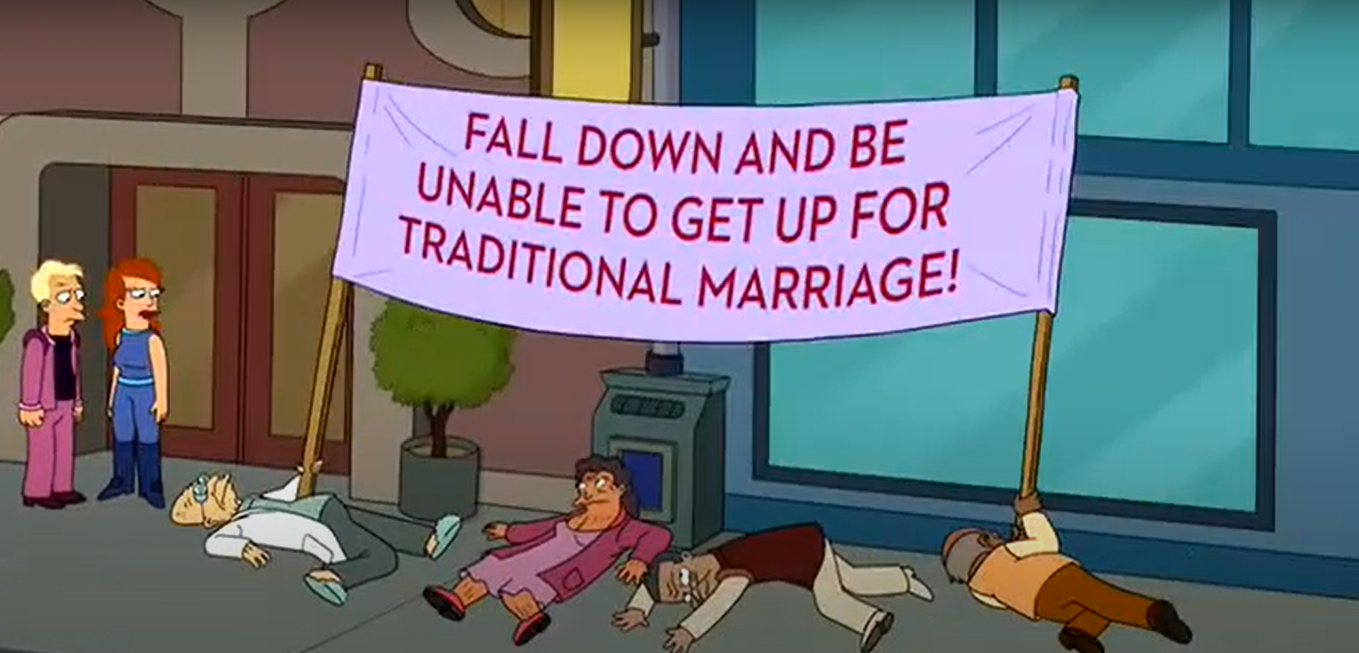
“Of course the Catholic Church started it, of course they did. I shouldn’t even be surprised.” -Me, about 90 minutes ago
Source: Futurama, Season 6 Episode 4, “Proposition Infinity”
The Paternotte/Kuhar article shows that modern anti-gender campaigns originated from the Catholic Church in the 1990s. The Church created a fictional dichotomy between a “culture of life” represented by themselves and a “culture of death” represented by feminism and the LGBT+ community. Despite being a Catholic thing, this idea quickly spread transnationally. However, there is still a potentially Catholic-inspired anti-semitic angle to it, as we see in Hungary with the Peto article. There (and presumably in other countries too), gender is viewed as coming from universities and primarily from the Central European University, which was established by George Soros. Last week, the readings discussed how the use of Soros as a scapegoat was an anti-semitic distraction from actual government corruption under Viktor Orban. This reference to Soros is no different, and really the whole thing smells of smoke and mirrors.
Both the Paternotte/Kuhar and Butler articles note that anti-gender campaigns accuse the LGBT+ community of being pedophiles, and gee I wonder why the CATHOLIC CHURCH would do that. Maybe they use those accusations as a distraction from their own actions? This rhetoric can also be used to strengthen the Church’s position by embedding it in religious freedom debates, anti-colonialism, moralism, and national cultures, as most of this week’s articles point out. Somewhat separate from religion is the aspect of Holocaust memory brought up in the Zuk/Zuk article. Here, we see Polish politicians and clergy equating abortion to the Holocaust, which is evidence of Eastern Europe’s failure to come to terms with the Holocaust, as discussed in previous weeks. It also fits into the anti-semitism of the Soros conspiracy.
I believe the question of European identity failing in the wake of a postcolonial society can be boiled down to a push by many (not all) governments and their respective medias to reflect a more utopian society, one that is more multicultural and representative of a wider population than what the majority is still composed of. This challenge however is that it only shows one face of a two sided society, the opposing side to this push in mass migration is just as if not more active and is only given mass attention during times of crisis, even though their extreme views and actions are still done in an everyday setting. Take Atilla Hildmann’s initiative towards spreading conspiracy theories along with anti-semitic rhetoric, the way Hildmann approaches his work is of an identity that is rooted with extreme nationalistic views.
There is an attempt to tie back to a past that is more sought after, and can be more blatantly seen in countries such as Turkey where there was once a high level of white colonial interference that there is still a present day modern yearning to see Turkey in a white context. Politically the White Turk and Black Turk as is described in Güner’s article, are pitted against each other a tale of the working class vs the elite, and in history’s case a white supremacy. Both progressives and populists use narratives like this in their own political agendas as it is an aspect of history that has affected all nations in some regard, with the main difference between the two political sphere’s is either using this as a way to bring about change or going against it. Ironically both wanting to create a way of uniting a prospective group of people, it is just done so in fundamentally different ways.
Coming out of the major scandals that rocked the Christian Democrats and Italian Socialists, an unlikely political outsider takes the reins of Italy in the 1994 election: Silvio Berlusconi. Poised on bringing populist politics into the spotlight, Berlusconi and his centre-right coalition Forza Italia would prime the Second Republic to be a conservative European stronghold. Along with the official formation of the European Union in 1993, Berlusconi’s populism would prove to be beneficial to fellow conservatives later down the line…
POST-FASCISTS BACK IN FASHION
Berlusconi’s Forza Italia party was the main point of a three-party alliance which also included Lega Nord and the Alleanza Nazionale. These radical right-wing parties were strongly associated with the new Prime Minister’s anti-elitist and anti-corruption platform. Most notably, Alleanza Nazionale is the direct successor of the old postwar…
A key part of the VICE interview that I felt was only briefly touched upon were the reasons behind the growth of QAnon in Germany in particular. If Germany hosts the second largest QAnon group, the feelings of isolation due to COVID seem insufficient in underlining this growth, as this was certainly not exclusive to Germany. A point made early in the documentary suggested that German disillusionment with the pandemic was especially present because Germany was relatively unaffected (keeping in mind that this documentary was made over two years ago, when the second wave had not yet occurred). Once again, this hardly seems exclusive to Germany, with some other countries having even fewer cases. Perhaps the most appealing suggestion is that QAnon is good at including their rhetoric into local causes, which leads to the understanding that somewhat similar movements were already booming in the country. Still, it is impressive (and scary) to consider the effectiveness of QAnon in co-opting local rhetoric to garner support.
In a similar sense, the examples of Indonesia and Turkey have shown examples of where the importing of racial biases from abroad have been effectively shifted for a local audience. Especially in Turkey, which took American racial terms and instead shifted them towards religion and culture. Similarly, the imported “real antisemitism” in Indonesia perhaps represented the effectiveness of European Nazis in propagating their ideology abroad. I feel both of these cases kind of bring further discussion to the assessment that while populist and fascist movements are inherently local, local ideas can be adapted abroad successfully.
This weeks reading looked at how European identity deals with the changing dynamics of the 21st century and the issues that come of it. The notion of European exceptionalism, one that was seemingly put to bed following the rise of the USA, had begun to rise once more in the face of modern issues.
The media prescribed this week had two different pieces of content about “Q” and the conspiracy that surrounds it and how it has morphed in Europe. The conspiracy has become more global in scale while keeping Trump and the American cause in the centre. It demonstrates how fringe groups in Europe have begin to look to the Untied States for support, this flys in the face of what we would assume European nationalist would want. By this the citizens are looking to be culturally colonized as they see the answer to their problems (migration, elites and covid). The subversion of the dominant European and be seen in the turkic activities and identity in Africa.
In Africa, Turkey looked to move in and be a leading investor and help in development. Turkish politicians use the malleable identity of being European without being taken as a white Westerner. This is seen in the quote where the African politician says to the Turkish politician you look white but you act black, saying as if you have air of European well acting as an African. This malleability of the European identity allowed for Turkey to be accepted as a nation that looked to help Africa more than other European states.
Like previous videos that we’ve watched in this class, the video on Qanon in Germany interviewed people who were close to or even directly involved with the conspiratorial, Far-Right leaning movement. When individuals were asked why people joined this movement, many outsiders noted the idea of gaining control over uncontrollable circumstances. While I think that there is some merit to the argument that feelings of control/lack of control can be mobilizing factors, I think that there is a deeper issue going on here, especially after reading some of the other readings on the subject of xenophobia and Far-Right Hate. The Stone reading, which highlighted the role of collective memory in dictating responses to current crises, is applicable here. Throughout the video, the anti-vax, anti-mask protesters made numerous visual or oral references or parallels to Germany’s nazi past, presenting COVID-preventative measures as a style of eugenic, authoritarian plot. For them, this is evidently a morally motivated movement that draws heavily on the idea of preventing history from repeating itself. While the idea that these preventative measures are anywhere close to a fascist dictatorship is, as the video makes clear, ludicrous, I think that it represents an attempt to distance themselves from the fundamentally antisemitic conspiracies they push and therefore “validate” their involvement. They see their motivations as being “civic” and hinged on “protecting” people (especially the vulnerable like children) from a shadowy authoritarian government or secret society. In their eyes, this makes their movement incompatible with hate, or, at the very least rationalizes it for them in a sort of “greater good” situation. It prevents them from seeing the antisemitic origins and impacts this movement has and thus they continue to involve themselves in it. Overall, by coupling this sort of moral argument with imagery of preventing another genocide/authoritarian regime, they distance themselves from any type of critical thought about their actions or blame for them.
While the subject of race has been discussed a lot within our seminar, I was really struck with the malleability of racial identities in this week’s reading. Previously we discussed how Jewishness in far-right rhetorics could be transformed to encompass whatever flavour of anti-semitic conspiracy was most resonated with a national population. A similar flexibility is visible in Güner article in regards to whiteness in Turkey. It’s interested that just last week we discussed anti-turkish violence in the context of anti-immigration and anti-multiculturalism sentiments in German, where this week they become associated with Whiteness as a way to legitimize their “development” in Sub-Saharan Africa. Turkish Whiteness seems to be entirely relative to who they are surrounded by – being white enough to be associated with Europe, yet still not white enough to actually be European.
A similar malleability is visible in ideas of race and Jewish identity in Moses article, where Indonesian anti-colonialism sentiments surrounding Europe and Israel became interlocked in acts of anti-Chinese racism. While it may seem strange to associate Jewish people and Chinese populations, invoking ideas of anti-semitism global conspiracies seem to have less to do with an actual dislike for Jewish people and more so as a justification for violence against Chinese populations. This isn’t the only example of where a false association with Jewish people was used to imply the threat an ethnic group posed to the national population. In England’s interwar era, a similar conspiracy of a Jewish-Irish alliance was evoked by fascist parties like the League of Fascist and The Britons to showcase the threat of an independent Ireland to empire and as justification to re-conquer the nation.
I’m not entirely sure how these ideas connect with some of the other readings/videos this week, but I think the malleability of identity, especially around social constructed categorizes of race, will become an important theme in examining European identity in regards to mass migration and de-colonial movements.




 Hate 2.0

You must be logged in to post a comment.