The thin line between Populism and Fascism

In this weeks readings we looked at media that discussed fascism and populism, these articles and one podcast looked to define and explore how these ideologies occur. What stuck me as I read each article was the overlapping terms, especially when discussing the group each ideology was representing. Mudde states that the group that a populist is representing share common ethnic, religious or class identities that often over lap. This can be related to Paxton’s view that fascist leaders look to lead a group that is a majority and looks to “other” minorities in the state. Though Mudde doesn’t outright state that populist leaders look to the majority population to seek a cultural basis it is stated that populist look to create one group that leads the state.

I read the Anatomy of Fascism first and what struck me as I read portions of the chapter was the striking similarity to what has been called illiberal democracy. Where Paxton describes how fascist leaders lack a set public agenda/program, it struck me that is seemed very similar to hoe Viktor Orban wanted Hungary’s political system to be shaped like. This similarity was confirmed by Paxton as he showed data that had Hungary as the state that voted the most for populist parties (one party).

There is though a line that divides these two ideologies. Most importantly fascism and fascist movements have a violent undertone to their message that often threatens or delivers violence if their agenda is not meet or just to meet said agenda. This differs from populist movements that thrive in a quasi democratic space, where they control the levers of power while still offering an illusion of choice. Populist as described by Mudde aren’t populist first, they normally have a stronger more concrete ideology that guides their larger policy. They using populist thought and practice to garner support and create smaller more distinct policy based on the specific nature of their populist movement (anti-latin American in the United States vs anti middle eastern policy in Europe). This is juxtaposed to the firmly fascist governments that proclaim that as fascist they have risen above other ideologies to understand a superior movement.

In summation, fascism and populism share similar traits, ideas and aspirations but the methods in which they look to achieve them are different. As populists look to work within the confines of some democratic process versus the fascist approach as succeeding in their goals at whatever the cost, whether that includes violence or not.
Introduction post

Hello everyone,

My name is Louis and I am a fourth-year student in a History major. I find 17-20th century Europe to be quite interesting and took a lot of classes that turned around that continent. The Khans of Mongolia are also a subject that captivate me as they conquered and ruled Asia and parts of Europe for hundreds of years. I enjoy reading a lot for school, but also fantasy novels. It is my first semester on campus so I am excited to get this year going!

Introduction

Hi everyone! My name is Megan MacRae and I am a fourth-year History and Law student. Even though I am coming to the end of my degree, I have yet to technically ‘narrow down’ my specific interest in History. However, I do particularly enjoy the history of brewing (beer), pre-colonial African history, and Indigenous history.

When I am not studying, running various clubs at Carleton, or working at the Beer Store, I choose to spend my time reading, finding new coffee shops to try, and hanging out with my boyfriend’s cats, Peter and Nico! I am also a Residence Fellow here at Carleton this year so I am predicting quite a busy, but exciting, final year of my Undergraduate Degree!

I am looking forward to informative conversations and exciting interactions with you all over the semester!

Cheers!

Chapter 1: Defining Terms

By: Hannah Long

In general we as humans love to categorize and give things labels, it is an ability that allows us to recognize patterns and features that are collectively shared. In a political sense it allows us to come to an agreement on what characteristics a specific ideology should have and how those who adhere to it are expected to behave. This becomes all the more crucial when analyzing stronger political views that influence governance more deeply.

While, the importance of differentiating between terms such as authoritarian, populist, and fascist should be clear cut, that is farther from the actual truth. In this week’s readings, I realized how simply defining any given political sphere is a complex mix between our own personal opinions as well as textbook definitions. As the word populist was thrown around so much in 2019, Brubaker explained how it’s not just a lazy journalistic cliché (Brubaker, 2019), but rather as a result of the growing link between media and politics. As many governments have become more direct in their responses, making the word more common in ideological discourse.

I found Brubaker’s points provide a very clear discussion of populism as both a term and ongoing phenomena that has and is still a hot topic due what he describes as the perfect storm of political and social issues happening all at the same time. Likewise, Paxton discussed the rise of fascism in the twentieth century as a label to differentiate itself from the pack (Paxton, 3). The term itself is almost so analyzed and discussed that the set of characteristics that make up the word fascist can never really be shaken from it, or mistaken for another political ideology unlike populism has been and maybe will be for a time to come.

With populist having become the new controversial label many seek to avoid, I wonder if in the coming years we will see a trend of using different words and ideological spheres to define such a broad approach.

Rogers Brubaker, “Why Populism?” NUPI Podcast (51 minutes).

Robert Paxton, The Anatomy of Fascism (New York, 2004), pp 3-23.

Nupi. “Podcast: Why Populism? Why Here? Why Now?” NUPI. Norsk Utenrikspolitisk Institutt. https://www.nupi.no/en/news/podcast-why-populism-why-here-why-now.

Introduction!

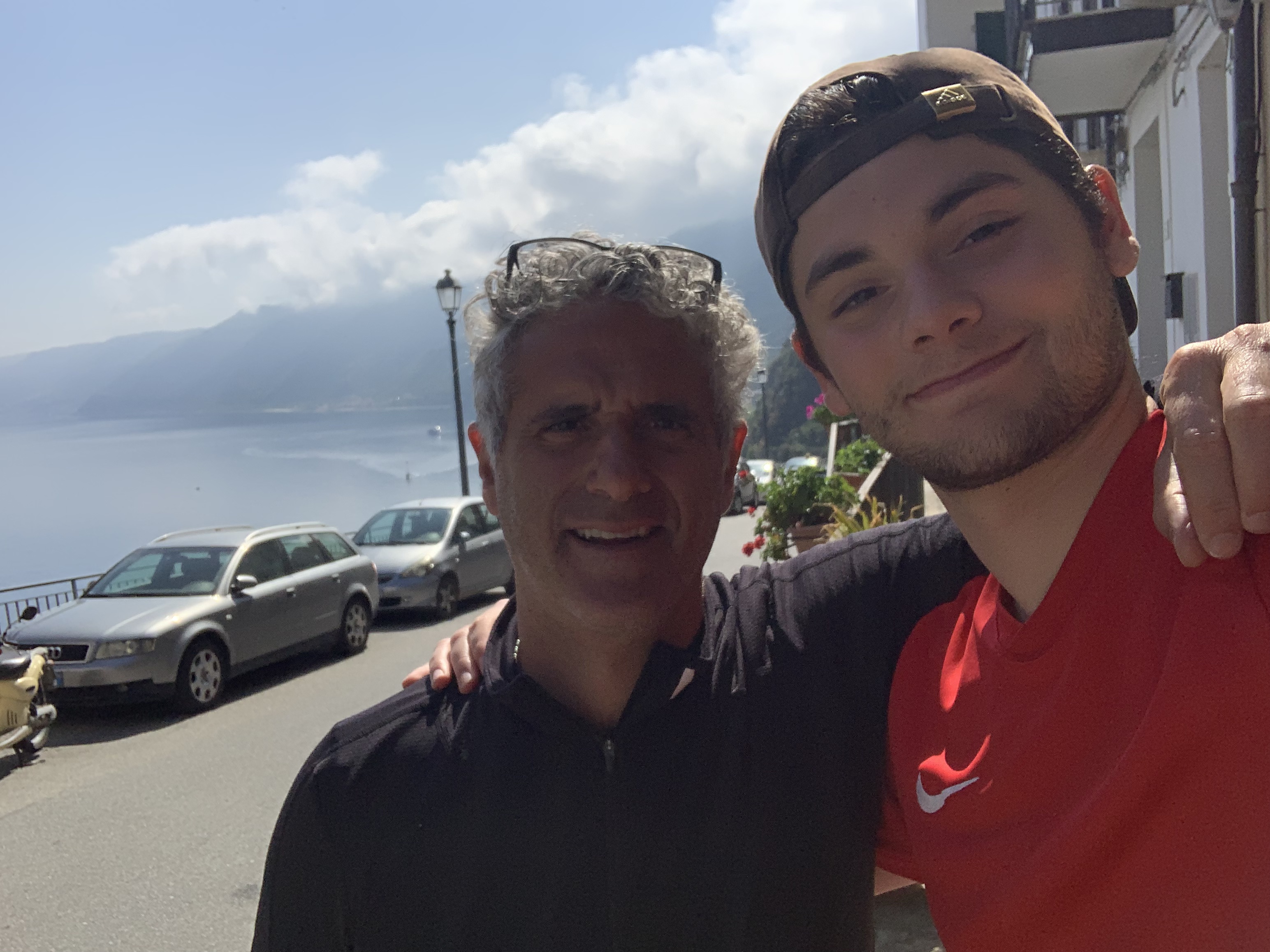
Hello everyone! (I saw people posting pictures so here is me and my dad in Scilla Calabria)

My name is Francesco (one of the students that was late to class last week) and this is my introduction. I am a fourth year student at Carleton with a major in history and a minor in archeology as I stated last class. My interests are primarily centered on ancient history (focused on the history of societies that thrived in the Mediterranean, such as Egypt, Greece, Rome, and Persia) although, I also have a large interest in physics courses that discuss planetary astronomy. I am very excited to take this class because it seems like a great place to challenge my issues with social anxiety that I have never really gotten over.

Looking forward to the year!

Introduction

Hello class! My name is Frank and I am a third-year MA student at the Institute of European, Russian, and Eurasian studies. My research interest is 20th century Russian cultural history, but I am also very keen to learn about other histories to study issues and topics through other disciplinary lenses. Populism and Authoritarianism are two ideologies which are unfortunately becoming increasingly salient in our political and cultural climate. I have learned about them in other European history courses as topics. However, I have never taken a course dedicated to their study that analyzes them from a transnational perspective, which is why I am looking forward to doing so in this course!

Defining Terms

I appreciate the notion, important in the Brubaker lecture and echoed elsewhere that Populism can be seen as a repertoire of elements by which to gain political support. Not a fully formed ideology on its own, it is first a style of democratic politics which can be deployed by parties of any ideology. This point it important in Mudde, who sees Populism as a “thin centered” ideology (contrasting to full ideologies such as liberalism, socialism or communism) as it only “informs” policy rather than representing a worked out system.

In Finchelstein’s view, populism re-emerged after WWII as a step back from fascism. I wonder whether fascism was shunned in other polities because its major proponents lost the war? Or was there actual revulsion at the centrality of violence in fascism (by Finchelstein’s definition). Paxton thinks fascism is also characterized by a romantic notion that the leader is in “mystical union with the historic destiny of his people”. Is such an exalted self-image of a people (and a leader) a good fit just anywhere? A combination of the latter two feels like the best explanation.

I got a new insight on the meaning of the Elite enemy in populism from Mudde’s discussion of re-politicization. In addition to the neoliberal globalization and mediated understanding of news, Mudde introduced the “rise of undemocratic liberalism”. When controversial issues like abortion and capital punishment become enshrined in law, they are “taken out of the political, most notably electoral, arena”. Immigration, and European integration are other excellent examples: mainstream political parties supported these, in spite of reservations by large portions of the electorate. Technocratic decision-making, and TINA (there is no alternative) arguments are part of this infuriating mix.

History as a Conceptual Tool in Defining Populism and Fascism

by Kaileigh La Belle

The objective of Brubaker, Finchelstein, Mudde, and Paxton in this week’s readings was to identify elements, processes, and in some cases definitions of Popularism and Fascism that are more nuanced and functional. Ultimately, I was struck by the two distinctive approaches to conceptualizing these terms, each relying on historically recognized fascist and populist movements and thought to different degrees. For Finkelstein and Paxton, history served as a point of reconnection and starting point for their characterizations, respectively. Meanwhile, though not entirely divorced from history, I felt that Brubaker and Mudde positioned these terms as frameworks that could be applied to historical scenarios. 

With the centrality of specific historical moments and movements in half of these works, I found myself reconsidering one of the undercutting concerns in each of the four articles: the emotionally-charged, unnuanced uses of terms like Populism and Fascism that these authors reject. Initially, I felt that focusing too closely on history would limit our understanding to how fascism and populism manifested in specific contexts, rather than embracing the models used by Brubaker, which position the definition as a template. Additionally, many authors noted how emotion complicates our definition. Again, I initially felt that history, being highly emotional, also risks perpetuating emotionally-charged usages. However, as I read through Finchelstein and Paxton’s works, I began to notice how looking for criteria in historically established movements provides a much more holistic perspective. For example, Finchelstein was able to identify the difference between theoretical Fascism and Fascism in practice. And, in making this distinction, I feel that we can have more specific and accurate definitions of these terms. 

Ultimately, considering the complicated nature of these terms and the almost paradoxical ways they can be defined, I do not believe that we can solely define these terms through history. I do believe that it can be a useful tool. As such, I continue to ask myself: is there a way to accurately blend abstract theory and historical fact? 

Sources:

Brubaker, Rogers. “Why Populism?” NUPI Podcast. 2017.

Finchelstein, Friederico. “Introduction: Thinking Fascism and Populism in terms of the Past”
in Federico Finkelstein. Fascism to Populism in History, 1-30. University of California
Press, 2017.

Mudde, Cas. “Populism in Europe: An Illiberal Democratic Response to Undemocratic
Liberalism.” The Government and Opposition/Leonard Schapiro Lecture
2019. Government and Opposition. 2021: 1-21.

Paxton, Robert. “Introduction.” The Anatomy of Fascism, 3-23. New York, 2004.

Fascism vs Populism: Differentiated by Violence? By Lauren McCoy

For this week’s reading response, I wanted to take a closer look at the relationship between populism and violence. Within his chapter, Finchelstein argues that while populism is the successor of fascism in the post-war context and possesses many similar features, its rejection of violence is critical in understanding how it differs from fascism. This disassociation between populism and violence is further visible in the other material for this week – while Finchelstein and Paxton both identified violence as a key part of fascism, neither Mudde nor Brubaker mentioned violence in their description of populism.

While I agree that top-down violence is a critical feature of fascism, I am confused about how populism could be seen as non-violent. Combining Mudde’s Monist understanding of “The People” and Brubaker’s emphasis of populism as fueled by a (economic, cultural, physical) protectionist narrative, it’s easy to imagine how this type of rhetoric could both scare and empower “The People” to act against the perceived threat. This is especially the case since this minority “threat” is considered illegitimate within a populist understanding of citizenship, negating their right to protection. Potential examples could include the violence against Muslim populations under Indian Prime Minister Modi and white terrorism in the United States – where violence is legitimized by the perceived threat posed by minorities against “true citizens”.

While these acts of violence are not the same as the institutionalized violence conducted within fascist governments, I do not understand how you could consider populism as unrelated to the violent consequences of its rhetoric.

The Circle of (Political) Life by Aimee Brown

I’m going to use a metaphor from one of those bloodthirsty Discovery Channel nature shows. Fascism is the lion. It sees the wilder beast (democracy, work with me here), runs it down, and tears its guts out. The lion only cares about other lions, it thinks that it is totally justified in doing whatever it takes to keep lions on top of the food chain, and it enjoys murdering that wilder beast. Violence is beautiful and democracy exists to be dismembered (Paxton, 41). Populism is the hyena. The wilder beast was already down when the hyena showed up. It isn’t dead, but it looks pretty sick. If it weren’t already sick, the hyena wouldn’t have been able to feed on it. Populism doesn’t hunt democracy down to destroy it, it’s a symptom of democracy’s pre-existing problems of income inequality and democratic illegitimacy (Finchelstein, 5).  And frankly, the hyena is not totally wrong about the whole “people versus the elites” interpretive paradigm. The elite are a mostly-closed group of the affluent and privileged who engage in the depoliticization of politics by shifting some political issues into the realm of law and declaring others to be beyond debate. (Mudde, 581). Where the populists tend to run into trouble is in their definition of ‘the people’. Populists do not like diversity and, for them, ‘the people’ is always a homogenous group which should have absolute democratic power as the majority, regardless of minority concerns. The hyena can still be deadly. And as long as the wilder beast is sick, it’s not going anywhere.