What is the Appeal of Fascism? A Gender Roles Approach

While we all know the classical story of the basic stuff that attracts people to Fascism. On the surface level its all about securing Arian supremacy for white, blond hair, blue eyed individuals. However I feel that it goes a little deeper than that. The first line of the Kühne reading provides some immediate insight into this. “Nicknamed “bloody Walter,” SS Obersturmführer Walter Hauck embodied the Nazi ideal of manly toughness.” (Kühne, p. 390) Nazi soldiers would certainly have been expected to be “manly” and “tough”, and its entirely possible that this has evolved to be expected of any kind of fascist, not just the Nazi’s. The problem with this is that this idea is not necessarily uniform across all walks of life. “for example, generals as opposed to the rank-and-file, war volunteers as opposed to draftees, soldiers as opposed to civilians, blue- as opposed to white-collar workers, black as opposed to white men, Jewish as opposed to Christian men—may adhere to different masculine norms.” (Kühne, p. 395) With this in mind, it might be generalizing to say that all fascists seek to be “tough”, or “manly”. However, I think an argument can be made that fascism seeks to enforce masculinity for men, and femininity for women, which for those who prefer the traditional family structure of a male dominated household, that might create some appeal to those individuals. “Men in the Freikorps radicalized common Western and German norms about male self-control, as well as about cold, tough, and “hard” masculinity, into a perpetual war against women and femininity—especially against femininely coded desires for domesticity, tenderness, and compassion within men” (Kühne, p. 395) The quote makes it abundantly clear that fascism would appeal to men who seek dominance over women. That said, while this post has focused on masculinity and femininity, it does make me wonder what other factors affect why fascism might appeal to certain people? Of course I have no doubt it will be covered by one of my classmates in their posts!

Thomas Kühne, “Protean masculinity, Hegemonic Masculinity: Soldiers in the Third Reich” Central European History Vol 51, Issue 3 (September 2018): 390, 395.
The Appeal to Fascism

Jacob Braun

With my preconceived notions that fascist dictatorships were normally rigid, totalitarian organisms that kept a watchful eye on all state activity, it surprised me how much agency it afforded to citizens that were members of the party. Fascism in this sense is flexible and pragmatic; willing to change the definitions of certain constructs or look the other way if someone’s actions would result in the furthering of their cause. Look at the Nazi approach to the concept of masculinity for example— Walter Hauck’s photos in the Kühne article demonstrate this. Although the Sturmabteilung (SA) banned males from pushing baby carriages, the Nazi government’s approach to this act was less restrictive, as they believed the pride of being a family father nurtured masculinity. Extrapolating from this, the main appeal of fascism (at least to those in charge) was that anyone and anything could be a tool of the state, and if they weren’t they could make them so.

Additionally, this attitude towards the furthering of the nation would extend beyond the Second World War into the Cold War— under Francisco Franco’s dictatorship in Spain. Through the usage of propaganda portraying the state as strong and prosperous under fascism, the Spanish economy saw growth via a tourism boom. Although the influx of tourists would undermine his dictatorship and promote the urge for democratization, Franco was able to effectively prolong the existence of fascism through cultural instead of military means. Overall, the appeal to fascism is its malleability to whatever one’s cause may be.

Question of Agency

By Lauren McCoy

            Considering the oppressive nature of fascist dictatorship, the agency demonstrated in this week’s material surprised me. Although this was limited to those who were considered legitimate citizens or within the “in-group” of fascist ideology, certain segments of the population seemed able to maneuver and negotiate the restrictive ideologies that, looking only at the strict policies of their government, would seem impossible in theory. In doing so, these citizens are offered a degree of flexibility in their actions, allowing them to challenge or contradict official mandates in a way that the “out-group” was not able to. This is best demonstrated through the leniency towards queer Aryan women or the tolerance towards men who failed to meet the masculine ideal of the super-solider – while opposing gender roles was officially discouraged, there was a grey zone citizens could operate within without evoking the anger of the state.

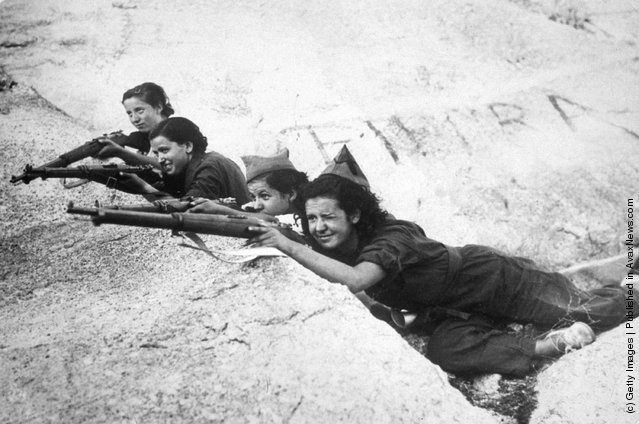
By extension, these citizens were able to manipulate official mandates to their own advantage. The Blue Angels reading by López and Sánchez illustrates this idea well. While some women fought as Republicans in support of Franco, there seemed to be several instances where women utilized the Republican movement to their own advantage – including Carina Unciti, who was spurred to create the Auxilio Azul Marı´a Paz organization in retaliation for the death of her sister Maria, or the female Catholic organization whose main concern was to protect the clergy from violence during the conflict. While the reading does not go into much detail about their personal beliefs, it is possible that these women were motivated to side with Franco because of what the Republican movement could offer them (i.e ability to act against the elements of the Nationalist movement that they opposed) just as much as their personal investment in his extremist ideology. The Marhoefer reading illustrated a similar idea. Neighbours were able to use Gestapo to their advantage for personal grievances and prejudices, ignoring official interest in persecuting Jewish people to report queer women, a group not formally targeted by the government. It seems clear that there are multiple reasons individuals supported (or at the very least remained complicit) to fascist dictatorship beyond ideology alone, including how their personal interests could be enhanced by the movement.

The place of the feminine under fascism

By Jim Dagg

My thoughts on the readings this week are primarily reflections on the feminine under fascism. It’s easy to observe that the male is dominant in fascism – even more so than under other systems. So, beyond baby-making and child-raising… what place does the feminine have under fascism?

Two of the readings – “Protean Masculinity…” by Kuhne and “Blue Angels…” by Lopez/Sanchez provide very interesting insights. The latter shows that during the Spanish Civil War, fascist women sometimes played non-traditional roles – in espionage, sabotage and organization. Paradoxically, they fought against women’s rights that had been provided by the existing democratic government (right to vote, divorce, education). Did they understand this? If so, what motivated them to work against their own rights? The history of the civil war was written by the fascists, and it downplayed the women’s contributions – putting women back in their “place”.

And yet the feminine is essential. In Kuhne’s article, we see that operating successfully as a hard man and a comrade would provide license for more typically feminine actions and sentiments. And these were essential to the good functioning of military units. Examples are quoted included the organizing of a Christmas celebration, and even crying for lost comrades. These types of incidents helped maintain comradely bonds among hard men – and show how the feminine was essential to the operation of predominantly-male environments.

In the “Spain’s Fascism Fandom” video-doc we see that women’s main role is in abusing women who disagree with them. While counter-protesters are being arrested, other women shout abuse at them – including sexualized language. In Marhoefer’s article we hear of an anonymous letter which denounces Totzke primarily for having a lesbian affair. We don’t know the gender of the letter-writer, but it certainly fits the pattern of attacking women who act outside of traditional roles.

The common theme of all these is that fascism values the traditional role for women. Further when some women operate outside tradition, they stand to be abused by traditional women, and their positive contributions will be hidden from the record.

Femininity and Fascism??

Owen Billo

The Marhoefer, Kuehne, and Lopez/Sanchez readings all offer examples of the different kinds of masculinity and femininity within the 20th century’s fascist states. Between the Kuehne and Lopez/Sanchez articles especially, we can see masculinity and femininity’s relationship to militarism, where both were present in the military in both men and women despite the hypermasculine nature of fascist militarism.

For example, the Nazis idealized the ‘political soldier,’ who had no trace of femininity, followed all orders, and had absolute loyalty to the political program of the regime. However, these men were still expected to maintain comradeship, which inherently has some traits that were considered feminine, such as caring for your comrades and doing the cooking and sewing for your squad. (Kuehne) The opposite example is the women’s section of Franco’s Spain, who were expected to be “feminine” in that they were supposed to be domestic, caring, and submissive, yet a “masculine” side clearly came through. These women primarily acted as spies but also fought, which would go against their “feminine” expectations and could be seen as quite masculine. (Lopez/Sanchez) It also feels almost oxymoronic to say “fascist woman,” but at the same time perhaps it’s dismissive to women to say that they can’t be repugnant fascists as well. Overall, in fascist militarism we see masculine men showing some femininity and feminine women showing some masculinity. But then we have to ask ourselves the question: is this specific to the situation, or maybe is everything like this? I would argue the latter, since, as we’ve seen, even with masculinity or femininity being drilled into people as intensely as fascist regimes did, people are never 100% one or the other.

The Ironic Use of Internationalism Amongst the Far Right

By: Melyssa Clark

Internationalism has been used by the far right as a framing tool to promote a narrative that seeks to vilify a group and create division between the people and the elites. As illustrated in “The Myth of Judeo-Bolshevism”, Hanbrink discusses how the way in which tying Jewish folks to an international conspiracy helped bolster the narrative of Judeo-Bolshevism. Despite using internationalism as a tool to frame otherness, the far right, ironically, uses it as a highway to spread its ideas and collaborate with others in the international sphere. Just as Hanbrink outlined the use of internationalism as a means to vilify Jewish folks, it was also a means through which the vilification was communicated. Namely, through the unmasking of Jewish Bolshevik leaders as well as through émigrés who recounted their stories. Internationalism as a means of transporting ideas was also used as a pragmatic war tactic by the Nazi regime in which anti-colonial sentiments were stoked as a means to destabilize the United Kingdom and France’s global empires. In addition to the spread of anti-colonial propaganda, the Nazi’s also spread ideas of nationalism, which moved towards being more militant and ethnic in nature.

The ironic and pragmatic use of internationalism by the far right is ongoing. However, there is a limited scope in which they are able to operate as a collective since they have more limited commonalities and can disagree on issues outside of those linked directly to nationalism. Despite the fact that they may be split on a variety of policy goals, the participation of the far right within international settings should not be viewed without caution. Within the European Parliament, the far-right has become a more prominent group over the years. This group has often interacted within the institution with the goal to disrupt the developments of policies and use it as a means to voice right wing nationalist ideologies.

Fear of Influence and Replacement- Francesco Sacca

Hello again everyone, and welcome to my second blog entry on some of the reasoning behind fascism (an example will also be provided similar to last weeks posting).

“jews will not replace us!” starting off strong I have taken this sample from Paul Hanebrink, in his work titled, A Spectre Haunting Europe: The Myth of Judeo-Bolshevism. This sample was taken by one fascist marcher in Virginia during the Warsaw rally and this quote, however small and simple displays the fear of diversity and how the introduction of new cultures may impact their own is extremely threatening to fascist ways of life. My opinion on these passionate events within the United States is not solely based on job availability as many speakers such as Donald Trump (whom I discussed last week) have claimed the reasons to be. This is a war on integration, “and Jewish liberals who wanted to force their morality on ‘real’ Americans.”. What are “real” Americans? What defines a true American in this definition? There are almost 250 years of development within the United States and through these years there have been a combination of many peoples and cultures. How can there be a specific outlook on what it means to be an American? I believe that in most cases, fascism is simply a defensive mechanism. When there is fear that one’s culture is at risk from outside influence, people may target issues such as job availability to use as a rational excuse for their state of panic but in reality, the primary objective is to see outside culture and influences repelled from what may be perceived as their “territory” and their view of what it means to be “American”. This may be a rather odd example but here is a link to a video of Sacha Baron Cohen creating a fake proposal for a new mosque to be built within Kingman, Arizona. The reaction to this plan is an obvious suppression of outside influences and a direct message is being made that there is a preference for one race and one specific set of values for that perceived race. Pre WW2 Italy can also be connected to these ideologies, from Fascist Modernities by Ruth Ben-Ghiat, a quote is taken stating; “In Italy, such sentiments also found support as part of a larger effort to contain the influence of ‘enemy’ ideologies and cultures.”. Fascism has been developing for decades and while roots can be found from within Europe, its ideals have spread throughout and this fear is ever potent.

Fascist Internationalism is not altruistic and very dangerous

Frank

Authors from this week suggest that far-fright movements, in particular interwar and WWII European Fascism, are much more international than ethno-nationalist ideologies might suggest. Motadel argues in his essay that Nazi Germany actively forged transitional military ties and anti-colonial solidarity with radical nationalist groups in colonized countries, a pretty significant incongruity considering that the Nazi regime was murdering peoples deemed “racially inferior” across Europe. As he argues in his article, far-right internationalism does not advocate for multiculturalism and pluralism, but rather for cooperation among “supposedly homogenous, organically grown, closed national communities.” While these groups may cooperate with foreign radical nationalists, they are not advocating for a “friendship of the peoples” like the Soviet Union did.

It is important to nevertheless stress that European fascists were not embracing international cooperation altruistically. As Motadel stresses in his essay, Nazi solidarity with nationalist movements abroad was a way to undermine their liberal European imperial rivals, who presented significant geopolitical obstacles to their own imperial projects, as well as the “Versailles system” imposed by these European powers post-WWI. Moreover, the Judeo-Bolshevik conspiracy invented by Fascist and far-right nationalists was another international threat perceived to be subordinating many European nations and even Western civilization itself. Thus, radical nationalist movements and leaders sought mutual support from international partners in order to combat international threats both real and invented.

What strikes me is how far-right movements are becoming increasingly international in our present moment. In addition to racist and antisemitic chants echoing from far-right demonstrations from Charlottesville to Warsaw, organizations like the American Conservative Union hosted a 2022 Conservative Political Action Convention in Budapest, Hungary this year. Perhaps this is a contemporary iteration of the Geneva International Convention of Interwar Europe discussed in Motadel’s article.

A Contradiction? the Far-Right and Internationalism

By: Hannah Long

From reading these articles I think it’s safe to say that the far right has always had a relationship to internationalism. Which is a strange concept to begin with, as one of the key components to any far right ideology is that of a distaste for any greater states/nations. A great example of this contradictory standard is Italy’s fascist period, their subsequent rule by Mussolini had a prime focus upon bonifica della cultura, otherwise known as cultural reclamation. The far sought to purge outside influences but when it came to further pushing their own culture and society elsewhere the issue became irrelevant. 

By projecting their own beliefs and doctrines on an international scale the far right was able to gather a bigger following, allowing themselves more attention by picking and choosing when and more importantly to whom they are having an influence on. In the past this could be seen with the Ethiopian population and the greater surrounding populations of Africans in East Africa as it was seen as an opportunity to overwhelm these areas and repopulate with white Europeans. In addition Jewish communities have also found themselves to consistently be a part of the far right’s agenda to cross international boundaries to further reiterate their anti-semitic views, conspiracies, and crimes against this group. The Judeo-Bolshevism sealed the fates of Jewish people across Europe in the late 1910’s and early 1920’s, providing a great platform for far-right governments to connect with the far-left over their own hate.

Works Cited:

Paul Hanebrink, A Specter Haunting Europe: The Myth of Judeo-Bolshevism (Harvard
University Press, 2018), pp. 1-10,

Ruth Ben-Ghiat, “Conquest and Collaboration” in Fascist Modernities: Italy, 1922-1945
(University of California Press, 2004), pp. 17-45

Fascism is not as Opposed to Internationalism as it Thinks

Megan MacRae

As defined in previous readings, it can be difficult to pinpoint an exact meaning of fascism due to the various interpretations of the term. I found that this theme was echoed throughout this week’s conversations surrounding the relationship between fascism and internationalism. Such theme alluded to the fact that the far-right does not have a strict stance on whether or not they are in agreement with internationalism as it can be used to aid fascists in their battle against a common enemy. 

In David Motadel’s piece, he examines Hitler’s strategy to partner with countries from outside of Europe in an effort to fight against Britain and their colonial agenda. This theme is demonstrated as ‘anticolonial’ and shows that in an effort to work against a common enemy, fascists will utilize internationalism. However, Motadel’s article in the New York Times does make a point that not all right-wing group members agree with internationalism and therefore, the use of such remains a sensitive topic. Again, this echoes the theme that fascism does not have a single definition and therefore, one should not be attempting to define how fascism perceives particular issues.

Such complexity surrounding fascism and its relationship with internationalism is also depicted in Paul Hanebrink’s piece as they connect Judeo-Bolshevism sentiment within Europe and the United States. Hanebrink makes it clear that right-wing groups in the United States have connected racist histories from Europe, specifically Germany, Poland, and Hungary, to those of their local lands. For instance, in Charlottesville, Virginia, neo-Nazis claimed that Jewish citizens were ‘ruining’ their ‘pure’ communities. Here, such neo-Nazis are adopting the racist sentiment towards Jews from Poland, and applying it to their own lands. Therefore, we are again seeing various countries ‘unite’ in an effort to battle against a common enemy.

Although fascism is complex and loosely defined, it can be seen that fascists are not totally against internationalism, even if they believe that it is a ‘dirty’ word. 

Works Cited:

Hanebrink, Paul. A Specter Haunting Europe: The Myth of Judeo-Bolshevism. Harvard University Press, 2018: 1-10, 11-45.

Motadel, David. “The Far Right Says There’s Nothing Dirtier Than Internationalism — But They Depend on It” in The New York Times. July 2019.

Motadel, David. “The Global Authoritarian Moment: The Revolt Against Empire” American Historical Review Vol. 124, Issue 3, July 2019: 843-877