OP/ED#1 – Modern Authoritarian Snapshot: Viktor Orbán and his Anti-LGBT Legislation

Viktor Orbán is a classic example of a modern day authoritarian that I have noticed in spite of many headlines featuring him, he has slipped under the radar when it comes to general discussions that criticize him. The Hungarian Prime Minister’s recent legislation preventing LGBT content from being in schools or kids TV, shows that he is a man who wants more and more control of the nation he presides over. He is however not the first case in recent European history of anti-LGBT mobilizations. Starting as early as the mid-2000’s, “the Catholic Church, conservative groups and political parties mobilized against the government of José Luis Rodríguez Zapatero and the same-sex marriage bill from 2004 (Aguilar Fernández, 2010, 2013).”1 Another example can be seen with Russia’s 2013 law against “gay propaganda.” Similar circumstances like these would also pop up in Croatia, Italy, Slovenia, France, Slovakia, and all share in common that they come down to petty policy debates, and only really seek to combat what is labeled as “gender theory” or “gender ideology”.2 Just like with Orbán, these incidents also all share in common that they represent a gross overreaching of authority that undermines the idea of democracy to the core.

The aforementioned legislation regarding LGBT content being blocked off, showed a complete disregard for the basic rights of the LGBT community, and in spite of pleas by European Human Rights officials and boycotts by politicians not in favor of the change, it still went through. These actions against the LGBT community only serve to erode relations with them that have so carefully been built upon not just in Hungary, but globally over many decades. Orbán has been labeled as a result of these actions as a tyrant, bigot, and autocrat, while his party has even been called out for essentially acting as a “hybrid regime of electoral autocracy” On the note of this last label, he is also alleged to have Hungarian state media under his control, and even has supposedly rigged elections in his favor, but whether this is true remains uncertain, though evidence points towards it indeed potentially being the case. If it is true, election rigging is certainly one of the hallmarks of an authoritarian leader.

It is evidently clear that Orbán seeks a traditionalist and conservative society that is not very inclusive. In fact, Orbán aligns himself with the idea that he is establishing an “illiberal state”, and even went as far as to say on the matter, “Societies that are built on principles of liberal democracy will probably be incapable of maintaining their global competitiveness in the upcoming decades and will instead probably be scaled down unless they are capable of changing themselves significantly” (Orbán, 2014). Yet again we see another hallmark of an authoritarian leader, labelling anything that is progressive in the slightest as being in some way, shape, or form an inferior system with inherent flaws, that make it a less desirable option. Based off of what has been looked at thus far, I think it is fair to say that Orbán is a man that bears some of the traits of an authoritarian leader.

The primary issue with the new legislation above all else is that it fundamentally ignores the potential for it to have “tragic effects on the mental wellbeing of young LGBT people.” For a legislation that seems to pride itself on the fact that it is protecting the young minds of those who are under 18, it simultaneously does the exact opposite. Dunja Mijatović, who is the Council of Europe’s commissioner for human rights exclaims, “The proposed legislative amendments run counter to international and European human rights standards. It is misleading and false to claim that they are being introduced to protect children.”

So what can be done on the matter? It is difficult to say as a regime change is likely the only chance for the new law to be reversed. Though with how much authoritarian control Orbán has over the country and its media, this may be a difficult task that will take some time.

Viktor Orbán – Image from www.populismstudies.org

HIST4606A Sources:

1 David Paternotte and Roman Kuhar, “Disentangling and Locating the “Global Right”: Anti-Gender Campaigns in Europe Politics and Governance Vol. 6, No. 3 (2018): 7.

2 David Paternotte and Roman Kuhar, “Disentangling and Locating the “Global Right”: Anti-Gender Campaigns in Europe Politics and Governance Vol. 6, No. 3 (2018): 7-8.

Outside Articles:

https://www.theguardian.com/world/2021/jun/15/hungary-passes-law-banning-lbgt-content-in-schools

https://www.theguardian.com/world/2017/jun/20/russian-gay-propaganda-law-discriminatory-echr-european-court-human-rights

https://www.washingtonpost.com/opinions/2022/09/15/viktor-orban-hungary-eu-funds/

https://www.opendemocracy.net/en/breaking-fresh-evidence-hungary-vote-rigging-raises-concerns-fraud-european-elections/

https://www.populismstudies.org/viktor-orban-past-to-present/

Germany Post WWII: Reactions and Avenues of Rehabilitation

Created by: Francesco Sacca

Hello everyone!

It is an absolute pleasure to welcome you to another week of interesting material surrounding the “lessons and legacies of fascism”. In this week I will be mentioning four scholars and their sources (which will be posted at the bottom of this article) so with no more delay let us discuss the material.

This weeks material and sources were specifically challagening, not in their length but in their substance and effect. these authors particularly focus on the reactions of the GDR (or East Germany) and FRG ( or West Germany) and their sources review the different responses by Germany to the development and the eventual failure of the Nazi fascist government in 1945. Each source aids the reader in laying the foundations for the aftermath and how the GDR and FRG operated very differently in their responses to such things as judicial process, governmental adaptation, and legislation. However, out of all of these sources, one struck me as being particularly (while also gruesome in its details) fascinating, this was Mary Fulbrook and her articles titled, “Discomfort Zones” and “Voices of the Victims”, in the text Reckonings: Legacies of Nazi Persecution and the Quest for Justice. In these articles, Fulbrook describes results of certain cases of German SS officers and their commanders. These accounts were not only shocking due to the the recounting of the atrocities committed during World War 2 but also in how the GDR and FRG had tried the SS soldiers that had been located years after the war in court differently. Her accounts of Holocaust survivors was also very revealing as the validity of their claims were often challenged and the borders of who could claim the position of a “survivor” were also (originally) quite thin.

In essence, these materials were truly an eye opener when it came to understanding the fallout of Nazism in Germany (and elsewhere) and the solutions that were made to ensure that the fascist class were not to return.

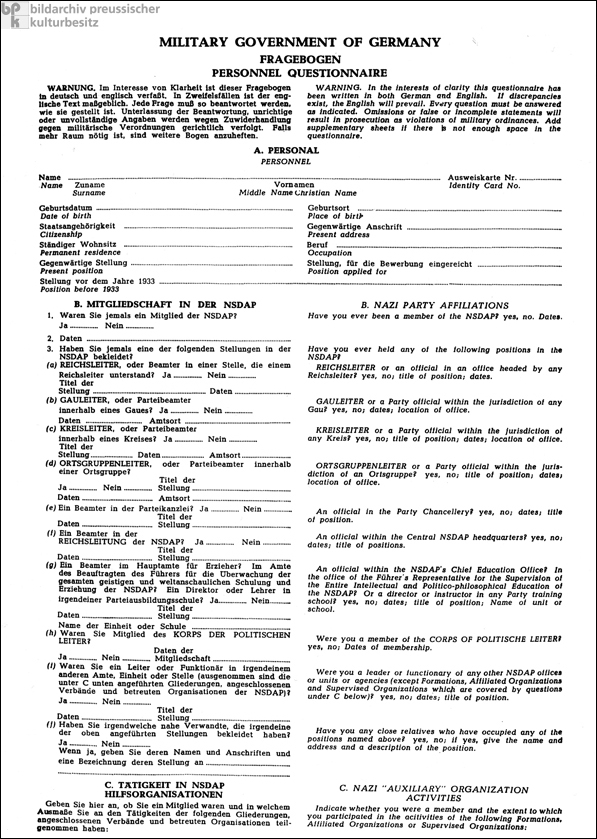
Image of a mandatory 1945 Fragebogen.

Sources:

Mary Fulbrook, “Discomfort Zones” and “Voices of the Victims” in Reckonings: Legacies of Nazi Persecution and the Quest for Justice (Oxford University Press, 2018), pp: 314-336, 361-377.

W. Sollors, “Everybody Gets Fragebogened Sooner or Later’: The Denazification Questionnaire as Cultural Text.” German Life & Letters. Vol 71, Issue 2 (2018): 139-153.

Joachim Häberlen, “(Not) Narrating the History of the Federal Republic: Reflections on the Place of the New Left in West German History and Historiography” Central European History Vol. 52, Issue 1 (March 2019): 107-124.

Robert Moeller, “How to Judge Stanley Kramer’s Judgement at Nuremberg” German History Vol. 31, Issue 4 (December 2013): 497-522.

Moving Away From Nazism and Modern Parallels

By Cyrus Hutnyk

This week’s discussion primarily concerned Nazism, moreover the lasting impacts and aftermath that the ultimately devastating ideology had. The authors of this week’s readings each touched on Germany’s experience in this post-war environment and how they had a serious mess to clean up, having to do the the terrible consequences of their former leader’s actions, the massive debts placed on the nation post-war, as well as simply addressing the many atrocities committed. The process of “denazification” as Werner Sollers described it, garnered international attention. Alongside this experience for the Germans was the experience for the tremendously traumatized Jews. Mary Fulbrook describes how Holocaust survivors moved from extreme scrutiny to empathy. These two perspectives offer a valuable insight into either side of this move away from Nazism and how it impacted different groups who were ultimately part of the experience.


This highlight on victim’s testimonies is one that is very interesting and holds modern parallels, both obvious ones with the ongoing presence of Nazi behaviours and far right sentiment in the United States, but equally with the scrutiny of already marginalized communities globally, whether on a basis of sex, race, gender, etc. Perhaps we will continue to see this sort of transformation into societies that value empathy and trust of those victimized in the future, the positive change and strictness that we see in modern Germany can be mirrored elsewhere without a doubt.

Playdough

By: Hannah Long

It was never in my mind to draw such a strange comparison, but history is indeed like playdough. As anyone can alter the frame of the events, key figures, and ultimate outcome. It possesses the unique quality of being adaptable, for better or worse people of the past and present still use it today to come to terms, most often with prominent events in world history. 

A week like this wouldn’t be complete without a discussion of Nazism, more specifically the aftermath of it all. Each author from this week focuses on some aspect of Germany having to figure out how to deal with the resulting consequences of the war on top of the sheer number of atrocities committed by their regime on a global stage. Arguably this was the first major time in which a single country in the aftermath of the war became the center of the world’s attention, with the major on everyone’s mind being what now? Author Werner Sollors describes the ensuing response by Germany to be both “a bureaucratic nightmare” and a “a site of German cultural memory… And denazification” (Sollors, 139). 

On one part of history there is the political side of Germany, pushing the narrative of denazification on all of its citizens, wanting to instill into the minds the dangers of this ideological sphere and muting any remaining members of the Nazi Party/Nazi affiliation (Sollors, 141). Sollors goes on to describe the lengthy measures made to ensure the group would never rise again and also how the public was made to go through a re-education and lengthy process themselves to become a part of this “new Germany” (Sollors 142). 

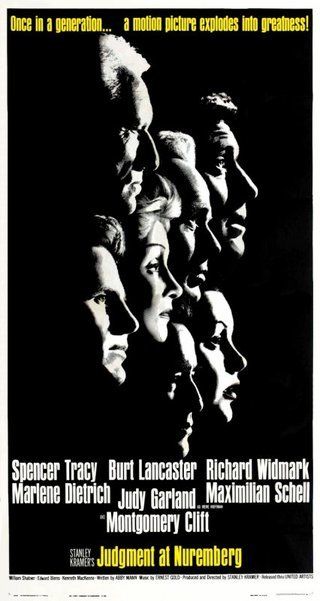
While the state wanted to refocus German society the media seemingly wanted to counter that idea by staying on the topic of Nazism by deconstructing it to its very core. The media of which I speak of is that of global media of the time, as Author Robert Moeller discusses in his work, “How to Judge Stanley Kramer’s Judgement at Nuremberg” (Moeller, 497). 1961 seemed to be rife with a global re-examination on the Second World War, with Adolf Eichmann’s trial bringing about much public discourse and reflection of the past sixteen years (Moeller, 498). Kramer himself was inspired to release the film in Berlin as he felt it was a testament to “how far Germany has come” (Moeller, 498). Personally I have always found the post-war media’s fascination of the fallout of the War to be interesting in itself as it almost demonstrates how different people come to terms with something so monumental.

History became a useful tool for the rebuilding of Germany post-war, as  for them it became an opportunity to reflect and formulate a plan to reform their fractured society. Vergangenheitsbewältigung was never about re-imagining their own history but rather process of coming to terms with it all.

A poster for the film Trial of Nuremberg.  Stanley Kramer, Judgement at Nuremberg (1961: United Artists).
Image courtesy of https://elcinema.com

Sources:

Robert Moeller, “How to Judge Stanley Kramer’s Judgement at Nuremberg” German History Vol. 31, Issue 4 (December 2013): 497-522.

W. Sollors, “Everybody Gets Fragebogened Sooner or Later’: The Denazification Questionnaire as Cultural Text.” German Life & Letters. Vol 71, Issue 2 (2018): 139-153.

The Survivor

Megan MacRae

I feel that much of my knowledge about Nazi Germany, the Holocaust, the struggles of Jewish people etc. comes from studying these experiences as they occurred during and leading up to World War II. Therefore, I enjoyed this week’s discussion as it centered around what the treatment and experiences of Jewish people were like during the postwar era. 

Specifically, I enjoyed Mary Fulbrook’s take on how the postwar era transformed from a time which scrutinized the testimonies of Holocaust survivors, into a period that saw widespread empathy towards these individuals who survived Nazi Concentration Camps, Jewish Ghettos etc. Apart of me finds it difficult to understand why, after so much destruction, postwar Germany continued to view the voices of Holocaust survivors in a doubtful manner. There was evident loss, death, and devastation during the Holocaust so I would have assumed that during any Nazi trial, the word of the victim would be held with the most importance and respect. However, then I reflect on the position of a victim, who is a part of a minority group, in any justice system and it becomes clear that these individuals are often met with skepticism solely because of their identity. We see this with racialized groups, women, those apart of the 2SLGBTQ+ community etc. 

Therefore, although Germany’s postwar era eventually does transform into one that values the oral testimonies of survivors, it can be understood that there was skepticism surrounding the testimony of Jewish survivors due to the historical and contemporary treatment of victims within the justice system.

The Road To Hell Is Paved With Good Intentions, The Fragebogen

By Blaise Rego

A copy of part of the Fragebogen, this section is about Nazi affiliation

I’d like to hope that everyone reading this post would agree with the idea that after WW2 Germany needed less Nazi and even less in positions of power. This idea was the basis of the allied task following the end of the war. Germany had to be rebuilt, institutions must be reconstructed and Nazi must be punished but figuring out who would be able to help on this task and who would hinder progress being made was the primary task before much could be accomplished. The American military government created what became a 131 question questionnaire most commonly know by its German name, Fragebogen, the German word for questionnaire. This questionnaire asked everything from eduction history to voting history to questions of ones height and weight. This was deemed to be a necessity as there were millions of germans living in allied occupied areas and it was deemed inefficient to interview and investigate very single person in the country. So this bureaucratic form was made to root out who needed to be sought out and investigated deeper.

This is were the crux of the issue lies, this questionnaire is good on face value, if people are honest, at determining who was or was not a collaborator with a Nazi regime. However it lacks the nuance necessary to root out deeper reasons why people join the party. Some as the reading state joined out of fear, in one particular example from the book Small Victory a man joins the party in an attempt to save his implied jewish daughter. Stories such as these, fictional as they may be place the idea in our brains that maybe individuals might’ve had deeper reasonings for joining the party than just antisemitism and hate.

This leads to the deepest issue with the Fragebogen the hypocrisy of the American state. In the “everybody gets Fragebogened sooner or later” reading there is a story of American officers being openly antisemitic in post war interment camps. This story demonstrates an idea that the Americans were doing this less to root out those with hatefully beliefs but more to push their enemy even in defeat. When speaking of American hypocrisy on hate, it must be mentioned that at this time segregation was still alive and well and wouldn’t be made illegal for another 20 years. The idea of the Fragebogen was well intentioned as a way to root out those who may have participated in heinous acts during the war but it turned into a bureaucratic nightmare that exemplified American hypocrisy and insensitivity to what those in Germany may have truly believed.

Western Expectations of de-Nazification

Aleksander Bracken

One of the aspects of de-Nazification that stood out to me was the degree to which American and Allied expectations and needs of the time affected it. Moeller’s piece on the Judgement of Nuremberg highlights that the American bought into the “dream” of Janning’s confession as the embodiment of the enormity of the crimes committed by Germany and as a confession of guilt that provided the possibility for forgiveness, despite the fact that this confession was not actually something that happened historically. There was also the idea of the Fragebogen as a “bureaucratic process of revolution by decree,” since it was expected that a 131 question questionnaire could alone “de-nazify” West Germany. Thus, the West leaned heavily into the perception that Germany was quickly heading down the path towards de-Nazification.

But these two articles highlight several instances where Germans were not on the same page as their Western allies/occupiers. While Willy Brandt somewhat embraced a critical view of his country’s past and the need for reconciliation, German film critics harked on the films historical inaccuracies and were less critical of their nation’s wrongdoings. Some respondents of the Fragebogen also scoffed at the questionnaire, feeling that some aspects of it were reminiscent of Nazi scrutiny (i.e. physical characteristics and ancestry certificates). Furthermore, Americans were boasting a 92% denazification rate in areas like Bad Weisse (147). But as Moeller highlights, radical neo-Nazi antisemitic acts – like attacks on synagogues and Jewish cemeteries – occurred in major cities, like Cologne in 1959. Thus, the American dream of de-Nazification was built on a shaky foundation at best.

These texts demonstrate that German discourse and perspectives did not echo the dreams put forward by Americans, suggesting that West Germans’ relationship with their past in the first two post-war decades was not sufficiently critical to purge Nazism from the body politic and prevent the rise of new Nazi-inspired movements.

Malleability and Imagined Possibilities

By Lauren McCoy

An interesting theme from this week’s readings was the malleability of history, where shifting cultural/political contexts and individual interpretations can heavily shape how we represent the recent past. Added to the pliability of memory, it seems impossible for us to create a stable view of the past, especially when the subject is as complex and morally-charged as the Holocaust.

An interesting pattern across the readings was how the past was employed or re-invented to meet the needs of present actors – ranging from Nazis trying to reconcile their involvement in the Third Reich to American directors trying to take the moral lessons of German history and connect it to his own national challenges. Though for different purposes, both cases forward a plausible but ultimately inaccurate version of the past, deviating from “historical fact” to better fit a simplified narrative or to serve their needs in the present.

 While I think it’s easy for us to be suspicious of representations of the past that aren’t “accurate”, I think there is an interesting space here for “imagined possibilities” of the past. I’m not trying to suggest that representations or understandings shouldn’t be grounded on factual evidence or to encourage people to falsify the past for their own benefit (which, as previous classes have shown, is common in fascist regimes). However, I think it may be useful considering the complexity of Holocaust experiences to use “imagined possibilities”, where perhaps an event didn’t occur exactly how it is represented but is grounded in real history or combines several historical experiences for a more “complete” narrative. The film Judgment at Nuremberg showcases this, straying from official trial transcripts to create a plausible situation that spoke more to the American context. I think this is common within the history of slavery, where the lack of resources by enslaved peoples has forced historians to use what evidence is available and “fictionalize” historical experience.

I’d be interested to hear what you guys think!

Post-Nazism in the Federal Republic of Germany

After the tremendous destruction that was brought upon all of Germany during the last years of the second World war, reality was hammered in the German conscientiousness. With the creation of the Federal Republic of Germany, they would have to go back to square one, a more liberal and democratic regime, a post Great war repeat of the Republic of Weimar in the 1920-30s. But instead of instead of seeing it fail once again due to disastrous economic and political reasons, West Germany was able to make it work by deconstructing the ideology of Nazism as it was argued by Joachim C. Häberlen. One of the ways to do so was trough the popular culture and it was very interesting to see that things such as the Allies denazification questionnaire was introduced to change the population’s perception of it. The answers highlighted by Werner Sollors were confirming a point that was foreseeable, that Nazism after the war was already getting rejected as an ideology. Still, it shows that no one was really sure of what would actually happen in the late 1940s and 1950s as political instability was omnipresent since the start of the 20th century. Americans while trying to help the German society radically change as fast as possible may have also slowed the process a bit because of initiative like the questionnaire that was perceived as a bit much. It is also shown in the German culture that they were ready to move on from this period of Nazism when Stanley Kramer, an American cineaste, was able to present a movie which dove in the trial of Nuremberg that left no stone unturned.

  • Louis Lacroix

Nazism’s Lessons & Legacies

By: Nicole Beswitherick

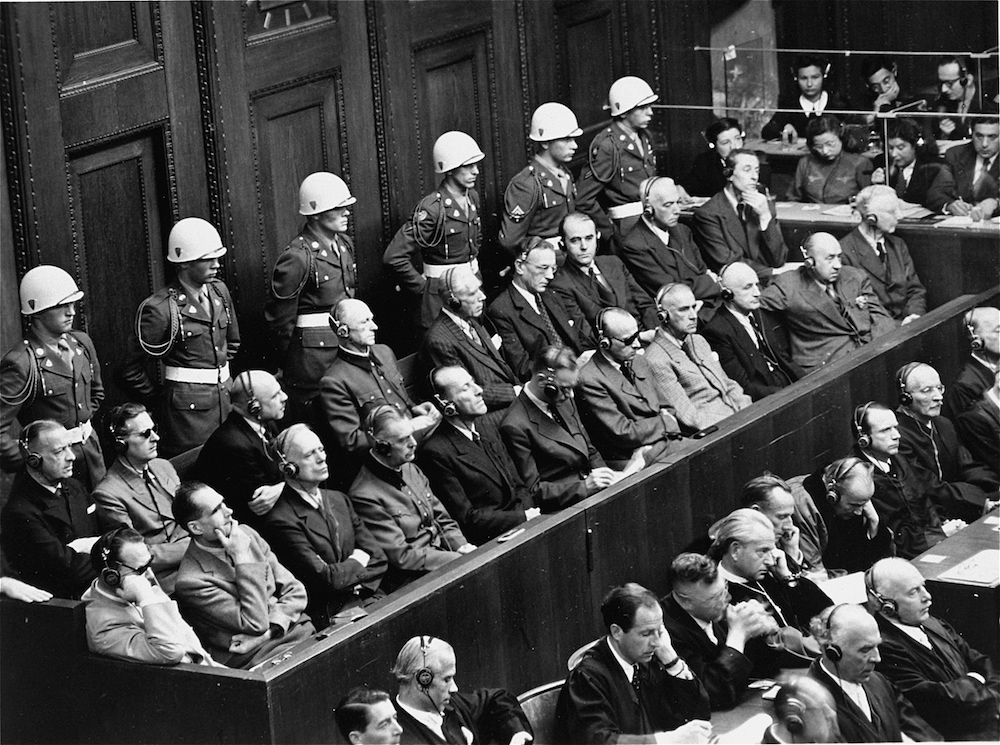
The defendants in the dock at the International Military Tribunal at Nuremberg. ——US Holocaust Memorial Museum, courtesy of John W. Mosenthal

As someone who had great grandparents who either fought on the front lines of WW2, nursed the injured or yielded crops, the topic of West Germany and Nazism is not completely unfamiliar. The main question in regard to this week’s readings is “What did coming to terms in the past (Vergangenheitsbewältigung) look like in postwar Germany?” If we look at the reading from Fulbrook, “The Diffraction of Guilt”, we see that a West German judge could still appear to have more sympathy with former Nazis than with their victims, even more than 20 years after the end of the war. It was added that a long prison sentence for the accused, in their advanced stage of life, also destroys their economic existence; and this makes it difficult to build it up again after the sentence is done (Fulbrook 323). West German interpretations of the law offer the idea that killing was a less odious crime if the victim had no suspicion that it was going to happen. From what I’ve gathered from these readings, the Nazis and West Germans were simply coming up with excuses to make their crimes come off as justifiable – which they are not.

In Sollors’ work, I found the explanation of the title of the reading quite interesting. “Everybody gets fragebogened sooner or later”, was described to summarize the American literary responses of the period (Sollors 147). It is seeming that Sollors makes many connections to America and its involvement and perhaps progression toward Nazi Germany. In Salomon’s version of the questionnaire in the chapter,  it not surprising to Sollors that Americans are viewed as the true anti-semites (Sollors 150). He tries to expand on this, but I find this particular reading did not do fantastic in translating or explaining the quotes written in German. But in Moeller’s “How to Judge Stanley Kramer’s Judgement at Nuremberg” there is also a connection to Americans being that Mann asks: was postwar America inching toward Nazi Germany? (Which I will be asking in this week’s discussion for those who stumble upon my reflection). In this article, in particular, Moeller gathers the theory that Kramer and Mann used the film to reflect on what America had done, and America’s transgressions. They did this, according to Moeller, by focussing on the fatalities and presenting German fascism as a tool to measure the forms of injustice that permeated the daily life of Americans in 1961.

Works Cited:

Mary Fulbrook, “Diffraction of Guilt” and “Voices of the Victims” in Reckonings: Legacies of Nazi Persecution and the Quest for Justice (Oxford University Press, 2018), pp: 314-336, 361-377.

W. Sollors, “Everybody Gets Fragebogened Sooner or Later’: The Denazification Questionnaire as Cultural Text.” German Life & Letters. Vol 71, Issue 2 (2018): 139-153.

Robert Moeller, “How to Judge Stanley Kramer’s Judgement at Nuremberg” German History Vol. 31, Issue 4 (December 2013): 497-522.