Femininity and Fascism??

Owen Billo

The Marhoefer, Kuehne, and Lopez/Sanchez readings all offer examples of the different kinds of masculinity and femininity within the 20th century’s fascist states. Between the Kuehne and Lopez/Sanchez articles especially, we can see masculinity and femininity’s relationship to militarism, where both were present in the military in both men and women despite the hypermasculine nature of fascist militarism.

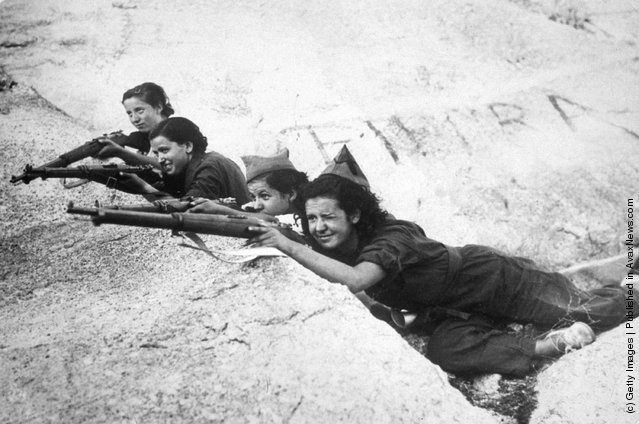
For example, the Nazis idealized the ‘political soldier,’ who had no trace of femininity, followed all orders, and had absolute loyalty to the political program of the regime. However, these men were still expected to maintain comradeship, which inherently has some traits that were considered feminine, such as caring for your comrades and doing the cooking and sewing for your squad. (Kuehne) The opposite example is the women’s section of Franco’s Spain, who were expected to be “feminine” in that they were supposed to be domestic, caring, and submissive, yet a “masculine” side clearly came through. These women primarily acted as spies but also fought, which would go against their “feminine” expectations and could be seen as quite masculine. (Lopez/Sanchez) It also feels almost oxymoronic to say “fascist woman,” but at the same time perhaps it’s dismissive to women to say that they can’t be repugnant fascists as well. Overall, in fascist militarism we see masculine men showing some femininity and feminine women showing some masculinity. But then we have to ask ourselves the question: is this specific to the situation, or maybe is everything like this? I would argue the latter, since, as we’ve seen, even with masculinity or femininity being drilled into people as intensely as fascist regimes did, people are never 100% one or the other.

German Fascism, Italian Fascism, and Fascist Inconsistency

Owen Billo

The readings for this week, as they related to each other, all reminded me of Paxton’s article from last week, specifically where he argues that fascism is different from the other -isms. He says that fascism is not based on a consistent framework or philosophical tradition, but will instead believe in and do anything it deems necessary to achieve the stated ‘destiny’ of the in-group and, presumably, to defeat the out-group. While I don’t believe this is a complete definition, I do believe that it has a lot of truth to it, as we have seen fascist movements being incredibly inconsistent.

The best examples I saw were Motadel’s articles, which focus on the collaboration between anti-colonialist nationalists and the Nazis. The Nazis made it no secret that they viewed non-aryans as racially inferior, and yet they were happy to work with them simply because it helped them fight the Allies and achieve their supposed destiny. It was also convenient because Germany no longer had a traditional colonial empire, something that Italy did have. This is why Italy took a different path, opting to work towards their own supposed destiny through their colonial empire. And yet, as Ben-Ghiat discusses, Italy (rather abruptly) ended up bowing to Germany, accepting institutionalized anti-semitism and a less colonial approach because this had suddenly become more feasible for achieving Italian national ‘destiny.’

This understanding gives an interesting perspective on the Judeo-Bolshevism conspiracy theory analyzed by Hanebrink. An alliance between communists and Jewish capitalist bankers (which sounds ridiculous because it is) can only make sense from a fascist perspective where any alliance is ok so long as it moves you towards ‘destiny.’

Political Definitions are Nebulous

Owen Billo

All the readings this week offer some kind of definitions for “populism” and “fascism” as well as discussing the definitions of others. These definitions are used, among other purposes, to draw a line between populism and fascism, but the definitions and lines drawn differ such that I am still left wondering: which is the most correct? Mudde offers his own take on the dominant “ideational approach” for populism, where a group identified as “the people” must defeat a group identified as “the elite.” I personally agree with this definition, but it is incredibly broad (which is the intention) and could potentially describe movements which are not conventionally considered populist.

Finchelstein loosely applies the ideational approach to draw a line between populism and fascism, arguing that populism becomes fascism when “the people” becomes a race/ethnicity/nationality and tries to bend politics to the will of that group. It might also be added that fascism loses the democracy-focus of populism, and Finchelstein’s definition misses some aspects of Paxton’s description of fascism. In other words, the line between populism is thicker than we might think, but also very flexible.

Additionally, both Mudde and Finchelstein argue that populism is also an “illiberal-democratic response to undemocratic liberalism” (Mudde, 1) while also acknowledging that populism can vary in political orientation. But what is the possibility of liberal populism, especially in an illiberal political environment? In this case, I think their definition of populism could exclude some kinds of populism.

Perhaps “which definition is most correct?” is the wrong question for such nebulous concepts – concepts which might be better described by qualifiers than a definition.

Introducing Myself

Hi everyone,

My name is Owen and I’m a fourth year history student with a minor in political science. I have an interest in art, geography, and D&D, as well as in sports like fencing and kayaking. I’m also a part of Carleton’s model UN team, where I’m currently acting as a Co-Director of Training. I’ve recently finished eight months of co-op so I’m still readjusting to academic life, but I hope to learn a lot from all of you in this course as populism is a subject that I’ve always had an interest in. I’m excited to see what everybody writes about!