The international flavour nationalism brings to the table – Blaise Rego

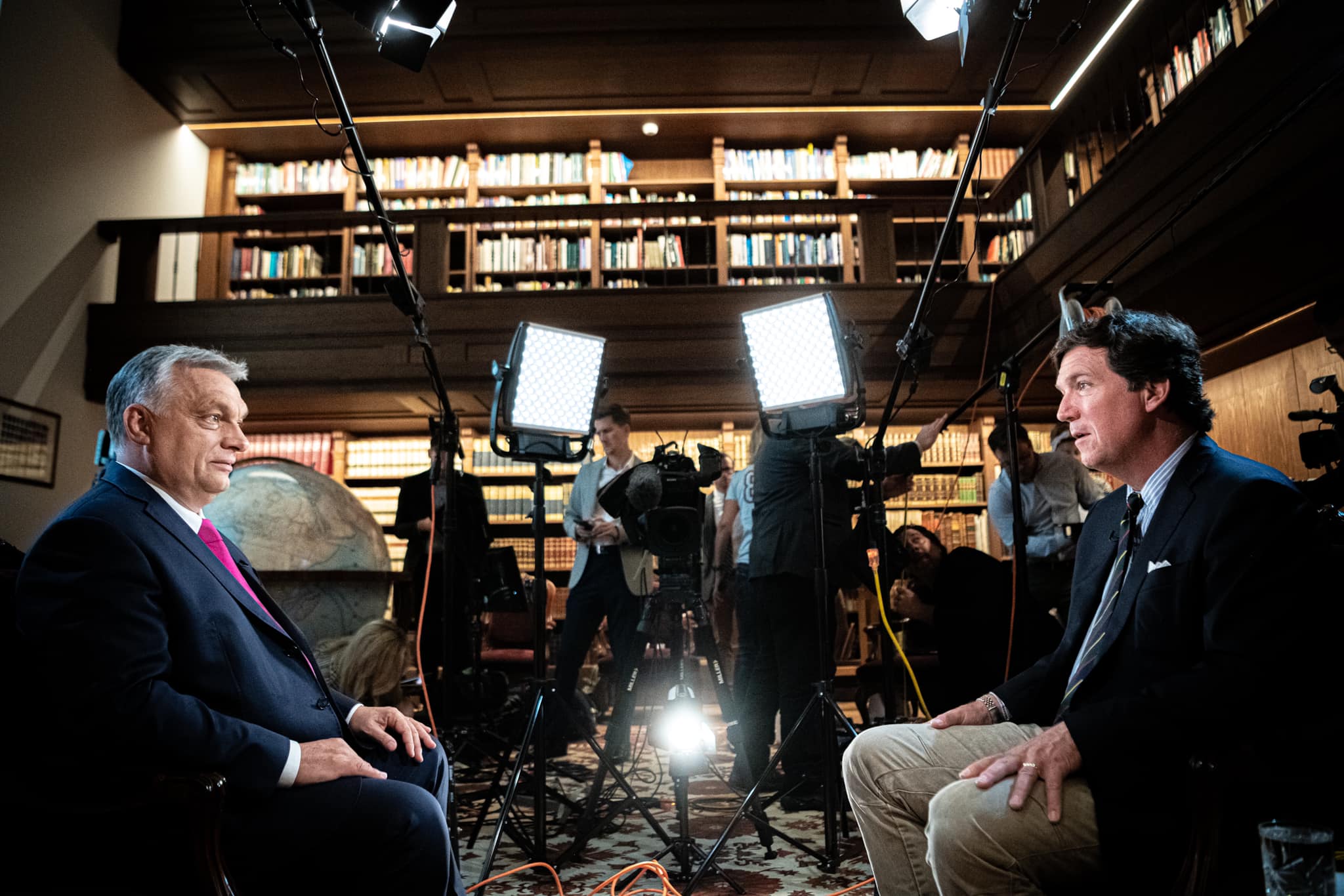
Tucker Carlson sitting down with Viktor Orban – Hungary’s nationalist authoritarian leader

The readings this week look at the international aspects of nationalist movements. When first discovering this in the reading it felt like an oxymoron, nationalist by nature should be sceptical of any internationalism but yet there seems to be a long track record of nationalist groups working together throughout history.

As the photo above demonstrates, I shouldn’t have been surprised about the international flavour that nationalism can have. Tucker Carlson (famed American nationalist), has made headlines this year by doing live shows from authoritarian that countries such as Hungary and Brazil. These shows are often spent fawning over whatever recent policy or authoritarian move Orban or Bolsonaro made, talking them and their governments up to his FOX audience. This move makes sense for both the nationalist movement in the United States and for the nationalist movements in the host countries. It aggrandizes their movements while promoting and garnering support from the worlds “leading nationalist movement”.

The move to be supported by a larger nationalist power/movement is one that is seen throughout the readings. In the reading by David Motadel, he describes how anti-colonial nationalists came to Nazi Berlin to garner support for there movements against their colonial oppressors. Though the Nazis and Hitler did not hold individuals from the anywhere but Europe in high regard they aided them as an effort in their wartime strategy. This idea of mutually beneficial relationships despite glaring differences is a key aspect of nationalistic internationalism.

The mutually beneficial nationalistic International relationships are highlighted in Motadel’s new York Times piece. In it he talks about the growing number of right wing nationalists being elected to the European Parliament. He discusses how French and Italian nationalist parties have begun to unite with eastern European nationalists to create a right wing voting bloc within the parliament. Though they are united on certain issues such as immigration, the way each nation wishes to deal with these problems differs vastly. This is the central issue with the nationalist internationalism, as they all wish to put their own nation first, their priorities and solutions are rarely aligned with one another or they are outright butting heads. On the issue of Russia Western nationalists are much more sympathetic to Putin and his invasion of the Ukraine in comparison to the eastern European nationalists who greatly distain Putin and his continued threat to their nations sovereignty.

What I have taken from these readings is that we must be conscience of the continued internationalism that nationalists use to bolster their own and nationalist movements around the globe. We must also be aware of the major potholes they must navigate themselves on major global issues that can tear these budding coalitions apart.

The thin line between Populism and Fascism

In this weeks readings we looked at media that discussed fascism and populism, these articles and one podcast looked to define and explore how these ideologies occur. What stuck me as I read each article was the overlapping terms, especially when discussing the group each ideology was representing. Mudde states that the group that a populist is representing share common ethnic, religious or class identities that often over lap. This can be related to Paxton’s view that fascist leaders look to lead a group that is a majority and looks to “other” minorities in the state. Though Mudde doesn’t outright state that populist leaders look to the majority population to seek a cultural basis it is stated that populist look to create one group that leads the state.

I read the Anatomy of Fascism first and what struck me as I read portions of the chapter was the striking similarity to what has been called illiberal democracy. Where Paxton describes how fascist leaders lack a set public agenda/program, it struck me that is seemed very similar to hoe Viktor Orban wanted Hungary’s political system to be shaped like. This similarity was confirmed by Paxton as he showed data that had Hungary as the state that voted the most for populist parties (one party).

There is though a line that divides these two ideologies. Most importantly fascism and fascist movements have a violent undertone to their message that often threatens or delivers violence if their agenda is not meet or just to meet said agenda. This differs from populist movements that thrive in a quasi democratic space, where they control the levers of power while still offering an illusion of choice. Populist as described by Mudde aren’t populist first, they normally have a stronger more concrete ideology that guides their larger policy. They using populist thought and practice to garner support and create smaller more distinct policy based on the specific nature of their populist movement (anti-latin American in the United States vs anti middle eastern policy in Europe). This is juxtaposed to the firmly fascist governments that proclaim that as fascist they have risen above other ideologies to understand a superior movement.

In summation, fascism and populism share similar traits, ideas and aspirations but the methods in which they look to achieve them are different. As populists look to work within the confines of some democratic process versus the fascist approach as succeeding in their goals at whatever the cost, whether that includes violence or not.

Introduction

Hi everybody my name is Blaise, I’m a fourth your student in BGINS with a specialization in global politics. A lot of my interest stems from the interaction between economic, development, and security policy and how interactions within these spheres of policies can have much larger rippling effects over all of society.

On a personal level I love just being outside whether that’s playing sports or just existing in the outdoors, it just brings me loads of happiness. I find that nature just puts everything into greater perspective as our (human) problems are only temporary to the Earth. It gives me a little solace when discussing some of the heavier topics we will be discussing in class.

I look forward to getting to know everybody this semester!

This is me stuck in a snow drift after hiking 10km up a mountain near Banff