Giorgia Meloni; New face, same regime

Megan MacRae

Unlike what some may think after skimming the recent headlines of popular news outlets, the election of Giorgia Meloni as Italy’s first woman prime minister is not a step forward for feminism or girl power. Rather, Meloni represents a hard-right wing belief system that is anti-LGBTQ, anti-immigration, and, despite Meloni’s personal statements, seemingly pro-fascist. 

Meloni is the leader of the far-right Brothers of Italy party, or in Italian, Fratelli d’Italia. This nationalist party does little to hide the fact that they are outright anti-LGBTQ and hope to boost the Italian population through blocking abortions and ‘illegal’ immigration. Meloni helped establish the Brothers of Italy party in 2012 by shaping it to look like the National Alliance, but more nationalistic, Christian, and conservative. The National Alliance was birthed during the post-World War II Italian Social Movement and was influenced by Benito Mussolini’s fascist ideals. 

The fact that Meloni not only leads the Brothers of Italy party, but worked to establish it and shape it after a party that was founded by Mussolini supporters, makes it hard to believe her when she claims that she is an anti-fascist. Meloni has continued to contradict herself when it comes to discussions surrounding the infamous Russian president, Vladimir Putin. After Putin secured his presidency in 2018, Meloni publicly applauded him and showed her support for the autocrat. This sparked fear amongst NATO and Ukrainian allies that the sanctions against Russia which were established by Italy’s previous prime minister, Mario Draghi, would be demolished by Meloni and her government. However, when Putin invaded the Ukraine, Meloni put on a front and expressed her disproval of the president’s actions while assuring Italian voters that she would equip the Ukrainian military with weapons. Meloni’s ‘reassurance’ should be taken with a grain of salt as she has yet to take substantive action to prove that she truly is pro-Ukraine and anti-fascism. It is also incredibly difficult to believe that a politician who represents a neo-Nazi party will suddenly abandon her and her party’s core beliefs now that they have secured a win in the election. 

Meloni’s recent take on the actions of Putin can be considered a part of her strategy to appear more moderate than she truly is. Despite the fact that Meloni and her party are hard-right extremists, they are clearly aware that publicly defending this stance would cause more harm than good. Not only would Meloni divide herself from the left wing and even moderate right-wing followers, but she would face harsh criticism from politicians, journalists, and intellectuals around the globe. The efforts of Meloni to conceal her true political agenda could be considered intelligent by some, but conniving by others.

In recent years, Meloni has been compared to former United States president, Donald Trump. Despite the fact that Trump did not even try to obscure his political agenda and beliefs when running for office, there still remain similarities between the two right-wing extremists. Both Trump and Meloni refuse to accept transgender ideology as they are each stuck in their conservative, Christian ways. For Meloni, this ignorance plays out in her nationalist agenda which works to grow the Italian population by encouraging women to give birth and continue the Italian blood line. This eerily resembles Mussolini’s agenda which also worked to establish Italian dominancy through growth of the Italian empire. Like Mussolini, Meloni is clearly anti-immigration because she is looking to construct a nation that is ‘pure’ with Italian blood. Again, Meloni’s stance on gender ideology and the ‘traditional’ family makes it difficult to believe that she is unlike her fascist predecessor.

One common trend that continues to cloud around the various headlines is that Meloni is initiating a radical hard-right shift. Although Meloni and her party are radical in their political agenda, their efforts portray a direct continuation rather than a so-called ‘shift’. It was evident in the United States, and now Italy is experiencing the same phenomenon. These hard-right extremists have been around before and after the fall of Mussolini. However, there were few popular politicians who were willing to publicly take a divisive stance like the one Meloni and her party have currently adopted. Therefore, just because fascists have not been under the public eye similarly to how Meloni is right now, this does not mean that fascism had been completely wiped out after World War II. 

  1. Italy’s far-right coalition dominates in polls – The Globe and Mail
  2. Italian right-wing coalition set for majority – The Globe and Mail

CPAC Hungary is a recent example of how ultranationalist, radical-right politicians are gaining legitimacy through international cooperation

US television host and conservative political commentator Tucker Carlson delivers a speech via a videolink at the Conservative Political Action Conference (CPAC), a prominent conference of American conservatives, in Budapest, Hungary, 19 May 2022.  Credit: Szilard Koszticsak/EPA-EFE/Shutterstock (12946499a)

By Frank

This past May, the American Conservative Union (ACU) held one of its Conservative Political Action Conferences (CPAC) in Budapest, Hungary. While it may appear to be somewhat ironic that the ACU – a traditionalist conservative, nationalist, and populist-leaning organization – hosted a conference in Hungary, it shows how radical-right Republicans in the US and populist, authoritarian Prime Minister Viktor Orbán are willing to align themselves with the global far-right movement. Call it ultranationalist internationalism.

CPAC Hungary received a star-studded cast of new right figures. Donald Trump gave a speech virtually, and former UKIP leader and Brexiteer Nigel Farage made an appearance. Less famous figures to share the stage included Zsolt Bayer, a Hungarian television talk show host who has been repeatedly denounced for his racism and antisemitism.

Orbán delivered the keynote address at CPAC, but a controversial speech given a few days before the conference is what made international headlines. After taking the oath of his office for the fourth time, he endorsed the “Great Replacement Theory:” a xenophobic and racist conspiracy theory embraced by far-right figures.   

Viktor Orbán gives a speech at CPAC Dallas 2022 a few months after CPAC Hungary. In it, he refers to Hungary as the “Lone Start State of Europe” because of its shared values of Independence, freedom, sovereignty with Texas.

What do far-right nationalist figures gain from these types of events? How deep does their collaboration run? While it may seem to be merely a paradoxical feature of the globalized information age, ultranationalist internationalism has a historical legacy.

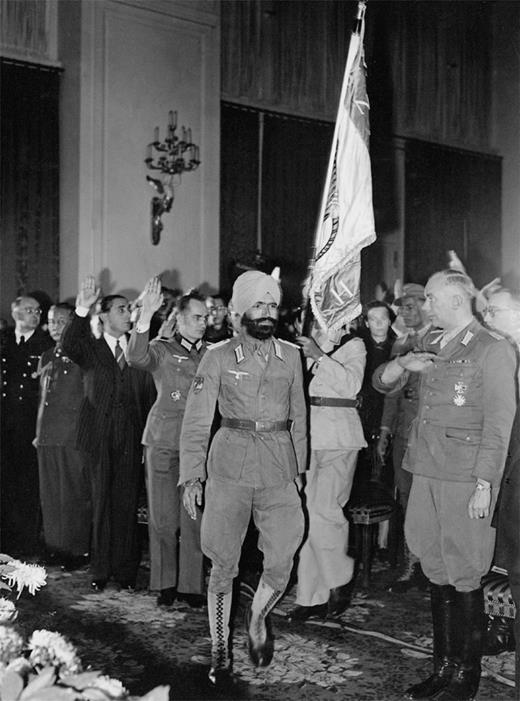
European Fascists leaders of the early-20th century actively sought out and solidified connections with likeminded governments, parties, and partisans globally. During the Second World War, Berlin became a hub of international Fascism, as the Nazi regime invited far right and ultranationalist leaders from across the globe, like Subhas Chandra Bose.

The contradictions of Fascist internationalism are evident, especially considering that Nazi Germany was exterminating peoples that it viewed to be “racially inferior” while they invited people from the Colonized world. However, this “reactionary cosmopolitanism” served larger goals for both parties. Nazi Germany garnered supported far-right militias and organizations : Fascist ‘fifth-columns’ had the potential undermine (or even overthrow) their European adversaries, thus enhancing Nazi power and prestige. For the leaders of these organizations, cooperation with the Nazis provided a power, likeminded ally who was fighting (and initially beating) their colonial rulers: a powerful Fascist model to be emulated.

Celebration of the foundation of the provisional Indian national government: soldier of Azad Hind Legion, Hotel Kaiserhof, Berlin, November 15, 1943. SZ Photo Archive, Image 00081540.

“Dressed in a black sherwani, [Subhas Chandra] Bose gave a passionate speech, denouncing “British imperialism” as “a cunning and diabolical enemy.” His address was replete with references to the global anticolonial struggle, to India, Burma, Palestine, and Iran: “The war offers not only India, but also all other enslaved nations of the British Empire a unique opportunity for throwing off the foreign yoke.””

– David Motadel, “The Global Authoritarian Moment and the Revolt against Empire.”

It is important to state the obvious here: our current moment differs vastly from the Second World War. Nevertheless, authoritarian, illiberal democratic states like Orbán’s Hungary acts as model ultranationalist state that American conservatives wish to emulate.

American conservative politicians are interested in Hungarian policies. For example, Hungary’s law banning the teaching of homosexuality and transgender issues in schools was enacted a year before Florida’s “Don’t Say Gay” Bill; laws which significantly curtail the rights of LGBTQ people in both states. Vox senior correspondent Zack Beauchamp suggests that the American law was “literally” inspired by Orbán’s law.

The policies and platforms of Viktor Orbán are not exclusively for a domestic Hungarian audience. In his speech at CPAC Dallas (which took place a few months after CPAC Hungary), Orbán provides a playbook for advancing ultranationalist, anti-pluralist agendas:

“I am here to tell you that our values: the nation, Christian roots, and family can be successful in the political battlefield. Even nowadays, when political life is ruled by liberal hegemony, I am here to tell you how we made these values successful and mainstream in Hungary. Perhaps our story can help you keep America Great.”

– Viktor Orban, CPAC Dallas Speech

Giving guidance to American conservatives also benefits Hungary. Strong ultranationalist governments in Western countries friendly to Hungary provide Orbán’s regime with legitimacy at home and aboard. As history shows, internationalism benefited Fascist states like Nazi Germany, as their allies provided the regime prestige, support and legitimacy.

Radical-right collaboration on policy is certainly significant, but it is only one of the heads of the ultranationalist internationalist hydra. The sharing of far-right, ultranationalist ideas – touted as “traditional” values – are also a key feature of their international cooperation. This too has a historical legacy.

For over half a century, new right figures have understood power of ideas and narratives to build long-term, durable power. In the late 1960s, the French Nouvelle Droite (New Right, or ND) saw the need to establish a right-winged “Cultural Hegemony” in civil society to combat perceived leftist influences over public discourse. As Political Scientist Tamir Bar-On highlights, ND leader Alain de Benoist saw that Gramscian-Marxist political theory could be used to further the far-right’s agenda, through the “control of dominant values, attitudes, and ways of seeing and being.” To achieve this goal, Bar-On argues, the ND and other European new-right organizations embraced “pan-Europeanism:” a transnational framework which promoted European traditional values in order to preserve the “authentic” regions of Europe against the “onslaught” of non-European immigrants. The ND countered this treat, as well as the alleged cultural hegemony of the liberal-left in Europe, by establishing journals, think-tanks, and conferences to link centre-right and extreme right-win political movements and parties throughout the continent.

Orbán speaks at CPAC Dallas. (Photo by Brandon Bell/Getty Images)

Like their new-right forefathers, today’s radical-right recognizes the value of these institutions to further their agendas. Conferences like CPAC become platforms for sharing ideas like “Replacement Theory.” The open discussion of these ideas; the cheers from the crowds in response to unapologetic racism and xenophobia; and the videos of important figures like Donald Trump and Viktor Orbán talking about them on flashy stages provide legitimacy to these incredibly divisive and destructive ideas in the eyes of supporters, be they Hungarian, British, or American. This legitimacy helps far-right, authoritarian leaders like Orbán implement even more discriminatory policies and build walls to prevent refugees and migrants from entering Hungary.

Throughout his speech at CPAC Dallas, Orbán presented his political struggle as a “culture war:” a battle of the virtues Western Civilization, Christianity, and family values against the vices of “wokeness,” pluralism, and multiculturalism. He even framed it as a battle between “David-sized” Hungary and the Globalist “Goliath.” In his conclusion, he pointed to two elections in 2024 – the US Presidency and the EU Parliament – as the crux of this battle. In his mind, the far-right must fight to control these two institutions. Orbán reassured his audience: “There is no enemy that Christ has not yet defeated.”

For the sake of the pluralist and multicultural values that we hold dear, let us pray that Christ loses this one.   

Transphobia, Eugenics, and the Nation State in Britain

Op/Ed #1

By Kaileigh La Belle

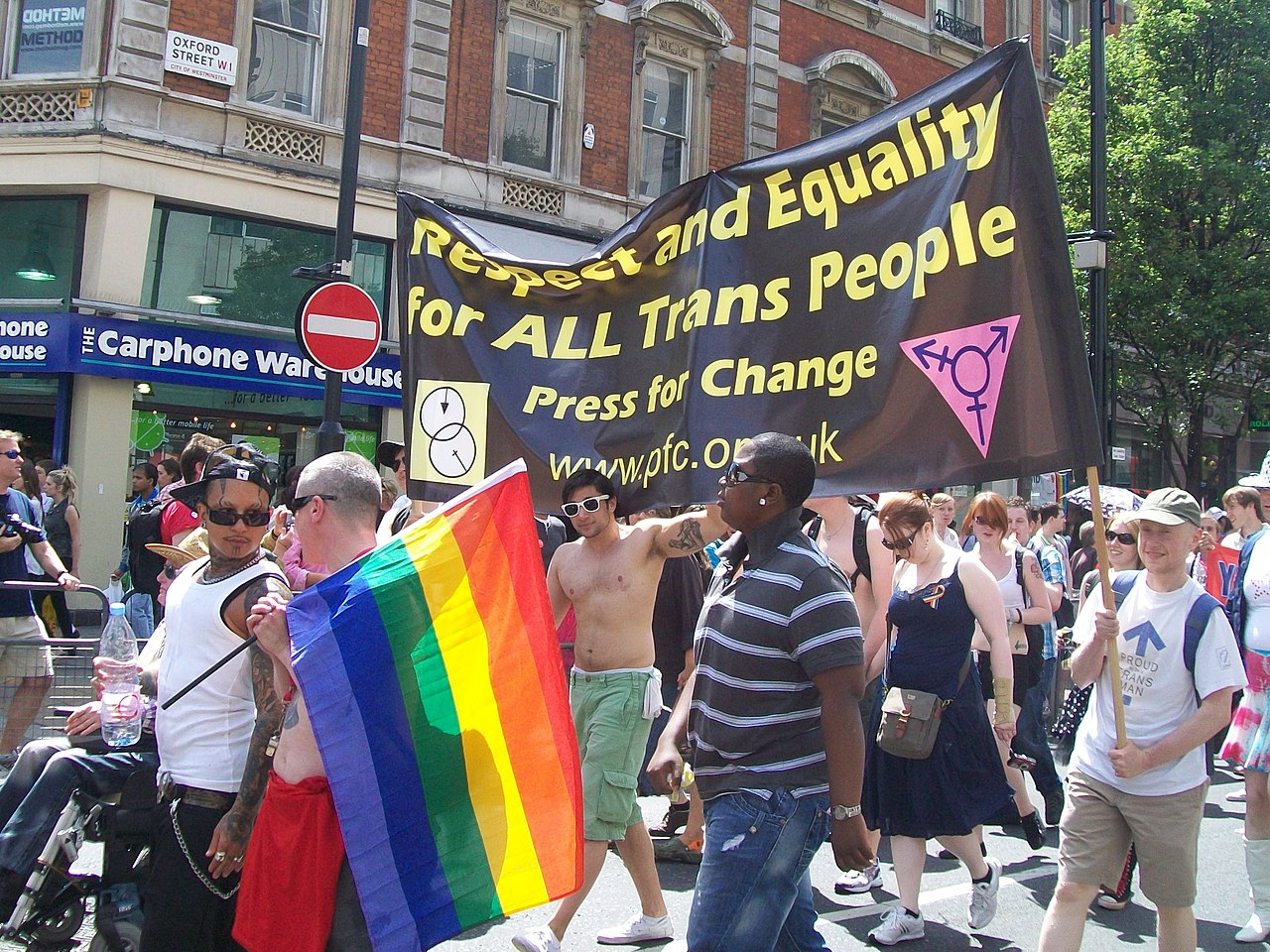
Activists march in solidarity with trans people at London Pride, 2010, reclaiming the image of the pink triangle, once used as a symbol of persecution for queer and trans individuals under the fascist and eugenic mission of the Nazis.

“An imported culture war,” decry critics in response to Drag Queen Story Hour UK. Despite the organization’s commitment to inclusivity and literacy, British conservatives, TERFS, and the Far-Right see it as an attempt to “indoctrinate” the youth into foreign “woke” principles. For them, trans inclusion is not only antithetical to the British nation but a threat to the nation’s future, represented here by children. This Far-Right vocabulary is becoming increasingly popular with anti-trans groups across the political and social spectrum, as a recent study by Global Action for Trans Equality [GATE] found. As GATE sees it, the decrease in popular support for trans rights in Britain is driven by mainly Far-Right actors “enmeshing” the two ideologies. However, this perspective fails to account for the innate historical connection between transphobia and the Far-Right. This connection, often surrounding eugenic talking points on ‘moral’ health and reproduction, negotiates the place of transphobia in alarmist, nationalist claims, one that breeds an incredibly fascistic potential. 

Recent queer histories reveal that transphobia, as we know it today, was unfortunately born not long after trans identities were named in western culture and science. Much of this early transphobia was (and continues to be) centred around the western, Christian gender binary; grounded in the biblical dichotomy of pure versus sinful, anything outside of that, particularly non-Christian, non-White gender-sexual constructs, was quickly labelled as “deviant.” In the fascist worldview, trans people remained “deviants” who signalled the moral decay of the nation and represented an “ideology” imposed by ‘liberal elites’ in universities, medicine, politics, etc. It was, and is, in this climate of hate that fascists attacked trans people and systemically destroyed trans culture in the name of ‘tradition’ and ‘morality’. 

Today, anti-trans movements in Britain continue to propagate the image of the “sexual deviant.” When polled, the British public remained divided on many trans issues. In particular, there was less support for the presence of trans women in women’s bathrooms and other ‘women’s only spaces.’ As in earlier Far-Right ideas about trans womanhood, many transphobes present trans women and the trans rights movements as granting “male-bodied people” access to women and girls in ‘intimate’ spaces; they imply that trans women would harm cis women and girls morally or physically. This rhetoric, in presenting trans women as naturally deviant and dangerous, also biologizes vulnerability for cis women. Furthermore, children are often seen as being corrupted by the supposed ‘inherently’ sexual nature of trans inclusion and education. Not only does this present an overt moralist image of imperilled innocence around which people can rally, but it again assumes passivity in children, subtly evoking the fascist image of the paternalistic family. These assumptions ultimately uphold the gendered fascist status quo, as they have done historically. 

Historically, the conflation of trans identity with ‘moral deviancy’ justified the idea that being trans was an “illness” and one that could “contaminate” the nation, which underpins eugenic anxieties about race, reproduction, and the nation. Today these ideas play out in the recent Far-Right obsession with “de-transition” narratives—stories posited by transphobes about young people regretting transitioning and professing the supposed harms that it caused to their bodies. One of the most popular pieces of anti-trans literature, Irreversible Damage: Teenage Girls and Transgender Craze, posits (falsely) that the world has seen an increase in white middle-class teen girls seeking gender affirmation surgery due to “mental illness” and being “groomed” into “thinking” they’re trans. Much like Irreversible Damage, the de-transition narratives that circulate widely in these transphobic circles emphasize the loss of “natural womanhood”, that is reproductive organs like the uterus. In centring the reproductive capabilities of middle-class white girls, these narratives continue the fascist trend of designating women as “walking wombs”. Presenting young trans men as ‘groomed’ by outsider ‘sexual deviants’ and weakening the ability of (white, middle-class) “women” to reproduce, these narratives also prop up white supremacist anxieties about race “replacement.”

Bringing the nation once again into the picture is the eugenic policy enabled by this continuation of historically fascist rhetoric on trans people and reproduction. While past fascist regimes have been more overt in their attacks on trans people, modern Britain practices passive eugenics, namely the denial of safe medical care and preventing immigration. In 2021, one in seven trans individuals in Britain reported being denied medical care; conversion therapy remained legal for trans youth longer than it did for their gay counterparts; the use of puberty blockers, a life-saving procedure in many cases, was banned for minors; trans refugees are routinely denied entry. These systemic policies, not including the numerous attacks and harassment received by trans individuals every day, are dependent on the belief that trans identity is an ‘illness’ that deviates from the “healthy norm” (that is, in their eyes, cis heterosexuality) and poses a threat to the reproductive capabilities of (as they see it, predominately middle-class, white) girls and young women. As such these actions are passed off as ‘protecting’ the nation’s youth, health, women, tradition, future, etc. 

Unfortunately, transphobia is an ideology that is growing, mobilizing alongside its historical companion, the Far-Right. While identifying these historical continuities is not to say that Britain is now fascist or will rapidly become fascist, they make us aware of our blind spots in anti-fascist work. If anything, this perspective emphasizes why we must see supporting trans-inclusive initiatives and the trans community as a distinctly anti-fascist action.

Germany’s reliance on Russian oil Op/Ed 1

By: Adam Paquin

In the early days of February 1980 Germany would make a deal with the devil and sign a contract with Russia a deal that would prove to result in major repercussions down the road. This deal would look like a small negotiation for the supply of Russian oil into Germany. With Germany to supply the material such as pipelines and other industrial goods Russia would in turn supply Germany with crude oil for years to come. After warning signs from NATO Germany assured the rest of the world that they would remain far from reliant on Russia for oil and only receive no more than ten percent of their nations supply from the country. This ten percent would end up slowly rising over the coming years. This brings us to present day Germany where more than half of the countries supply of crude oil is imported from Russia which places them in a very dangerous place.

Not only simply because it is Russia which over the past several decades has been proven to be a very unstable country socially and economically. But through Germany’s reliance on Russian oil can prove to put them in a very unsettling position especially for the general public living in the country. This became even more of a problem beginning at the start of the year. With the current war in Ukraine, many other countries within NATO have been cutting off their supply of Russian oil and other resources that have been coming out of the country. But this may not be as easily settled with Germany and their situation, if they were to completely cut off their supply of oil this would create a lot of chaos and confusion in the country. Especially in the coming months leading up to this coming winter this would lead to many cold homes with rely on natural gas for survival. This puts Germany in a very unsettling place because as of right now they do not have the ability to just shut off their connection with Russia without disturbing many households throughout the country.

Germany over the past several years has become known for their anti-nuclear protocols and their use of natural gas since the Chernobyl catastrophe in 1986. As many other countries searched for other alternatives for clean renewable energy such as wind, solar or nuclear. This along with the chancellor of the free democrats in 2009 decided to begin what they called a phase out of nuclear power. This would begin the process of shutting down a large amount of the nuclear reactors in the country with remaining to be completely closed by 2022. Germany although doing other research into several forms of clean energy as well, appears to be reliant on a future of natural gas heating their homes and fueling their cars.

Which brings us back to why Germany is so dependent on oil from Russia, if they were to cut off their entire supply of oil from Russia as many other countries have done in the midst of the war on Ukraine. This would severely hurt the German economy and people more than it would have any actual effect on the Russian Economy. It would end up shutting down large corporations and factories which have a heavy dependence on natural gas and put several gigantic companies out of commission. Now in the recent months they have been working with United States and other NATO countries to secure energy partnerships. This has actually resulted in them lowering their dependence on Russian oil by as much as fifteen percent. Which shows that a massive amount of work has been in the works to aid in the worldwide ban on Russian products, but this is only a start. But many are hesitant in completely cutting off the supply chain with their neighboring country Russia as this has been a major part of their economy for the past fifty years.

So needless to say, with all the debates between positives of cutting off a massive country with is in the middle of self-provoked war on a smaller neighboring country. A country that has for the past year been creating catastrophe and chaos under the leadership of an insane dictator. While they may have been essentially keeping your country afloat for the last half century being the largest supply of power to your economy. It can certainly be a large decision and a very difficult one at that. But a decision that needs to be made and cannot simply be put on the back burner for this could potentially create a rather large problem down the road both politically and economically. Ones that may leave the citizens of the country into literal dark and cold times.

‘We were all wrong’: how Germany got hooked on Russian energy | Germany | The Guardian

How Germany Became so Dependent on Russian Natural Gas (businessinsider.com)

Germany’s Reliance on Russian Energy Forces a Nearly Impossible Choice (businessinsider.com)

Why is Germany so reliant on Russian gas? Investment Monitor

Germany is Dependent on Russian Gas, Oil and Coal: Here’s Why – The New York Times (nytimes.com)

Op/Ed 1: Romania and a Nostalgia for Nicolae Ceausescu’s Communist Regime

By Louis Lacroix

            Romania’s President Klaus Iohannis has been questioned lately about the integrity of his government as people are losing faith in it, and some old-time partisans even think of a time where Nicolae Ceausescu’s rule was “not that bad” compared to what they experience today. While criticism is a fundamental basis of all democracy, Romanians far-right populism recalling to that time as a positive period compared to Iohannis’ service is deeply saddening and worrying for the future of their nation. Romania chose to re-elect President Klaus Iohannis for a second five-year term on November 10th, 2019, and some of the Romanians are starting to have second thoughts about the sincerity of his government as corruption which was and still is a priority for his party is still going strong. Some of Iohannis criticized decisions include his close relationship with the Social Democratic Party (PSD) to gain more political power, while being in the National Liberal Party, a center-right political party that would essentially make him undisputed as a President. Even the PNL Prime minister, Ludovic Orban, decided to quit the party entirely by the end of 2020 because of a disappointing parliamentary election and this new association.

            This coalition government was formed with the goal to bring political stability. Going back to communist Romania, it was the complete contrary. Nicolae Ceausescu is known for his tragic end at the bloody hands of the Romanian but what is more important here is how he got to that point. One of the turning point of his regime was the Securitate, the secret police service to execute his will upon the population. Furthermore, he instigated a cult of personality around him and his wife to give them a more glorious status compared to his fellow citizens. From 1967 to 1989, his dictatorship of the country just kept getting worse as he kept demanding more from the Romanians in terms of taxation, exportation of agrarian and industrial products, the destruction of many villages for different schemes, and new restrictions on contraception and abortion. As a staple of a dictatorship, freedom of press and speech were both censured. The main thing that made him so bad at leading a country was his own incompetence, and it was the population that suffered for it and it explains why it was the Romanians that ended his term quite radically after years of oppression.

            When looking at how the Romanian democracy system has come so far in the last 25 years, it is hard to find reasons to call back to the dictatorial regime. One of the main improvements that was made in the years following the transition was the development of public relationship departments that would not only bring a more liberal era, but also give the control of Romania back to the Romanians. Their current leader, Klaus Iohannis, even won the Charlemagne Prize for transforming his country into a more standard “European state.” Yet, a Romanian communist past is still something that about 60 percent of the population would want according to a 2014 INSCOP Research poll. One of the biggest things that they look for is to be heard as a population and this is when the comfort of populism comes in. Previously in power, the PSD with Liviu Dragnea was a favorite because of all the tax cuts and in a way, the availability of corruption for the middle class in his government up to 2012. But as corruption grew further into the institution of Romania, Dragnea was caught for money laundering, which opened the door for Iohannis to proceed with some institutional changes. Since it was much more well perceived, the fight against corruption was a good entry for the new President in function since 2014. But as of today, some people are worried about the joint forces of the PNL and the PSD as they once were political rivals, and the justification as previously discussed is stability. It can be worrisome as a party like the PSD with a recent uneasy past of political wrongdoings mixed with a president that sits since 2014 with a solid popular support that a less democratic system could be to come with corruption remaking its roots deep within. The most important thing to remember is that it’s a democratic coalition with both the president and parliamentary elected separately, so a break between the two party could happen easily if a side is unsatisfied. Also, in the current time, a regime that may present a more centralized government will always be better than the communist regime of Nicolae Ceausescu.


The Conspiracy Media and It’s Dark Origins – OP-ED

by Blaise Rego

I was 6 or 7 the first time I was introduced to cryptozoology,  thesearch for and study of unknown, legendary, or extinct animals whose present existence is disputed or unsubstantiated. I vividly remember this because it has sparked a lifelong love of the unknown, from speculating about bigfoot and aliens to watching bad TV with my dad, it has given me hours of entertainment and enjoyment. With that in mind,  you can imagine my horror when I come across this article recently. In a piece by the Southern Poverty Law Center (SPLC), the author lays out an in-depth the connection between some famous conspiracy’s and their link to the ALT right. 

My attention was caught by a story from the show “America Unleashed”, where the show’s host, Scott Wolter, continually endorsed a theory on the show about how Celts and Scots settled north America and “hybridized Native Americans centuries before Columbus”. I remember watching this show and being confused but impressed because Wolter was presented by the show as a leading expert in his field. This theory, like most others, is appealing because it is built upon some fact before expanding into the world of fiction. 

It is true that there were European settlers in North America before Columbus but not in the ways Wolter tries to attest. The only Europeans to arrive pre-Columbus were Viking settlers that arrived in what would become Canada’s Maritime provinces. The myths being presented by Wolter may seem harmless but historically they’ve been used to perpetrate some horrendous crimes against the native population of North America. The idea that there once was a “great white race” that populated North America was an idea peddled by Andrew Jackson who stated “In the monuments and fortifications of an unknown people, we behold the memorials of a once-powerful race, exterminated to make room for the existing savage tribes.”. This unknown group was known at that time as the mound builders.

The mound builders were a myth perpetrated by English settlers of North America who claimed that mound structures across the American Northeast were built by an ancient “superior” race. It is claimed that they built structures  like the snake mound in Ohio and other Adena culture sites.

The snake mound in Ohio

Settlers assumed that the builders must have been one of the lost tribes of Israel, who were than massacred by the Native American population. Though this may seem like a pseudoscience conspiracy theory this was a popular held notion in the 19thcentury that was the basis for the removal of North America’s native people from their land. North American colonizers thought that if the indigenous populations colonized this land than they (European settlers) had as much right to that land as the native populations did.

The salient idea that alt-history is an acceptable way to view the world has permeated much of the far rights ideology. The Nazi’s used the Ahnenerbe think tank to research the “great Aaryan race and it’s history”. They used pseudo/alt history to back up fascist ideology, a trend that has continued with neo fascist groups across the world. They use this alternative history to back up their own bigoted ideology in which they can claim that “Jews, oppressive government’s and other enemies” have persecuted them and that they are right to feel self-righteous and angered.

Television channels such as the History Network and its family of channels use pseudo history to dramatize or aggrandize history. Though this can be entertaining and amusing it has a dark undercurrent as many of the theories presented on their shows have controversial, if not racist, origins. 

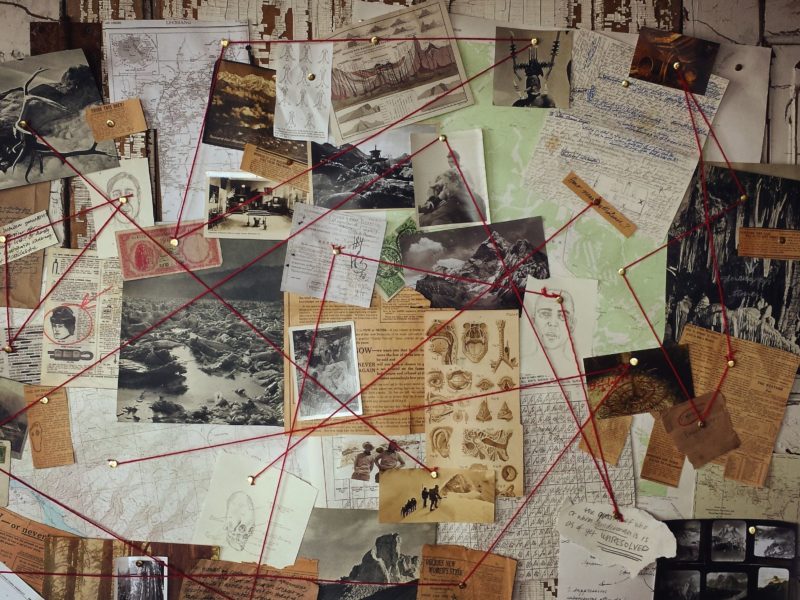
 Imagine you get home from work and you turn on the television to have some background noise.   There is a show that’s on H2 (History 2) called “Uncovering the Himalayas”. The show is hosted by a man with a beige explorer’s hat who talks to a PhD who says “there have been studies that have shown that pre-history, 2000 BCE, Nordic peoples migrated across Eurasia to the Himalayas where they intermingled with the native populations and help establish communities there. This might be humorous to you or it might stick out in your mind as bizarre and you might mention it to a family member or a friend. The main danger with programs like this is that it is impossible to unhear something, so the next time you think about the Himalayas, this fact might pop in to your brain and you may start wondering if it was a true fact or not. The theory outlined above is not a figment of imagination it is actually a true theory that the Nazis investigated and collected research on in the 40s to justify why the Nordic people were superior to others.  In conclusion, if you enjoy consuming conspiracy media, continue doing so but be wary of what the underlying message may be or of where the origins of conspiracies may lie.

Opinion Piece #1

“Where the Shadows Lie”: The Far-Right and “The Lord of the Rings” by Aimee Brown

Giorgia Meloni, the leader of the far-right party Brothers of Italy, is expected to become Italy’s next prime minister. She is also a big Lord of the Rings fan. These two facts are not unrelated as, beginning in the 1970’s, Italy’s far-right movement canonized J.R.R. Tolkien’s novels and co-opted his various creations, setting up Hobbit Camps for young activists and popularising extremist bands with names like “Followship of the Ring”. Such politicised fandom is not even unique to the Italian context, as far-right admiration for “The Lord of the Rings” (LOTR) has become an international phenomenon. In the early days of the American-based website Stormfront, the first major hate site on the internet, there was a section dedicated to LOTR and white nationalism, and in 2019, actor Viggo Mortenson, who played Aragorn in the film adaptations, rebuked Vox, a far-right political party in Spain, for using his image to promote their message online. What is it about LOTR that makes it so popular on the far-right?

There are three main reasons, the first of which is the structure of the fantasy world that Tolkien created. It is a Manichean world in which good does battle with evil against a backdrop of clearly delineated races who mostly keep separate from each other. When Meloni says “I don’t consider ‘The Lord of the Rings’ fantasy,” it is to this which she is presumably referring. For the head of a party which has demonized immigrants and the LGBTQ community and called upon Italian voters to defend a beleaguered white Christian civilization against them, a good-us versus evil-them world view is not a fictional construct, but an accurate description of reality. Similarly, if a Manichean world view is compellingly descriptive for Meloni and the far-right, then separation between races is aspirational. Meloni cites LOTR as having taught her “the value of specificity”, a lesson which she applies to the necessity of protecting European culture from outsiders. As dwarves live with other dwarves and elves with other elves, so native populations must embrace xenophobia or perish.

The second reason for the far-right popularity of LOTR is the fact that it is steeped in Norse mythology. A professor of Anglo-Saxon, Tolkien was one of the world’s foremost authorities on the literature of the Middle Ages in Europe, so it is unsurprising that his field of expertise would inform his novels. Unfortunately, Norse mythology has long been coopted by the far-right and implicated in some of its worst atrocities. For example, the white supremacist terrorists who murdered 77 people in Norway in 2011, 51 people in Christchurch, New Zealand in 2019, and 10 people in Buffalo, New York this year all referenced it in their manifestos. Norse mythology resonates for the far-right because it portrays a warrior ethos predicated upon violence and a narrative that culminates in cataclysm and rebirth. Thus, far-right terrorists like to portray themselves as warriors wielding the power of Mjollnir against monsters at Ragnarök who, when they fall, are taken to Valhalla by Valkyries to feast eternally with the gods. Aragorn wielding the reforged sword of Isildur against the servants of the Dark Lord is entirely comprehensible within this imaginative paradigm.

Ironically, the final reason that LOTR is popular on the far-right is because it provides an alternative to the warrior ethos of Norse myth in the form of hobbits and their home, the Shire. With LOTR, Tolkien created a mythic world of medieval heroes and monsters and then placed a charming anachronism, a community of late 19th century English countryfolk, at its center. There is no equivalent to hobbits in Norse myth or medieval epics, and Tolkien uses them as a means of entry for readers into these unfamiliar worlds. In contrast, the far-right uses hobbits as an opportunity to play the victim. Ms. Meloni attended Hobbit Camp and not Elven Warrior Camp because the Italian neo-fascists wanted to portray themselves as diminutive underdogs, relatable victims instead of the heirs of Benito Mussolini’s bloody dictatorship. For them, Italy is the Shire, an agrarian Utopia menaced and laid waste by invading hordes, and its plucky defenders are those on the far-right. This is a useful imaginative construct that is readily applicable to any national context.

In August, Ms. Meloni expressed her regret that her busy campaigning schedule had thus far prevented her from watching the new Amazon Prime show “The Rings of Power”. It is unlikely, when she finally does so, that she will enjoy it. Ever since the first trailer for the series premiered, the far right has flooded online spaces with condemnations of it based upon the diversity of the casting. For far-right fans, the inclusion of people of color threatens a previously cherished white space and reproduces in miniature what they believe to be happening in the world at large. This is the Great Replacement, the idea that white people in Europe and North America are being actively replaced by non-white immigrants. This theory, first articulated by white nationalist author Renaud Camus, has subsequently been popularized by figures ranging from Éric Zemmour of France, Viktor Orbán of Hungary, and the American Tucker Carlson. Not insignificantly, it was also cited by the killer in Buffalo, New York. The far-right has a lexicon of ideas that transcends national borders and, it would seem, a fandom upon which it can project them.

The Balancing Act

BY FRANCESCO SACCA

Welcome back to the Francesco report! (and no, this will not be the last that I will be saying that, it will catch on)

For this week, we have been served up some rather interesting articles regarding the “new left” and “new right” ideologies that arose into place not long after the end of WWII. From what I can derive from the readings, there seems to have been a great attempt by people all over the European world (France, Germany, Italy etc) to try and replace the fascism of the Nazi’s with their own subdued versions. One example that is represented in two of these sources is that of the ND (or Nouvelle Droite) which was basically the “new right”. The new and improved way to support white power and segregate those who were seen as lesser. While this new theology may have been better then the Nazi regime and their ideals, this was not an improvement upon matters. This was simply a way to make fascist ideals more acceptable in the modern world. Although, with this “new right” there also comes the balance of the “new left”, which can be seen by writer Frank Biess, in an article titled: Revolutionary Angst. In this article, the reader learns of a West German student movement that was able to gain real ground in the year 1967, when they claimed their first martyr, a man by the name of Benno Ohnesorg, who was killed during a “cleaning up” at the West Berlin Opera by police officers. The death of this man was taken to heart by many students who believed that this action by the officers; “had ripped the mask off the face of West German state and society.”. The author goes on to say that the Federal Republic had now become a “democracy of anger”. With these samples, a balancing act of opposing ideologies is made quite clear and is still being debated today.

A photo depicting the Benno Ohnesorg (laying down) and Friederike Dollinger (cradling his head). Frank Biess states that this image “became an iconic image of the student movement.”.

_________________________________________________________________________________

Sources (just in case any of you want to follow up on any of this info)

Frank Biess, “Revolutionary Angst” German Angst: Fear and Democracy in the Federal Republic of Germany (Oxford, UK: Oxford University Press, 2020), 195-241.

Robert Deam Tobin, “The Evolian Imagination: Gender, Race, and Class from Fascism to the New Right” Journal of Holocaust Research vol. 35, Issue2 (Confronting Hatred; Neo-Nazim, Antisemitism, and Holocaust Studies): 75-90.

Roger Griffin, “Between Metapolitics and Apoliteia: The Nouvelle Droite’s Strategy for Conserving the Fascist Vision in the ‘Interregnum.’” Modern & Contemporary France, vol. 8, no. 1 (Feb. 2000): pp. 35–53.

Tamir Bar-On, “Transnationalism and the French Nouvelle Droite.” Patterns of Prejudice, vol. 45, no. 3 (July 2011): 199–223.

Two Dichotomies

By: Hannah Long

Image : georgelmosseprogram. “Confrontation: Paris, 1968.” YouTube. 5:45, November 1, 2012. 

The intriguing aspect of post-war politics has to be the extreme shift and impact the left and right had democratically, so much so that I believe we can still feel the effects today. Each of this week’s readings seamlessly flowed over one another to provide a detailed perspective of both the historical events and thoughts of societies who were looking to reestablish themselves. Bar-On’s work delves into this matter by discussing the birth of Nouvelle Droite and many French national’s subsequent scramble to defend cultural identity. The need for a cemented identity in France took two turns, one in a liberal standoff for the emerging adolescent portion of the population in the 1968 student riots, and the other form of cultural homogeneity. 

The riots challenged the democratic foundation to change traditional institutions as well as a contempt for leftover imperialist attitudes that were embedded in the conservative system (Confrontation Paris, 1968). This far-left movement wanted to uproot the seemingly unchanging right wing to move to a new era that better represented the rapidly growing interconnectedness more youths were feeling that the access of post-secondary education was allowing them. This unprecedented confrontation between the state and students changed the cycle of conservatism, shutting down the Gaullist Regime and the economy. 

In a measure of opposition Alain de Benoist (founding member of the Nouvelle Droite) sought to annihilate the far-left as it was up-rooting societies across Europe. There was a belief that hierarchy was key in maintaining a functional and secular society away from international influence. The founding of the ND provided “new spaces” for other far-right wing political parties to emerge (217, Bar-On). Benoist provided growth for the extreme right wing in Europe that can still be seen to this today, which circles back to the present day facist movements that were discussed two weeks ago, which I believe further shows how widespread and rooted the ND has become since its inception more than fifty years ago. 

As I stated prior, when anlyazing each of the readings closely the remnants and more so the influence WWll has had can be easily spotted when looking at the actions and beliefs of those around this time. On one hand we see a part of society who wanted to permanently get as far away as possible from the past, seeking to change it and move their nation into the then “global/modern” liberal concepts. On the other there is a seeking out of fascist concepts, masquerading them as traditionalism, to focus on internal matters such as recementing ideas of hierarchies, ethnic identity, and Judaeo-Christian world-view. All of which are straight from Nazi rhetoric. What is interesting to me as a final thought is the internal struggle that comes up each week with these readings, there is a present “need” to hang onto the past however it seems that when it comes to discussing the past and pulling back the layers of the rationale and history behind these concepts there is almost a denial of fascists to state that what they are doing is derived from Nazism.

The Paris Review - May '68: Posters of the Revolution
Image: The Paris Review. “May ’68: Posters of the Revolution.” The Paris Review, May 1, 2018. https://www.theparisreview.org/blog/2018/05/01/may-68-posters-of-the-revolution/.

Sources:

georgelmosseprogram. “Confrontation: Paris, 1968.” YouTube. YouTube, November 1, 2012. 

Tamir Bar-On, “Transnationalism and the French Nouvelle Droite.” Patterns of Prejudice, vol. 45, no. 3 (July 2011): 199–223.

Op/Ed #1: A war of fascist aggression that will not end well

Jim Dagg

Vladimir Putin said that he was launching his “special military operation” in order to deal with “neo-nazis” who persecuted a peaceable ethnic Russian minority. In his speech on the day of the invasion (February 24, 2022), he said “We will strive for the demilitarization and denazification of Ukraine.” We will “stop this nightmare, this genocide of millions of people who rely only on Russia, only on us”. On the second day of Russia’s “special operation”, an ambulance brought a small boy to a children’s hospital in Kiev. His parents died in the shrapnel of exploding shells, as they drove through the city. The boy survived the attack but needed emergency surgery to stabilized him. Even so, he was not in good shape, showing little sign of brain activity. It’s not clear whether the boy survived.

Since coming to power as the chosen successor to an enfeebled Boris Yeltsin at the end of 1999, Vladimir Putin has succeeding in building a fascist state. This statement is supported by the two-element definition provided by British historian Roger Griffin: creation/exploitation of populist ultra-nationalism and promoting the idea of regeneration of a great nation that his been under threat. Putin’s favourite tactic is to accuse the West of disrespect and aggression against the Motherland, in order to build Russian fear and outrage. This plays on both elements of the definition.

Further, Putin claims that Ukraine is historically one with Russia – with roots as far back as the 9th century. Harking back to medieval roots is a favourite tune of fascists and other right-wingers in Europe and beyond. Other former USSR states with significant Russian minorities (such as the Baltic states) are worried that, a Putin success in absorbing Ukraine might make them next. This pattern was exploited in the late 1930s by the Nazis who claimed to be saving persecuted ethnic Germans when they stole a chunk of Czechoslovakia.

So Putin is, in some ways, following in Hitler’s path. That said, there are fascists who are good at war, and fascists who are not. Hitler spent years building a military mindset in his people, establishing their belief in their duty to fight and fight well for the Fatherland. He built a formidable fighting machine. Putin, we are told, also spent a decade in reforming the Russian military. And yet, the Russian air force is absent from the skies of Ukraine. A 40-mile convoy of tanks and other military equipment was stalled for weeks on the road to Kiev, before turning back to Belarus in disgrace.

More recently, Ukraine regained thousands of square kilometers in a couple weeks. It doesn’t yet feel like the Soviets chasing the Nazis out of Ukraine, but it’s getting there. And just last week, someone – maybe using marine drones – blew up part of Putin’s favourite bridge (joining Crimea to Russia’s north Caucasus). In retaliation, Putin used 83 cruise missiles, worth an estimated $500M USD, in a single day, on non-military targets. Western military experts have, since July, pointed to evidence that Russian supplies of such missiles is limited. Does that sound like a wise use of resources by a leader focused on winning a “special military operation”? No, it sounds like a wounded leader trying to demonstrate strength to his people, in the most effective way he can manage.

Speaking of the home front, Putin and his defence minister announced plans on September 21 to mobilize reserve troops, numbering up to 300,000. This seems motivated by the unexpected loss of large numbers of troops in the conflict to this point. Polls quoted at this time showed a majority of Russians in favour of the “special operation”, but only a minority supporting mobilization. Demonstrations against the mobilization and the war broke out in Moscow and over 30 other cities in the following days. 1300 people were arrested and some apparently were issued draft notices. Assuming that the most-eager and best-trained soldiers were already fighting, what can be expected from the next wave of soldiers? Two videos circulating in Russia in October showed men in uniform who claimed to be a group of 500  recent draftees. “They complain of ‘animal-like’ conditions, of having to buy their own food and bulletproof vests.”

Ukraine has a demonstrated will to fight, and the support of a united West. As per CNN, Russia has “poor and inflexible leadership, sour troop morale, inadequate logistics and hardware beset by maintenance issues”. It won’t happen soon, but Russia will lose this war.